Unfiltered truths about money, aging, and survival after 50 — through the lens of history and the African American experience
Sunday, February 02, 2020
BROKE: Hardship and Resilience in a City of Broken Promises - REVIEW
In BROKE: Hardship and Resilience in a City of Broken Promises, which follows seven Detroiters as they navigate life during and after the city's 2013 bankruptcy, Jodie Adams Kirshner asks:
How could policymakers hype bankruptcy as the solution to struggling cities without understanding the efficacy or basic consequences of its use? We had overlooked urban residents and considered the issues all wrong.
The individual lives portrayed in BROKE underscore Kirshner's assertions. Reggie loses his savings trying to make a habitable home for his family. Cindy fights drug use, prostitution, and dumping on her block. Lola commutes two hours a day to her suburban job. For them, financial issues are mired within the larger ramifications of poor urban policies, state and federal negligence, and-even before the 2013 decision to declare Detroit bankrupt-the root causes of a city's fiscal demise.
Like Matthew Desmond's Evicted, BROKE looks at what municipal distress means in practical and personal terms. More than 35 percent of Detroit's 700,000 residents fall below the poverty line. Post-bankruptcy, they struggle with a broken real estate market, school system, and job market-and their lives have not improved. In his foreword, Michael Eric Dyson sums it up beautifully:
The central, trenchant, undeniable argument of BROKE is clear: bankruptcy is neither a fiscally responsible nor morally irresistible response to the myriad challenges faced by the modem American city ... after reading the poignant, heartbreaking, defiant pages of BROKE, no one should question the need for a moral referendum on how policy is created in and for urban America.
BROKE's implications extend beyond the city it takes for its subject because Detroit is nationally emblematic. Kirshner makes a powerful argument that cities-the economic engine of our nation aren't being given the state or federal government aid they need for their residents to survive, much less flourish. Success for all America's citizens depends on equity of opportunity.
About the Author: Jodie Adams Kirshner is a research professor at New York University. Previously a law professor at Cambridge University, where she also served as the deputy director of the Cambridge LLM program, the deputy director of the Cambridge Centre for Corporate and Commercial Law, and as a fellow of Peterhouse College, Cambridge, Kirshner also teaches bankruptcy law at Columbia Law School. She is an elected member of the American Law Institute, past term member of the Council on Foreign Relations, and a technical advisor to the Bank for International Settlements. She received a prestigious multi-year grant from the Kresge Foundation to research BROKE. Kirshner received her undergraduate degree from Harvard University and graduate degrees in law and in journalism from Columbia University. She lives in New York City.
BROKE: Hardship and Resilience in a City of Broken Promises
by Jodie Adams Kirshner
St. Martin's Press. ISBN: 978-1-25-023712-5
"BROKE provides a humane but clear-eyed account of the collapse and rebirth of Detroit that re,reals what a court can and cannot accomplish via a well-managed municipal bankruptcy."
-Paul Romer, co-recipient, 2018 Nobel Memorial Prize in Economic Sciences and founding director, Marron Institute of Urban Governance, NYU
Sunday, January 19, 2020
The Art of Resistance - My Four Years in the French Underground: A Memoir - REVIEW
The Art of Resistance - My Four Years in the French Underground: A Memoir
by Justus Rosenberg
An unforgettable memoir written by a 98-year-old Jewish Holocaust survivor about his escape from Nazi-controlled Danzig in the 1930's and his adventures with the French Resistance during World War II In 1937, as the Nazi Party tightened its grip on the Free City of Danzig (now Gdansk, Poland), Justus Rosenberg's parents made the heart-wrenching decision to send their son to Paris, where he would have the hope of finishing high school and going on to university in safety. He was sixteen years old, and he would not see his family again for sixteen years more. When the Nazis pushed toward Paris in the spring of 1940, Justus was penniless, in danger, cut off from contact with his family in Poland, and forced to flee south.
A chance meeting led him to Varian Fry, an American journalist in Marseille who ran a clandestine network that helped thousands of artists and intellectuals escape the Nazis, among them Hannah Arendt, Marc Chagall, Andre Breton, and Max Ernst. With Justus' German background and fluency in several languages, including English, he became an invaluable member of Fry's network as a spy and scout. For the subsequent four years, Justus relied on his wits and skills to escape captivity, survive several close calls with death, and continue his fight against the Nazis, working with the French Resistance and later becoming attached with the United States Army. At the war's end, he emigrated to America and built a new life.
Featuring never-before-seen photographs from Justus' personal archives, THE ART OF RESISTANCE: My Four Years in the French Underground is a powerful saga of bravery, daring, adventure, and survival with the pacing of a spy thriller. As Justus writes, "I survived the war through a rare combination of good fortune, resourcefulness, optimism, and most importantly, the kindness of many good people."
Justus Rosenberg was born in the Free City of Danzig in 1921. When the Nazis rose to power there, he moved to France, where he joined an extralegal French-American network that helped to bring anti-fascist intellectuals and artists from Vichy, France to the United States. He subsequently served with the United States Army, who awarded him a Bronze Star and a Purple Heart. For the last 70 years, he has taught at American universities, and is currently a professor emeritus of languages and literature at Bard College. He is the co-founder of the Justus & Karin Rosenberg Foundation, which works to combat antisemitism. In 2017 the French ambassador personally made Justus a Commandeur in the Legion d'Honneur, France's highest decoration. Professor Rosenberg lives in Rhinebeck, New York.
THE ART OF RESISTANCE - My Four Years in the French Underground: A Memoir
By Justus Rosenberg
304 pages Hardcover ISBN: 978-0062742193
Saturday, January 18, 2020
Owen Lovejoy and the Coalition for Equality - REVIEW
Owen Lovejoy and the Coalition for Equality - Clergy, African Americans, and Women United for Abolition examines how these three distinct groups merged their agendas into a single antislavery, religious, political campaign for equality with Lovejoy at the helm. Combining scholarly biography, historiography, and primary source material, Jane Ann and William F. Moore demonstrate Lovejoy's crucial role in nineteenth-century politics, the rise of antislavery sentiment in religious spaces, and the emerging commitment to end slavery in Congress. Their compelling account explores how the immorality of slavery became a touchstone of political and religious action in the United States through the efforts of a synergetic coalition led by an essential abolitionist figure.
Antislavery white clergy and their congregations. Radicalized abolitionist women. African Americans committed to ending slavery through constitutional political action. These diverse groups attributed their common vision of a nation free from slavery to strong political and religious values. Owen Lovejoy's gregarious personality, formidable oratorical talent, probing political analysis, and profound religious convictions made him the powerful leader the coalition needed.
"Owen Lovejoy was that rarest of beings-a dedicated abolitionist and a savvy politician. Having already published an indispensable collection of Lovejoy's most important writings, the Moores have now given us the most thorough biography of Lovejoy to date. Grounded in deep research and an unparalleled familiarity with the ins and outs of Illinois politics, the Moores demonstrate Lovejoy's crucial role in the creation of the 'coalition for equality' that eventually brought slavery down."
-James Oakes, author of "The Scorpion's Sting: Antislavery and the Coming of the Civil War"
Authors Jane Ann Moore and William F. Moore are co-directors of the Lovejoy Society. They are the authors of "Collaborators for Emancipation: Abraham Lincoln and Owen Lovejoy" and are the editors of "Owen Lovejoy's His Brother's Blood: Speeches and Writings, 1838-64". They manage the website www.increaserespect.com which applies the concepts of this book.
Owen Lovejoy and the Coalition for Equality - Clergy, African Americans, and Women United for Abolition
Jane Ann Moore and William F. Moore
Hardcover, ISBN: 978-0-252-04230-0
Paper, ISBN: 978-0-252-08409-6
www.press.uillinois.edu
The Broken Road by Peggy Wallace Kennedy - REVIEW
THE BROKEN ROAD: George Wallace and a Daughter's Journey to Reconciliation
by Peggy Wallace Kennedy with Justice H. Mark Kennedy
Peggy Wallace Kennedy has been widely hailed as a "symbol of racial reconciliation" (Washington Post), winning numerous awards for her efforts and speaking out on the politics of fear and on finding one's voice. In the summer of 1963, though, she was a young girl watching her father stand in a schoolhouse door as he tried to block two African American students from entering the University of Alabama. This man, governor of Alabama and future presidential candidate George Wallace, was notorious for his hateful rhetoric and his political stunts. But he was also a larger than-life presence in the life of young Peggy, who was taught to sit straight, smile, and not speak up as her father took to the political stage. At the end of his life, Wallace came to renounce his racist views, although he could never attempt to fully repair the damage he caused. But Peggy, after her own political awakening, has dedicated her life to spreading a new Wallace message-one of peace and compassion.
"Why did Paw Paw do those things to other people?" asked Wallace Kennedy's nine-year-old son, Burns, while visiting the Martin Luther King Jr. National Historic Site and Museum. He'd just seen the photo of his grandfather blocking the entrance of University of Alabama. It was this moment that compelled Wallace Kennedy to come to terms with her family's history. "It awakened in me the deep desire to create my own chapter in the Wallace saga," she writes in THE BROKEN ROAD : George Wallace and a Daughter's Journey to Reconciliation.
Collaborating with her husband of 46 years, Justice H. Mark Kennedy, Wallace Kennedy provides an intimate and tender portrait of her family and their circumstances, dreams, and challenges, all within the larger context of a time and place when issues of race and gender were dealt with in ways that many would view as abhorrent today.
In this powerful new memoir, Wallace Kennedy looks back on the politics of her youth and attempts to reconcile her adored father with the man who coined the phrase, "Segregation now, segregation tomorrow, and segregation forever." As she writes, "My story is much like that of the broken road, heaved up and cracked for the truth of what power can do. It mingles amid history for the sake of the truth, gives rise to the inspiration that no matter who we belonged to, 'each of us can overcome,' and offers hope that America will take the 'road less traveled by' before it is too late."
Timely and timeless, THE BROKEN ROAD speaks to change, atonement, activism, and racial reconciliation, reckoning with the past while firmly focusing on creating a better future.
About the author: Peggy Wallace Kennedy is a nationally recognized speaker, lecturer, and writer. Her father, George Wallace, and her mother, Lurleen Wallace, were both governors of Alabama. Mrs. Kennedy has received, among others, the Southern Christian Leadership Conference Rosa Parks Legacy Award; the Emmett Till Legacy Foundation Woman of Courage Award; the Brown Foundation Human Rights Award; and the MLK Commission Award. Her dedication to racial reconciliation offers hope for change in a divided America. She lives in Montgomery, Alabama. Justice H. Mark Kennedy, Peggy's husband of forty-six years, served as a judge for more than two decades including two terms as a Justice of the Supreme Court of Alabama.
"Anybody who knows Peggy Wallace Kennedy, or who reads these pages, will understand immediately the anguished authenticity of her passage. Civil rights leaders such as John Lewis ultimately forgave George Wallace for the sins of his past, just as they have embraced his daughter as a sister in the quest for human rights. The Broken Road is the story of how that happened-a needed reminder in these times that love and simple decency can be more powerful than their opposites." -Frye Gaillard, author of A Hard Rain, America in the 1960s
"[A] thoughtful, evenhanded debut ... Kennedy's astute memoir also serves as a probing record of politics and racism in the South." -Publishers Weekly
"(Wallace Kennedy] shows poignantly the toll (George Wallace's] actions took on his family and draws parallels between his tactics and those of Donald Trump .... A fair-minded memoir and portrayal of an exceptionally divisive civil rights-era politician." -Kirkus Reviews
"Searingly revelatory" -Diane Mcwhorter, Pulitizer Prize-winning author of Carry Me Home
Hardcover ISBN:978-1635573657
Ebook ISBN:978-1635573664
Thursday, December 19, 2019
The Impeachers by Brenda Wineapple
In 1868, "out of the midst of political gloom, impeachment, that dead corpse, rose up and walked forth again!" Mark Twain wrote. Republicans in the House impeached President Andrew Johnson by a vote of 126-47. They were desperate, as Brenda Wineapple chronicles in her gripping new book, "The Impeachers: The Trial of Andrew Johnson and the Dream of a Just Nation." Johnson, a Tennessee Democrat who didn't free his slaves until 1863, after the Emancipation Proclamation, had been Abraham Lincoln's improbable Vice President, and had assumed the office of the Presidency after his assassination, in 1865. Lincoln and congressional Republicans had one plan for Reconstruction: it involved welcoming the freedmen into the political community of the nation. Johnson, who believed that, "in the progress of nations, negroes have shown less capacity for goverment than any other race of people," betrayed that vision. "Slavery is not abolished until the black man has the ballot," Frederick Douglass declared. But granting the franchise to black men was the last thing Johnson intended to allow. While Congress was out of session, he set in motion a Reconstruction plan that was completely at variance with what Congress had proposed: he intended to return power to the very people who had waged war against the Union, and he readmitted the former Confederate states to the Union. "No power but Congress had any right to say whether ever or when they should be admitted to the Union as States and entitled to the privileges of the Constitution," the Pennsylvania representative Thaddeus Stevens said during Johnson's impeachment proceedings. (Stevens, ailing, had to be carried into the Capitol on a chair.) "And yet Andrew Johnson, with unblushing hardihood, undertook to rule them by his own power alone." Johnson vetoed the 1866 Civil Rights Bill and nearly every other congressional attempt to reassert authority over the law of the United States. But the Republicans' strategy, to pass a law they expected Johnson to break, so that they could impeach him, backfired.
The Senate acquitted Johnson, falling short by a single vote of the two-thirds majority necessary to convict. Stevens died a couple of months later, "the bravest old ironclad in the Capitol," Twain wrote. The Republicans had tried to save the Republic by burying the Confederacy for good. They failed.
Every impeachment reinvents what impeachment is for, and what it means, a theory of government itself Every impeachment also offers a chance to establish a new political settlement in an unruly nation. The impeachment of [Justice] Samuel Chase steered the United States toward judicial independence, and an accommodation with a party system that had not been anticipated by the Framers. Chase's acquittal stabilized the Republic and restored the balance of power between the executive and the judicial branches. The failed impeachment of Andrew Johnson steered the United States toward a regime of racial segregation: the era of Jim Crow, which would not be undone until the Civil Rights Act of 1964 and the Voting Rights Acts of 1965 were passed, a century later, in the Administration of another Johnson. Johnson's acquittal undid the Union's victory in the Civil War, allowed the Confederacy to win the peace, and nearly destroyed the Republic.
Johnson's acquittal also elevated the Presidency by making impeachment seem doomed. Jefferson once lamented that impeachment had become a "mere scarecrow." That's how it worked for much of the twentieth century: propped up in a field, straw poking out from under its hat. A Republican congressman from Michigan called for the impeachment of F.D.R., after the President tried to pack the Court. Nothing but another scarecrow.
The impeachment of Richard Nixon, in 1974, which, although it never went to trial, succeeded in the sense that it drove Nixon from office, represented a use entirely consistent with the instrument's medieval origins: it attempted to puncture the swollen power of the Presidency and to reassert the supremacy of the legislature. Nixon's Presidency began to unravel only after the publication of the Pentagon Papers, in 1971 - which indicted not Nixon but Lyndon Johnson, for deceiving the public about Vietnam and the public anger that made impeachment possible had to do not only with Nixon's lies and abuses of power but also with Johnson's. But a new settlement, curtailing the powers of the President, never came. Instead, the nation became divided, and those divisions widened.
The wider those divisions, the duller the blade of impeachment. Only very rarely in American history has one party held more than two-thirds of the seats in the Senate (it hasn't happened since 1967), and the more partisan American politics the less likely it is that sixty-seven senators can be rounded up to convict anyone, of anything. And yet the wider those divisions the more willing Congress has been to call for impeachment. Since Ronald Reagan's Inauguration in 1981, members of the House have introduced resolutions for impeachment during every Presidency. And the people, too, have clamored. "Impeach Bush," the yard signs read. "Impeach Obama."
Not every impeachment brings about a political settlement, good or bad. The failed impeachment of Bill Clinton, in 1999, for lying about his sexual relationship with Monica Lewinsky, settled less than nothing, except that it weakened Americans' faith in impeachment as anything other than a crudely wrought partisan hatchet, a prisoner's shiv.
Clinton's impeachment had one more consequence: it got Donald Trump, self-professed playboy, onto national television, as an authority on the sex lives of ego-mad men. "Paula Jones is a loser," Trump said on CNBC. "It's a terrible embarrassment." Also, "I think his lawyers ... did a terrible job,"Trump said. "I'm not even sure that he shouldn't have just gone in and taken the Fifth Amendment." Because why, after all, should any man have to answer for anything?
"Heaven forbid we should see another impeachment!" an exhausted Republican said at the end of the trial of Samuel Chase. The impeachment of an American President is certain to lead to no end of political mischief and almost certain to fail. Still, worse could happen. Heaven forbid this Republic should become one man's kingdom.
- New Yorker magazine, October 28, 2019, p31.
Friday, December 13, 2019
White Negroes: When Cornrows Were in Vogue ... and Other Thoughts on Cultural Appropriation - REVIEW
White Negroes: When Cornrows Were in Vogue ... and Other
Thoughts on Cultural Appropriation by Lauren Michele Jackson
"Appropriation is everywhere and is also inevitable. If appropriation is everywhere and everyone appropriates all the time, why does any of this matter? The answer, in a word: power."
In her debut essay collection, White Negroes: When Cornrows Were in Vogue ... and Other Thoughts on Cultural Appropriation, Lauren Michele Jackson, a professor of English and African American studies at Northwestern University, examines the problematic social trend of "black aesthetics without black people." Her essays analyze the desire for black culture by people who are not black and takes to task America's tendency to poach blackness for its profit and benefit. From art to fashion, language to activism, black culture influences worldwide trends. And, according to Jackson, everyone wants to be "cool" without fearing for their lives, to be "black" with the wealth and privilege of whiteness.
Jackson asserts that when the powerful appropriate from the
oppressed, society's imbalances are worsened, and its inequalities extended.
White people in America, Jackson writes, hoard power like Hungry Hungry Hippos.
She cites statistics on the ever-growing wealth gap between white and black
people in the United States-according to the Institute for Policy Studies, if
current trends continue, the average black family won't reach the amount of
wealth white families own today for another 228 years. The seriousness of this
reality comes into focus when we see who can thrive off of intellectual
property and who is prevented from doing so by "this nation's hysterical,
driving compulsion to own and regulate all things black."
Jackson divides her book into areas of popular culture to
explore the concept of "blackness in decay without its people."
Topics include:
• Sound and Body: Jackson uses the evolution of Christina
Aguilera's music career as the backdrop to examine the typical trajectory of a
young white female popstar-emancipating themselves from an image of innocence
by using black aesthetics to appear older and mature. "The entire Stripped
era put black culture in motion in a departure from Christina's earlier
aesthetics, even as a child performer raised on jazz and soul records."
Throughout her career, Aguilera goes from one interpretation of black culture
to another until, with her most recent album, she finally achieves a tenor of
homage to the black music that formed her, Jackson concludes.
• Art and Language: Jackson questions the motives of Dana
Schutz, whose painting Open Casket was a recreation of a 1955 photograph of
Emmett Till's body in his casket. The painting was created for the Whitney
Museum of Art's 2017 Biennial, which Jackson explains is remembered primarily
for its blatant dismissal of violence and black pain. "Mamie Till-Mobley,
thrust into activism, took control of her son's image in death, plain evidence
of what America does to black children," Jackson states. "Today, the
chasm between seeing a person in pain and in death and the actions it would
take to reduce the pain and death is so much wider than the Atlantic."
• Technology: "Black people are the best part of going
online," Jackson asserts. "Black culture is the fiber in the memes
that are sometimes the only reasonable excuse for logging on while the world
crumbles." She tells of Vine and the funny storytelling of its former
black users. Before its demise, Vine's most popular meme came from Kayla
Newman, a black woman who admires her brows in the camera and says they're
"on fleek." Jackson shares that Newman's attempt to raise money to
fund a line of hair and beauty products led to derision and claims that she was
entitled for wanting to profit off her creation-despite the term's co-opted use
in Hefty ads and fast fashion crop tops.
• Economy and Politics: Detailing cultural appropriation's
inherent political nature, Jackson describes a period in the 1970s, when the
white working class experienced a financial depression they called the
"blue-collar blues," which was attributed to a black upward mobility
that was perceived to outpace white prosperity. Then, as now, Jackson writes,
they needed use of black aesthetics to describe the circumstance. In the new
millennium, attempts to delegitimize #BlacklivesMatter spur absurd terms like
All Lives Matter and Blue Lives Matter. Another example Jackson cites is the
Women's March on Washington, a name borrowed from a black-led political march.
Anger and rage, she writes, are all the rage. Thanks to white feminists'
appropriative actions, the politics of activism and self-care are given a new
and profitable look. "After Ferguson, Baltimore, Chicago, and Oakland,
everyone can make a hashtag and be mad and make it home safely. As long as
well-heeled white people are angry, others can be angry too."
Jackson concludes that although thoughtless appropriation is
impossibly embedded in our culture, it can become appreciation if the world
reorders society to be a place where black people have options and where they
matter to society just as much as their contributions. "Whether black
people will be acknowledged and allowed to thrive more than spiritually from
their innovations remains to be seen," she states. "If there is a
call embedded in this book, it is a call to more alertness, more intensity,
more care, and more fluency in the racial dramas performed as part and parcel
of business as usual."
About the Author Lauren Michele Jackson teaches in the departments of English and African American studies at Northwestern University.
White Negroes: When Cornrows Were in Vogue ... and Other Thoughts on Cultural Appropriation
by Lauren Michele Jackson
$25.95 Hardcover • 978-080701180-5 • Audio book: 978-080708132-7
Contact: Perpetua Charles, Associate Publicist, pcharles@beacon.org / 617-948-6102
A literary scholar examines the many ways in which African American influences are incorporated, without acknowledgment or thanks, into the white cultural mainstream. Cultural appropriation, writes Jackson (English and African American Studies/Northwestern Univ.), "gets a bad rap." Rap, for instance, borrows from the styles of earlier generations-soul, disco, funk, even gospel-but includes the likes of Billy Joel and Paul Simon in its DNA. Appropriation, she writes, 11 is everywhere, and it is inevitable," though it is also a matter of power as much as artistic license: The culturally dominant group gets away with borrowing fashions, musical styles, and language, developing "black aesthetics without black people." In a lucid explication of the work of appropriation in music, she examines borrowings not just by white artists such as Britney Spears, but also members of minority populations such as Jennifer Lopez, who, by Jackson's account, lifted liberally from a less-known artist named Ashanti. It's Lopez's good luck that the borrowing, including the passing insertion of the N-word, took place in a time when "the internet wasn't then what the internet is now, and time forgives all slurs." Pop star Pink took a different course, gradually shedding any blackness in her sound, even as Miley Cyrus dropped her whitepop teen persona to embrace the hip-hop world and Khloe Kardashian did her hair up in cornrows and called herself a "Bantu babe." The author ranges across a broad field of reference, writing of the appropriation of the Southern-ism "chile" (child, that is) by means of the TV show Real Housewives of Atlanta and the culinary borrowings of Paula Deen, "white Mammy, plumping America one fried delicacy at a time," who got in trouble not for her lifting recipes but instead for using the N-word. Jackson is evenhanded throughout, though there's a welcome fire to her discussion, as when she writes, "America is addicted to hurting black people. America is addicted to watching itself hurt black people.”
A revelatory, well-argued work of cultural criticism.
- Kirkus Reviews, October 1, 2019 issue
Northwestern University professor Jackson's insightful debut essay collection takes on cultural appropriation-particularly of black innovation by white celebrities, artists, and entrepreneurs-through the lens of power dynamics, identifying it as a process by which "society's imbalances are exacerbated and inequalities prolonged." In the realm of pop culture, she analyzes the pursuit of "urban" sexual wildness by Britney Spears and Miley Cyrus, the aesthetic but not economic investment of the Kardashians in black fashion, and Paula Deen's fetishistic presentation of Southern food alongside explicit racism. Her exploration of the art world juxtaposes the public reaction to Rachel Dolezal, made famous by her "impulse to inhabit blackness," with accusations against institutions such as the Whitney Biennial, which she asserts ignores black artists but treats depictions of antiblack violence as edgy and relevant. She identifies toxic white resentment of black success in the recent viral videos of white people calling the police on black people (often children) for using public pools, having lemonade stands, or barbecuing in parks. Jackson is uncompromising in her bold language, palpable in her outrage; she keeps her razor-sharp analysis in an accessible but academic register. She both calls out the damage done by appropriative and oppressive behavior and calls in white readers to take part in valuing black contributions in a way that helps black lives.
- Publishers Weekly August 19th issue
"Like 'intersectionality' and "diversity'' and "neoliberalism" and perhaps even "capitalism," the word "appropriation" has taken on so many interpretations and interpolations as to court ontological disaster: what does it even mean? Lauren Michele Jackson wrestles with the idea, the concept, the history, the bodies, and the selves that are implicated in cultural appropriation. Jackson does not absolve anyone, but she does point toward some of the most complex corners of culture. In those corners she asks us to consider not freedom and choice but power. That emphasis on _who can commodify appropriation is different from pedestrian debates about who can do appropriation. White Negroes is a mature meditation for debates that have, at times, wallowed in their own intellectual infancy. The collection is witty, wry, and welcome. In the vein of lmani Perry and Zoe Samudzi, this book is an excellent addition to critical thinking about culture and contemporary racial orders."
- Tressie McMillan Cottom, author of Thick and Lower Ed
"What I love most about Lauren Jackson's incisive and richly detailed work in White Negroes is how it does not imagine any cultural phenomenon as something that does not have a history attached to it. And through the work of charting that history, a new cultural understanding arises. This is a vital textone that offers new ways of seeing, hearing, and consuming."
- Hanif Abdurraqib, author of They Can't Kill Us Until They Kill Us
"We've needed this book for years~ and yet somehow it's right on time. Miraculously, Lauren Michele Jackson is able to write about cultural appropriation in a way that doesn't make you want to drink a glass of sand. She brings incredible nuance and a sharp critical voice to a discussion that has sorely lacked both-yet somehow emerges with a text that is as accessible as it is theoretically relevant. Jackson avoids platitudes and easy answers, has a keen eye for history and popular culture, and, moreover, she is funny."
- Eve L. Ewing, author of Electric Arches and Ghosts in the Schoolyard
"Blacking up-the American caucasoidal desire to inhabit, stage, and master an imaginary Black identity-has been a national obsession and a national enterprise since the antebellum days of traveling tent show minstrelsy. With language laced with critical clarity, tempered outrage, radical snark, and researched detail, Lauren Michele Jackson's White Negroes interrogates and exposes our present-day society of appropriated racial spectacle-highlighting a plethora of the ways contemporary white minstrelsy reproduces the erasures and violence of its Jim Crow-era predecessor, then circulates its badto-rad copies for profit and mockery through viral technology. Jackson eruditely connects the dots between such disparate phenomena of the modern racial age as Eminem, Christina Aguilera, Kim Kardashian, Rachel Dolezal, the fashion and cosmetic industries, the Whitney Biennial, and the appropriation of 'Bye Felisha.' In so doing, Jackson makes us wiser and even more disturbed about how much stolen Black imaging and ideations matter to the cultural, political, and economic maintenance of the nation's anti-Black status quo."
- Greg Tate, author of Flyboy in the Buttermilk and editor of Everything but the Burden: What White People Are Taking from Black Culture
Saturday, November 23, 2019
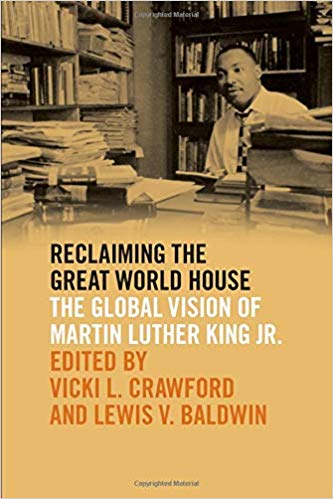
Reclaiming the Great World House - REVIEW
Reclaiming the Great World House - The Global Vision of
Martin Luther King Jr.
Edited by Vicki L. Crawford and Lewis V. Baldwin
The Morehouse College King Collection Series on Civil and
Human Rights
A global context for understanding the intellectual and
sociopolitical legacy of MLK in the twenty-first century. The burgeoning terrain
of Martin Luther King Jr. studies is leading to a new appreciation of his
thought and its meaningfulness for the emergence and shaping of the
twenty-first-century world This volume brings together an impressive array of
scholars from various backgrounds and disciplines to explore the global
significance of King - then. now, and in the future.
Employing King's metaphor of "the great world house,"
the major focus is on King's appraisal of the global-human struggle in the
1950s and 1960s, his relevance for today's world, and how future generations
might constructively apply or appropriate his key ideas and values in
addressing racism. poverty and economic injustice, militarism. sexism,
homophobia, the environmental crisis, globalization, and other challenges confronting
humanity today. The contributors treat King in context and beyond context,
taking seriously the historical King while also exploring how his name,
activities, contributions, and legacy are still associated with a globalized
rights culture.
The University of Georgia Press and Morehouse College's
Martin Luther King Jr Collection are pleased to announce the Morehouse College
King Collection Series on Civil and Human Rights Series, a new collaborative
book series. Using the 13,000 papers of the King Collection as a foundation,
books in the series will offer new scholarship that provides insightful
overviews and analyses of Dr. King's intellectual, theological, and activist
engagement with a variety of broad themes.
These themes include (but are not limited to) poverty,
nonviolence, the Vietnam War, capitalism, racial discrimination, education, and
civil rights. Along with the thematically focused works, the series will
include brief critical studies on King's involvement with specific campaigns, such
as the Montgomery Bus Boycott of1956-57 and the Poor People's Campaign of 1968.
Though scholarly in nature, the books are intended to be accessibly written,
relatively brief (50,000-70,000 words), and engaging for general readers,
offering overviews of King's life and legacy through a twentieth-first-century
lens.
Vicki L. Crawford is the director of the Martin
Luther King Jr. Collection at Morehouse College and general editor of the
Morehouse College King Collection Series on Civil and Human Rights. She is a co-editor
of Women in the Civil Rights Movement: Trailblazers and Torchbearers,
1941-1965 and the author of numerous scholarly articles.
Lewis V. Baldwin is a professor emeritus of religious
studies at Vanderbilt University. He is the author of many books, including Make
the Wounded Whole: The Cultural Legacy of Martin Luther King Jr.; Toward
the Beloved Community: Martin Luther King Jr. and South Africa; and
Behind the Public Veil: The Humanness of Martin Luther King Jr.
RECLAIMING THE GREAT WORLD HOUSE
The Global Vision of Martin Luther King Jr.
Edited by Vicki L. Crawford and Lewis V. Baldwin
Paperback 978-0-8203-5604-4
Hardback 978-0-8203-5602-0
University of Georgia Press
www.ugapress.org
The Global Vision of Martin Luther King Jr.
Edited by Vicki L. Crawford and Lewis V. Baldwin
Paperback 978-0-8203-5604-4
Hardback 978-0-8203-5602-0
University of Georgia Press
www.ugapress.org
Friday, October 18, 2019
W.E.B. Du Bois and the Critique of the Competitive Society by Andrew J. Douglas - REVIEW
Competition and competitiveness are roundly celebrated as public values and key indicators of a dynamic and forward-thinking society. But the headlong embrace of competitive market principles, increasingly prevalent in our neoliberal age, often obscures the enduring divisiveness of a society set up to produce winners and losers. In this inspired and thoughtfully argued book, Andrew J. Douglas turns to the later writings of W. E. B. Du Bois to reevaluate the very terms of the competitive society.
Situating Du Bois in relation to the Depression-era roots of contemporary neoliberal thinking, Douglas shows that into the 1930s Du Bois ratcheted up a race-conscious indictment of capitalism and liberal democracy and posed unsettling questions about how the compulsory pull of market relations breeds unequal outcomes and underwrites the perpetuation of racial animosities. Blending historical analysis with ethical and political theory, and casting new light on several aspects of Du Bois' thinking, this book makes a compelling case that Du Bois' sweeping disillusionment with Western liberalism is as timely now as ever.
"Andrew Douglas's book is an excellent contribution to a growing body of scholarship engaged with the complexity and evolution of Du Bois's political thought. His treatment of Du Bois's debates with Abram Harris and other black Marxists, his analysis of Du Bois's philosophy of education, and his account of Du Bois's relevance to contemporary discussions of neoliberalism are all first-rate."
- Robert Gooding-Williams, author of In the Shadow of Du Bois: Afro-Modern Political Thought in America
Andrew J. Douglas is an associate professor of political science and faculty affiliate in Africana Studies and international comparative labor studies at Morehouse college. He is the author of In the Spirit of Critique: Thinking Politically in the Dialectical Tradition.
W.E.B. Du Bois and the Critique of the Competitive Society by Andrew J. Douglas
August 2019 - 6 X 91 - 168 pp.
ISBN: 9780820355092
PUBLICITY CONTACT: Jason Bennett PHONE: 706-542-9263 Join our email list for regular news updates EMAIL: jason.bennett@uga.edu
WWW.UGAPRESS.ORG
Friday, September 20, 2019
The Princeton Fugitive Slave by Lolita Inniss - REVIEW
I never got no free papers. Princeton College bought me; Princeton College owns me.
James Collins Johnson made his name by escaping slavery in Maryland and fleeing to Princeton, New Jersey, where he built a life in a bustling community of African Americans working at what is now Princeton University. After only four years, he was recognized by a student from Maryland~ arrested, and subjected to a trial for extradition under the 1793 Fugitive Slave Act. On the eve of his rendition, after attempts to free Johnson by force had failed, a local aristocratic white woman purchased Johnson's freedom, allowing him to avoid reenslavement. The Princeton Fugitive Slave reconstructs James Collins Johnson's life, from birth and enslaved life in Maryland to his daring escape, sensational trial for re-enslavement, and last-minute change of fortune, and through to the end of his life in Princeton, where he remained a figure of local fascination.
Stories of Johnson's life in Princeton often describe him as a contented, jovial soul, beloved on campus and memorialized on his gravestone as "The Students Friend." But these familiar accounts come from student writings and sentimental recollections in alumni reports-stories from elite, predominantly white, often southern sources whose relationships with Johnson were hopelessly distorted by differences in race and social standing. In interrogating these stories against archival records, newspaper accounts, courtroom narratives, photographs, and family histories, author Lolita Buckner Inniss builds a picture of Johnson on his own terms, piecing together the sparse evidence and disaggregating him from the other black vendors with whom he was sometimes confused.
By telling Johnson's story and examining the relationship between antebellum Princeton's black residents and the economic engine that supported their community, the book questions the distinction between employment and servitude that shrinks and threatens to disappear when an individual's freedom is circumscribed by immobility, lack of opportunity, and contingency on local interpretations of a hotly contested body of law.
About the Author - Lolita Buckner Inniss, J.D., LL.M., Ph.D., is a professor at Southern Methodist University Dedman School of Law, where she is a Robert G. Storey Distinguished Faculty Fellow. Her research addresses historic, geographic, metaphoric, and visual norms of law, especially in the context of race, gender, and comparative constitutionalism.
The Princeton Fugitive Slave: The Trials of James Collins Johnson by Lolita Buckner Inniss
Fordham University Press
Hardcover - 3 September 2019 - ISBN: 918-0-8232-8534-l
$29.95, 272 pages, 14 b/w illustrations eBook Available
Wednesday, August 21, 2019
Peculiar Rhetoric: Slavery, Freedom, and the African Colonization Movement by Bjørn F. Stillion Southard - REVIEW
Peculiar Rhetoric: Slavery, Freedom, and the African
Colonization Movement
by Bjørn F. Stillion Southard
University Press of Mississippi
ISBN 978-1-4968-2369-4
A NEW ENGAGEMENT WITH THE TANGLED, FRAUGHT ANTEBELLUM DEBATE
SURROUNDING BLACK RESETTLEMENT
The African colonization movement occupies a troubling
rhetorical territory in the struggle for racial equality in the United States.
For white colonizationists, the movement seemed positioned as a welcome
compromise between slavery and abolition. For free blacks, colonization offered
the hope of freedom, but not within America's borders. Bjørn
F. Stillion Southard indicates how politics and identity were negotiated amid
the intense public debate on race, slavery, and freedom in America.
Operating from a position of power, white advocates argued
that colonization was worthy of massive support from the federal government. Southard
pores over the speeches of Henry Clay, Elias B. Caldwell, and Abraham Lincoln,
which engaged with colonization during its active deliberation.
Between Clay's and Caldwell's speeches at the founding of
the American Colonization Society (ACS) in 1816 and Lincoln's final public
effort to encourage colonization in 1862, Southard analyzes the little-known
speeches and writings of free blacks who wrestled with colonization's
conditional promises of freedom.
He examines an array of discourses to probe the complex
issues of identity confronting free blacks who attempted to meaningfully engage
in colonization efforts. From a peculiarly voiced "Counter Memorial"
against the ACS to the letters of wealthy black merchant Louis Sheridan
negotiating for his passage to Liberia to the civically minded orations of
Hilary Teage in Liberia, Southard brings to light the intricate rhetoric of
blacks who addressed colonization to Africa.
Bjørn F. Stillion Southard is assistant professor of communication studies at University of Georgia. He is coauthor of Presenting at Work: A Guide to Public Speaking in Professional Contexts. His research appears in the volume Thinking Together: Lecturing, Learning, and Difference in the Long Nineteenth Century. He has written articles in Quarterly Journal of Speech, Rhetoric & Public Affairs, Argumentation and Advocacy, and elsewhere.
Thursday, July 18, 2019
"NORMANDY '44 D-DAY and the Epic 77-day Battle For France" by James Holland - REVIEW
D-Day, June 6, 1944, and the 76 days of bitter fighting in
Normandy that followed the Allied landing, have become the defining episode of
World War II in the West—the object of books, films, television series, and
documentaries. The story is a familiar one—and yet, approaching the 75th
anniversary of this epochal event, its traditional narrative is still driven by
both myth and assumed knowledge that is often incorrect.
In NORMANDY '44, Holland has crafted a fresh chronicle that reframes our understanding of D-Day and the Normandy campaign: challenging the accepted views that Germany only lost because of the .Allies" material advantage; that the U.S. dominated the Allied effort; that air power was of lesser importance than ground power. Drawing on archives and testimonies of eyewitnesses—from foot soldiers, tank men, commanders, fighter pilots, as well as civilians caught in the maelstrom—Holland recreates the brutal campaign that, in terms of daily casualties, was worse than any in World War I. Field Marshal Sir Bernard Montgomery was in charge of Operation OVERLORD, whose main target was Caen, principal city in Normandy where rail, road, and river converged. Its capture took almost six weeks of bitter fighting from the bloody sea landing and chaotic air drop to the slog through the hedgerows and sunken lanes that were Normandy's landscape. Holland introduces characters such as Sgt. Curtis Curlin of the 2nd Armored Division who ingeniously devised saw-teeth to be added to the fronts of Sherman tanks, and Major General Pete Quesada, Commander of US IX Tactical Air Command, who developed crucial communication techniques between his planes and troops on the ground.
A stirring narrative by a preeminent historian, NORMANDY '44 sheds new light on one of history's most dramatic military engagements and is an invaluable addition to the literature of war.
James Holland is the author of Big Week, The Rise of Germany, and The Allies Strike Back in the War in the West trilogy, as well as Fortress Malta, Dam Busters, and The Battle of Britain. Holland regularly appears on television and radio and has written and presented the BAFTA shortlisted documentaries Battle of Britain and Dam Busters for the BBC, among others. A fellow of the Royal Historical Society, he has his own collection at the Imperial War Museum.
NORMANDY '44
by James Holland
Atlantic Monthly Press, $35.00 hardcover, publication date: 4 June 2019
ISBN: 978-0-8021-2942-0
by James Holland
Atlantic Monthly Press, $35.00 hardcover, publication date: 4 June 2019
ISBN: 978-0-8021-2942-0
Six Myths about the D-Day landings debunked by historian
James Holland
1. The myth: German soldiers were better trained than Allied soldiers.
REALITY: The best German units might have been at the
start of the war, but not by 1944. There were a few exceptions - such as the
Panzer Lehr, for example, but for the most part, German units were nothing like
as well trained as Allies. Some Allied units in Normandy had been training for
the best part of four years, while many German troops had had little more than
a few weeks'. The kampfgruppen - or battle groups - the ad hoc units
that traditionally are seen to showcase their tactical flexibility, were borne
of extreme shortages and desperation towards the end of the war. And even these
units still kept counter-attacking, and exposing themselves to Allied firepower
in the process.
The Fallschirmjager (paratroopers) were acknowledged
to be among the very best trained troops in the German Armed Forces, yet one Fallschirmjager
I spoke to recently had barely had any training at all, save a few route
marches and practice at laying mines. He had never trained with a tank, had no
transport at all, and when sent to the front from Brittany, marched 200 miles.
His case was not untypical. More than 80% of German forces in Normandy were
dependent on their feet and horses and carts for transport. He reached St Lo, a
major Normandy town in the American sector, on 12th of June with a company of
120 men. When he was captured on 19th August, he was one of just nine still
standing, the rest killed, wounded or captured.
Nor did the word aufstragstaktik- better known today
as Mission Command - mean anything to him whatsoever. This doctrine, the
ability to think on one's feet and use initiative, has been repeatedly hailed
as what set the German soldier apart. Training had become so reduced it was
simply impossible to implement.
2. The myth; The tactical skill of the Germans.
REALITY: The dogged determination of the Germans to
fight has been confused with tactical skill. Recent post-war conflicts in
Afghanistan, or even Vietnam a generation earlier, have proved that western
forces can have the best trained troops, best kit, and most lethal weapons in
the world, but still struggle to defeat a massively inferior enemy. As the
Taliban have shown, it is very difficult to completely defeat your enemy if
they don't want to be defeated. The only way is to kill them all.
This is why the Germans took so long to be defeated in
Normandy and beyond: they were still a very dangerous and deadly enemy, with
plenty of powerful weapons and a fierce determination to keep fighting. This
was for a number of reasons: Nazi indoctrination, a profound sense of duty, and
the threat of execution for deserters. In World War I the Germans executed 48
men for desertion; in World War II, that figure was 30,000.
3. The myth: D-Day was a predominantly American operation.
REALITY: For many people, D-Day is defined by the
bloodshed at Omaha - the codename for one of the beaches where Allied forces
landed - and the American airborne drops. Even in Germany, the perception is
that D-Day was a largely American show; in the recent German TV mini-series.
Generation War, there was a reference to the 'American landings' in France. But
despite Band of Brothers, despite Saving Private Ryan, and despite those 11
photographs by Robert Capa taken in the swell on that morning of 6th June 1944,
D-Day was not a predominantly American effort; rather it was an Allied effort,
with, if anything, Britain taking the lead.
Yes, Dwight D. Eisenhower, the Supreme Allied Commander, was
American, but his deputy. Air Chief Marshal Sir Arthur Tedder was British, as
were all three service chiefs. Air Marshal 'Mary' Coningham, Commander of the
tactical air forces - those directly supporting the ground troops - was also
British. The plan for Operation Overlord - as D-Day was codenamed - was largely
that of General Sir Bernard Montgomery, the land force commander: he was, of
course, British. The Royal Navy was overall responsible for Operation Neptune,
the naval plan. It might surprise many to know that of the 1,213 warships
involved, 200 were American and 892 were British; and of the 4,126 landing
craft involved, 805 were American and 3,261 were British.
Indeed, 31% of all US supplies used during D-Day came
directly from Britain, while two-thirds of the 12,000 aircraft involved were
also British, while two-thirds of those that landed in occupied France were
British and Canadian (Canada was then a British Dominion and Canadian and
British troops shared uniforms, equipment and weapons). Despite the initial
slaughter at Omaha, casualties across the American, and British and Canadian,
beaches were also much the same.
This is in no way meant to belittle the U.S. effort; rather
it is meant to add context. It is not helpful to anyone to view their history
through the narrow prism of their own experiences: rather a wider, 360-degree
view, is far more instructive. History needs to teach us as well as entertain.
4. The myth: American forces were ill-disciplined amateurs.
REALITY: By the end of the war, the U.S. had the best
armed services in the world bar none, and the 77-day Normandy campaign did a
huge amount to help them reach that point. But repeatedly throughout the war,
US troops showed their incredible ability to learn on the hoof, and then swiftly
implement changes.
Normandy was a showcase for American tactical and
operational flexibility At the start of the campaign, the Americans found
themselves fighting through the Normandy bocage, an area of small fields lined
with thick raised hedgerows and al the Germans would quickly retreat after a
successful Allied landing. For the German troops, the bocage offered both cover
and great ambush opportunities, with mortar teams and machine-guns hidden
behind the hedgerows. To effectively break through the bocage US infantry
needed the support of tanks to blast their way forward, but even thirty-ton
Sherman tanks couldn't get through these hedgerows. The ingenious solution came
from a lowly U.S. sergeant, who dreamt up the idea of attaching a hedge-cutting
tool built from German beach obstacles to the front of a Sherman tank. Within a
week, his prototype had been made and a few days after that he was able to
demonstrate it in front of General Omar Bradley, the US First Army commander.
He was so impressed with what he saw, he ordered the conversion of as many
Shermans as possible, as quickly as possible. Within a fortnight the device had
been fitted to 60% of all US Shermans in Nornmandy.
In no other army in the world would a solution created by a
junior non-commissioned officer have been implemented quite so readily and
swiftly. It showed the Americans' incredible tactical flexibility; and this was
just one example. During the campaign huge strides were also made in the
development of close air support, and in improving coordination between
infantry, artillery and armor. Medical services advanced so much that one in
four casualties returned to the battlefield after treatment. For 1944 this was
remarkable.
5. The myth: The allies allowed themselves to get bogged down in Normandy.
REALITY: It's true that in the pre-invasion estimates
for the campaign, the Allies expected to be roughly 50 miles inland. This was
based on experience of German retreats in North Africa and Italy. But Hitler
ordered his forces to fight as close to the coast as possible and not give an
inch. On a map, it seemed the Allies weren't making much progress, but
actually, the German policy worked to the Allies' advantage. By continuing to
fight close to the coast, the Germans remained in range of Allied off shore
naval guns and allowed themselves to be out-smarted by an enemy that had worked
out how to defeat them.
By 1944, the Allies had realized that tactically, the Germans
were rigidly predictable. The Germans were very proud of their military
heritage and drew on doctrine established by men like General Carl von
Clausewitz (1780-1831), who wrote the seminal pamphlet, On War. Part of their
DNA in World War II was to always counterattack - the idea was to strike back
at the moment the enemy had over-extended himself.
But the Allies realized that this penchant for
counter-attacking meant the Germans, previously well dug-in, then moved into
the open and exposed themselves. The Allied trick was to probe forward, get the
Germans to counter-attack - which they always did - then hammer them with a
combination of devastating artillery, air- and off-shore naval fire. By the end
of the Normandy campaign, the Germans had hemorrhaged men and machines and two
entire armies were all but destroyed. It's true a handful escaped the attempted
encirclement around Falaise, but it was still a massive Allied victory. In the
rapid advance that followed, the Allies sped more miles more quickly than the
Germans had done in the opposite direction back in May 1940 during the
Blitzkrieg in France.
6. The myth: America and Britain got off lightly in World War II.
REALITY: Allied front line troops suffered
horrifically in World War II. Democracies, such as Britain and America, quite
rightly, were trying to achieve victory with as few casualties as possible. For
the most part, they did this very successfully, using technology and machinery
to shield lives as much as possible.
However, the hard yards still had to be won by the infantry,
tank units and artillery, technology meant the Allies needed fewer of them than
a generation earlier, but those in the firing line had pulled a very short
straw, losses to front line troops were proportionally worse than on the Western
Front during World War I. Over the course of the 77-day battle, the average
daily casualty rate was 6,870, worse than the Somme. Passchendaele and Verdun,
three battles usually viewed as a benchmark for wanton slaughter. Normandy was
absolutely brutal.
Saturday, June 15, 2019
New Perspectives on the Union War - Gary W. Gallagher and Elizabeth R. Varon, Editors - REVIEW
New Perspectives on the Union War explores, at a wide array
of points along the political spectrum, the many shapes patriotic sentiment
took in the loyal states during the Civil War. The essays provide new insights
into well-known figures such as Secretary of the Treasury Salmon P. Chase,
political philosopher Francis Lieber, African American author/ entrepreneur
Elizabeth Keckley, abolitionist Abby Kelly Foster, New York governor Horatio
Seymour, and Attorney General Edward Bates. They also offer the perspectives of
common soldiers, of the partisan press, of the clergy, and of social reformers.
Edited by Gary Gallagher and Elizabeth Varon, two of the most
prominent nineteenthcentury American historians in the nation, New
Perspectives on the Union War provides a more nuanced understanding of what
"Union" meant in the Civil War North by exploring how various groups
of northerners conceived of the term. The essays in this volume demonstrate
that while there was a broad consensus that the war was fought, or should be
fought, for the cause of Union, there was bitter disagreement over how to
define that cause-debate not only between political camps but also within them.
The chapters touch on economics, politics, culture, military affairs,
ethnicity, and questions relating to just war.
Eight prominent and rising scholars come together to grapple
with the seismic shifts in the study of the North's decision to wage Civil War
in the wake of Gary Gallagher's The Union War (Harvard University Press 2012). Essays explore the Northern motivation for
Civil War through numerous perspectives: Liberal and conservative, abolitionist
and pro-slavery, from perspectives defined by religion, labor, finance, and the
eventual goal of reunification and Reconstruction. Reveals in case studies how Northern
arguments in favor of the Civil War influenced the terms of Reconstruction
through debates about which policies and what sort of political tone would
bring reunion on the loyal states' terms
Contributors: Michael T. Caires, Frank Cirillo, D.H.
Dilbeck, Jack Furniss, Jesse GeorgeNichol, William B. Kurtz, Peter C. Luebke,
and Tamika Nunley.
Gary W. Gallagher is the John L. Nau III Professor in the
History of the American Civil War and Director of the John L. Nau III Center
for Civil War History at the University of Virginia. He is the author or editor
of numerous books, including The Union War.
Elizabeth R. Varon is the Langbourne M. Williams Professor
of American History and Associate Director of the John L. Nau III Center for
Civil War History at the University of Virginia. She is the author of numerous
books, including Appomattox: Victory, Defeat, and Freedom at the End of the
Civil War.
New Perspectives on the Union War
Gary W. Gallagher and Elizabeth R. Varon, Editors
ISBN: 978-082-3284-535
Paperback, 272 pages
Gary W. Gallagher and Elizabeth R. Varon, Editors
ISBN: 978-082-3284-535
Paperback, 272 pages
Sunday, May 26, 2019
Lynching: Violence, Rhetoric, and American Identity by Ersula J. Ore - REVIEW
A rhetorical framework to comprehend anti-black violence
today within racialized citizenship since reconstruction.
While victims of antebellum
lynchings were typically white men, postbellum lynchings became more frequent
and more intense, with the victims more often black. After Reconstruction,
lynchings exhibited and embodied links between violent collective action,
American civic identity, and the making of the nation.
Ersula J. Ore investigates lynching
as a racialized practice of civic engagement, in effect an argument against
black inclusion within the changing nation. Ore scrutinizes the civic roots of
lynching, the relationship between lynching and white constitutionalism, and
contemporary manifestations of lynching discourse and logic today. From the
1880s onward, lynchings, she finds, manifested a violent form of symbolic
action that called a national public into existence, denoted citizenship, and
upheld political community.
Grounded in Ida B. Wells' summation
of lynching as a social contract among whites to maintain a racial order, at
its core, Ore's book speaks to racialized violence as a mode of civic
engagement. Since violence enacts an argument about citizenship, Ore construes
lynching and its expressions as part and parcel of America's rhetorical
tradition and political legacy.
Drawing upon newspapers, official
records, and memoirs, as well as critical race theory, Ore outlines the
connections between what was said and written, the material practices of
lynching in the past, and the forms these rhetorics and practices assume now.
In doing so, she demonstrates how lynching functioned as a strategy interwoven
with the formation of America's national identity and with the nation's need to
continually restrict and redefine that identity. In addition, Ore ties black
resistance to lynching, the acclaimed exhibit Without Sanctuary, recent police
brutality, effigies of Barack Obama, and the killing of Trayvon Martin.
ERSULA J. ORE is the Lincoln
Professor of Ethics in the School of Social Transformation and assistant
professor of African and African American studies and rhetoric at Arizona State
University. Her work has appeared in Rhetorics
of Whiteness: Postracial Hauntings in Popular Culture, Social Media, and
Education as well as Pedagogy:
Critical Approaches to Teaching Literature, Language, Composition, and Culture
and Present Tense: A Journal of Rhetoric
in Society.
Lynching: Violence, Rhetoric, and American Identity by
Ersula J. Ore
University Press of Mississippi ● ISBN 978-1-4968-2408-0 ● paper
Saturday, May 18, 2019
"Wayward Lives, Beautiful Experiments" by Saidiya Hartman - REVIEW
In WAYWARD LIVES, BEAUTIFUL EXPERIMENTS: Intimate Histories of Social Upheaval, Saidiya Hartman examines the revolution of black intimate life that unfolded in northern cities at the beginning of the twentieth century. While the Jazz Age holds an iconic place in America’s collective history, with its flappers and modem girls bobbing their hair, drinking bathtub gin, and dancing furiously in an attempt to shake off the restrictive societal norms holding them hostage, few have attended to the lives of young black women at the end of the nineteenth and early twentieth century, who first challenged and transformed prevailing ideas about love, sex, marriage, and family. In the years leading up to the Jazz Age, young black women in urban New York and Philadelphia were already deeply engaged in their own social revolution. From the streets of Philadelphia's Seventh Ward to New York's Tenderloin, to the nightclubs of Harlem and the dance stages of Coney Island, and to riots in the streets of New York and at the New York State Reformatory for Women at Bedford Hills, young black women "struggled to create autonomous and beautiful lives, to escape the new forms of servitude awaiting them, and to live as if they were free." In WAYWARD LIVES, BEAUTIFUL EXPERIMENTS, Hartman narrates the story of this radical transformation of black intimate and social life by narrating the stories of several black women, including Edna Thomas, Billie Holiday, and Esther Brown, who, between the years of 1890 and 1935, strove to form lives and relationships unmoored by society's strict standards and rules. Previously believed not to possess the power or social capital to radically influence cultural change, young black women rebelled against the restrictive expectations that society foisted upon them and fought for a greater, more aspirational vision of reality. Put simply, they yearned for a life that anyone else would want-a life of freedom. Hartman recreates the stories of a rich cast of characters, drawing her materials from journals, surveys and monographs, trial transcripts, photographs, reports of social workers and parole officers, interviews with psychiatrists and psychologists, and prison case files. Among the other women whose stories Hartman tells are:
• Mattie Jackson,
a young woman who arrives in New York from Virginia at the age of 15, looking
forward to the prospects that the big city can offer her. After relationships
with two men who proved to be less than upstanding, a stillbirth, and a baby
born out of wedlock, Mattie is caught stealing $3.97 of undergarments from a
neighbor. She is sent away to Bedford Hills, where she is tortured and abused
by the staff.
• Mabel Hampton, a
chorus girl who refuses to labor away in the laundry or the kitchen. She finds
freedom on stage in Coney Island and beyond. She creates the life she wants to
live through her affairs with other women and by dressing in suits and low
heels, unencumbered by society's rules for how a woman was supposed to appear
or act.
• May Enoch, who
is grabbed by a police officer in plainclothes and whose partner, Arthur Harris,
attempts to defend May and ends up killing the officer in self-defense. May and
Arthur are put on trial, and the district attorney refers to May as a
prostitute, even though there isn't any evidence to support this charge. New York
plunges into a race riot that lasts three days. "The wild idea that animates
this book," Hartman writes, "is that young black women were radical
thinkers who tirelessly imagined other ways to live and never failed to
consider how the world might be otherwise." Seamlessly combining history,
deep archival research, and literary imagination, WAYWARD LIVES, BEAUTIFUL EXPERIMENTS reminds us of these women's
radical aspirations and the distance that needs to be cleared in order to reach
out and grab hold of that true freedom. How can I live? these women asked. I
want to be free. Hold on.
About the Author - Saidiya Hartman is the author of Wayward Lives, Beautiful Experiments, Lose Your Mother: A Journey Along the Atlantic Slave Route, and Scenes of Subjection. She is a Guggenheim Fellow, and she has been a Cullman Fellow and Fulbright Scholar. She is a professor of English at Columbia University and lives in New York City.
WAYWARD LIVES, BEAUTIFUL EXPERIMENTS: Intimate Histories of
Social Upheaval
by Saidiya Hartman
W.W. Norton, New York
ISBN: 978-0-393-28567-3
by Saidiya Hartman
W.W. Norton, New York
ISBN: 978-0-393-28567-3
Wednesday, May 08, 2019
12 Essential Jazz Recordings by Wynton Marsalia
From Louis
Armstrong to Ornette Coleman, trumpeter Wynton Marsalis, picks breaks down
tracks and albums that exemplify different aspects of a great American art
form.
12. King Oliver’s Creole Jazz Band with Louis Armstrong, “Snake Rag” (1923)
Otherworldly
display of flatfooted improvisational skills.
To be given
an accompanying part and to hear it and play thematic material that fits in
with the material that you’re given with that degree of sophistication, insight
and nuance is a great display of skill. It’s very uncommon.
Louis
Armstrong played second cornet to King Oliver — it means he’s interpreting
internal harmony parts which have to resolve a certain way. He’s playing the
alto part basically. King Oliver’s playing the melody. So, no written music:
He’s improvising on a complex form: “Snake Rag.”
He makes up
an unbelievable part. When you listen to it, how clear and logical it is and
how beautiful the resolutions are of internal harmony, and he also improvises a
second harmony part to King Oliver’s improvised trumpet breaks. That’s an
unbelievable display of reflexes, musical understanding and ability to hear.
So, you’re
making up something and I’m accompanying you while you’re making it up and I’m
also playing an internal part to a part that you’re improvising. The accuracy
of his parts and the clarity that he plays with in an accompaniment role is
still astounding after all these years. The speed
and the quickness and the reflexes, it’s not believable. But it’s what he could
do and that’s why he’s Louis Armstrong.
11. Duke Ellington, “Daybreak Express” (1933)
All-time
baddest motherfucker. OK? That’s reserved for somebody like Bach. I could’ve
picked anything, but I picked train pieces, because I love trains. [Note:
Marsalis’ list also included four other train-themed pieces by Ellington: “Choo
Choo” from 1924, “Happy Go Lucky Local” from 1946, “Track 360” from 1959 and
“Loco Madi” from 1972.] I tried to get one from each decade. We’ve played most
of these [with the Jazz at Lincoln Center Orchestra].
That level
of sustained engagement, that level of technical achievement, the sophistication
of what he’s doing, the way he gets the harmonies to sound like trains, the
conception of different grooves and moods, the intelligent use of form, the
playfulness of it, the diversity of ideas, the understanding of the instruments
in their registers.
Young
musicians in your band are gonna work hard enough to play stuff that’s that
difficult accurately, [like] “Day Break Express” and the early-Thirties stuff?
[Exhales for emphasis] Fantastic.
10. Mary Lou Williams with Andy Kirk and His Twelve Clouds of Joy, “Walkin’ and Swingin'” (1936)
Manifestation
of genius and unparalleled set of unique achievements (playing, composing,
arranging, mentoring). “Walkin’ and
Swingin'” — she writes unbelievable soli with trumpet leading the reed section.
Unusual voicing, unusual pairing. One trumpet with reeds [sings]. It’s so
lyrical and beautiful that the bridge becomes the basis of one of Monk’s songs:
“Rhythm-A-Ning.” [Sings] That part is so hard to play. Man, every time I have
to play it, I look at it like, “Shit.”
It’s
unbelievably difficult to play. We laugh in our trumpet section. We go back and
forth on who’s gonna play it [laughs]. ‘Cause when you play it, you can’t help
but look at it because it has the beginnings of bebop, it’s in the Swing Era —
you could go on and on about it.
The
diversity in that arrangement, the call and response. She was very
forward-thinking at all times. She was a mentor to the bebop players. Her house
was like a salon. “In the Land of Oo-Bla-Dee” is an example of bebop music she
wrote that Dizzy [Gillespie] recorded.
They would
go to her house, Dizzy, Bird [Charlie Parker], all the heavyweights talked to
Mary Lou. Monk, they loved her. She taught them about arranging, she had
concepts, she was very philosophical. She’s unsung as a person who really
influenced them and when you talk to them — I talked to Dizzy, any musicians
from that time — they always say, “Man, Mary Lou, she taught us a lot.”
9. Benny Goodman, The Famous 1938 Carnegie Hall Jazz Concert
[In this
concert] Benny Goodman is setting out his concept of what we need to do as a
country. He plays his music; he deals with the history of his band; he features
virtuosic playing. He brings all the people of different races together at a
time of segregation and deep ignorance.
He brings
members of Count Basie and Duke Ellington’s band out, he does American popular
song, he does original jazz songs. He has a section that covers the history of
jazz. He plays the hell out of the clarinet. He has a small group; he has a big
band. He covered a lot of ground on that one concert.
That’s also
the most meaningful concert because he made Carnegie Hall give him rehearsal
time. He was like, “No, no. I have to rehearse this much to get my music
right.” It was in America’s premiere concert hall at that time. It signaled a
movement away from a type of prejudice that, at that time, there was no way to
remove it because prejudice survives all evidence. But at that time, it was a
very strong statement from someone. Very powerful to make that statement.
You get your
space in the premier concert hall and you make that type of encompassing
statement — it’s very powerful.
8. Dizzy Gillespie with Charlie Parker, “Shaw ‘Nuff” (1945)
Charlie
Parker and Dizzy. It’s one thing to practice yourself; it’s another thing to
practice with somebody else. To be able to play parts with that type of clarity
and togetherness. Dizzy always said Bird was the other side of his heartbeat.
To this day, I don’t know if two horns have equaled that degree of complexity,
nuance, sophistication and absolute togetherness. Fire, virtuosity.
When it
happened, people knew it was something spectacular. Time has proven to us, yes.
7. Ornette Coleman, “Peace” (1959)
Uncommon
psychological complexity while maintaining a lyrical intention.
I was very
close with Ornette. Ornette was a shaman. Man, I’d go to Ornette’s house at 1
o’clock in the morning. He said, [imitates Coleman’s reedy voice] “Hey man,
pull your horn out, man,” and literally, I would sit across from him and play,
with no talk, for two, three hours. Just playing phrases back and forth. Then
when he’d tell you stuff, it was always something so insightful about human
beings.
This solo,
“Peace,” it’s like, you know how you be talking and you raise your eyes, and
you have many gestures, you go up and down, you have a landscape of emotions
and thoughts and feelings? It’s hard to do that improvising. That’s in that
solo.
[Sings] Just
the areas he’s gonna take you in and the psychological complexity of his
phrasing and what he’s saying and his ability to change the mood and intention
in his sound — very complex.
6. Ben Webster and Harry “Sweets” Edison, “Better Go” (1962)
Destination:
Soul. The cover of that album [Ben and
“Sweets”] is so soulful, that’s all you need to know. You just put that up as a
poster, it just says it all. That’s a swingin’ record. It’s just blues they’re
playing. Veterans playing some blues at grown folks’ tempo. That’s about being
grown. Kids, stay at home, suck your thumb, play with some video games. This is
grown folks.
5. Charles Mingus, “Meditations on Integration” (1964)
What happens
with people is they generally fall into the misconception of their generation.
Like, when [Giovanni Pierluigi da] Palestrina was writing music, he’s writing a
lot of really thick counterpoint. Five-voice counterpoint, very complex. The
next generation wrote very simply, and then that style becomes old-fashioned
because you wanna compete with the style. Now, who can come in the era of
simplification and add complexity from the past? That’s the question.
Now you’re
in America during the middle of the youth movement, the first time you’re able
to sell stuff to kids that’s for adults. You’re making a lot of money and
you’re going as far away from anything adult as you can go. But you also have
the Civil Rights Movement going on at the same time and you are engaged with a
lot of stuff in your generation that’s real that did not happen before that
because it could not happen. Why would you, in the middle of that, reach back
into something that is being discredited, was a source of pain and shame for a
lot of people who didn’t know what it was, and bring that into your sound, as
you also reach further in the direction that your generation is going in?
That’s two reaches. That’s a yoga position.
That’s what
Charles Mingus did with all those records he made in the mid-to-late Fifties
into the Sixties and Seventies. He has the avant-garde with people talking and
playing music; it was considered to be free. He has New Orleans musical pieces
like “My Jelly Roll Soul.” He has ballads of unbelievable depth and complexity.
He has
long-form pieces like “Meditation on Integration” that gives you the African
6/8. He has traditional bebop songs, he has ironic songs, “Gunslinging Birds.”
He has church music. All these elements, folk elements, everything he’s putting
in his music. Theatrical elements, and he’s not segregating himself from the
music.
4. Wayne Shorter, “Infant Eyes” (1964)
Extremely
sophisticated, yet lyrical melody/harmony combination
What does
that mean? That means the harmonic progression is as sophisticated as the
melody. Very difficult. Sometimes you have a really great melody and the
harmonies are not up to the melody.
“Infant
Eyes”: haunting melody. It’s almost like it’s written on one mode. It’s not,
but it sounds like that — like something you would sing to a child, like a
lullaby. Harmony, very sophisticated.
When you
look at the harmonic progression, where he goes, he’s a master of harmony
anyway, but he goes to places in the harmony and the harmony is cyclical. It’s
the way that the cycle works. I could explain it, but it’s not gonna translate
on the page.
But just
suffice to say that, if you’re looking at a math equation that’s beautiful as
an equation, since math can be lyrical and beautiful, and you look at it and
say, “Damn, that’s how the math of this works?” That’s how these songs all are.
3. John Coltrane, A Love Supreme (1964)
Unprecedented
improvised development with least amount of thematic material
Trane set
out with A Love Supreme to give as a little thematic material as possible and
improvise. So most of what’s on A Love Supreme is like cells, like a minor
third and a whole step. So you invert it as a fourth, as a fifth; it covers a
lot of different intervals. [Sings themes] Out of the kind of pentatonic sound
that connects you to the East.
The exception
is the second part. But even that eight-bar form, an unusual form for blues,
went back to an earlier form. By then, people were playing 12-bar blues, 14-bar
blues, blues with longer forms. Trane went back to the earlier folk form of
eight-bar blues on A Love Supreme.
That’s a
tremendous achievement not just for the depth of engagement that it’s known for
but how little thematic material it is, how much improvisation goes on.
2. Eddie Harris, “1974 Blues” (1969)
A boogaloo
church shuffle in a funky 7 — damn! It’s a
boogaloo church shuffle but it’s in seven [7/4 time]. Not only are you playing
a boogaloo — which is a rhythm in four — you’re playing it in a church shuffle
feel, so you got the secular and the church, and then you’re playing it in
seven but the seven is funky. It’s not a kind of awkward beat drop in seven, or
a seven that’s like you’re trying to be Eastern European music but you’re
always failing because you didn’t grow up dancing to it. It’s like an organic
seven. He understood something.
The way that
they do it is slick too because the same riff recurs. A groove is based on
repetition, so the question of the repetition is when do you go away from it?
It’s kind of like what Louis Armstrong does with King Oliver. The key to the
syncopation is when they decide to syncopate phrases.
So it’s like
the balance of when you’re going to not repeat. This has a brilliant use of
repetition in the groove. It accounts for the fact that the seven is an odd
meter, so the seven itself is something that will create turmoil in the
repetition. You can repeat a lot more without becoming boring.
1. Betty Carter, “Bridges” (1992)
This is the
sound of protest for our time. [These are] people who decided they were gonna
make a statement of protest in music and how the different forms of protest
were formed. Louis Armstrong did “Black and Blue”, but the bridge says “I’m
white inside, but that don’t help my case.”
[Betty
Carter’s “Bridges” is] only scat singing, but the power, the virtuosity of it,
the diversity of what she’s singing, it speaks for itself. It speaks on the
power of instrumental music. It’s extremely virtuosic in a very free and strong
and progressive way.
At one
point, she goes into an African 6/8, she’s in four [sings]. The way she spells
out the rhythms. So she’s taking us on a journey through different rhythms, and
it’s the force of her sound. It is a statement. Because when I say protest,
it’s also sounds of freedom.
Subscribe to:
Posts (Atom)