Showing posts with label Martin Luther King Jr.. Show all posts

Saturday, December 13, 2025

One Man’s Freedom: Goldwater, King, and the Struggle over an American Ideal - REVIEW


by Nicholas Buccola

From the acclaimed author of The Fire Is Upon Us, the dramatic untold story of Barry Goldwater and Martin Luther King Jr.’s decade-long clash over the meaning of freedom—and how their conflicting visions still divide American politics

In the mid-1950s, Barry Goldwater and Martin Luther King Jr. emerged as the leaders of two diametrically opposed freedom movements that changed the course of American history—and still divide American politics. King mobilized civil rights activists under the banner of “freedom now,” insisting that true freedom would not be realized until all people—regardless of race—were empowered politically, economically, and socially. Goldwater rallied conservatives to the cause of “extremism in defense of liberty,” advocating radical individualism. In One Man’s Freedom, Nicholas Buccola tells the compelling story of Goldwater and King’s dramatic decade-long debate over the meaning of an all-important American ideal.

Part dual biography, part history, One Man’s Freedom traces the actions and words of Goldwater and King over a crucial and eventful decade, from their dizzying rise through 1964, which ended with Goldwater’s landslide defeat in the presidential election and King’s Nobel Peace Prize. The book chronicles why Goldwater and King, who never met in person, came to view each other as perhaps the greatest threat to freedom in America. It explains how their ideas of freedom could be so vastly different, yet both so deeply rooted in American history and their times. And it shows how their disagreement continues to shape and explain politics today, when the bitter divisions between Republicans and Democrats often come down to the question of what kind of freedom Americans want—the one defined by Goldwater or by King?

Nicholas Buccola is professor of government and the Jules L. Whitehill Professor of Humanism and Ethics at Claremont McKenna College. He is the author of The Fire Is upon Us: James Baldwin, William F. Buckley Jr., and the Debate over Race in America (Princeton), which was a New York Times Book Review Editors’ Choice, and The Political Thought of Frederick Douglass.

Princeton University Press
ISBN-13: 978-0691230306


Tuesday, October 28, 2025

Before the Movement: The Hidden History of Black Civil Rights - REVIEW


by Dylan C. Penningroth 

A prize-winning scholar draws on astonishing new research to demonstrate how Black people used the law to their advantage long before the Civil Rights Movement.

The familiar story of civil rights goes like this: once, America’s legal system shut Black people out and refused to recognize their rights, their basic human dignity, or even their very lives. When lynch mobs gathered, police and judges often closed their eyes, if they didn’t join in. For Black people, law was a hostile, fearsome power to be avoided whenever possible. Then, starting in the 1940s, a few brave lawyers ventured south, bent on changing the law. Soon, ordinary African Americans, awakened by Supreme Court victories and galvanized by racial justice activists, launched the civil rights movement.

In Before the Movement, acclaimed historian Dylan C. Penningroth brilliantly revises the conventional story. Drawing on long-forgotten sources found in the basements of county courthouses across the nation, Penningroth reveals that African Americans, far from being ignorant about law until the middle of the twentieth century, have thought about, talked about, and used it going as far back as even the era of slavery. They dealt constantly with the laws of property, contract, inheritance, marriage and divorce, of associations (like churches and businesses and activist groups), and more. By exercising these “rights of everyday use,” Penningroth demonstrates, they made Black rights seem unremarkable. And in innumerable subtle ways, they helped shape the law itself―the laws all of us live under today.

Penningroth’s narrative, which stretches from the last decades of slavery to the 1970s, partly traces the history of his own family. Challenging accepted understandings of Black history framed by relations with white people, he puts Black people at the center of the story―their loves and anger and loneliness, their efforts to stay afloat, their mistakes and embarrassments, their fights, their ideas, their hopes and disappointments, in all their messy humanness. Before the Movement is an account of Black legal lives that looks beyond the Constitution and the criminal justice system to recover a rich, broader vision of Black life―a vision allied with, yet distinct from, “the freedom struggle.”

Dylan C. Penningroth is a professor of law and history at the University of California, Berkeley. A MacArthur Prize fellow and author of The Claims of Kinfolk: African American Property and Community in the Nineteenth-Century South, he lives in Kensington, California.

Dylan Penningroth is the winner of the PEN Oakland Josephine Miles Award, Winner of the Beveridge Award, American Historical Association, Winner of the Littleton-Griswold Prize, American Historical Association, Winner of the John Philip Reid Award, American Society for Legal History, Winner of the Order of the Coif Book Award, Winner of the Charles Sydnor Award, Southern Historical Association, Winner of the Scribes Book Award, Winner of the Merle Curti Social History Award from the Organization of American Historian, Winner of the Ellis W. Hawley Prize from the Organization of American Historians, Winner of the David J. Langum, Sr. Prize in American Legal History, Winner of the James Willard Hurst Prize, Finalist for the Cundill History Prize, Shortlisted for the Stone Book Award, Museum of African American History, Shortlisted for the Mark Lynton History Prize, Columbia Journalism School, and Shortlisted for the Ralph Waldo Emerson Award, Phi Beta Kappa.

Liveright
ISBN-13: 978-1324093107

Saturday, March 01, 2025

You Have to Be Prepared to Die Before You Can Begin to Live - REVIEW


Ten Weeks in Birmingham That Changed America

by Paul Kix

From journalist Paul Kix, the riveting story, never before fully told, of the 1963 Birmingham Campaign―ten weeks that would shape the course of the Civil Rights Movement and the future of America.

It’s one of the iconic photographs of American history: A Black teenager, a policeman and his lunging German Shepherd. Birmingham, Alabama, May of 1963. In May of 2020, as reporter Paul Kix stared at a different photo–that of a Minneapolis police officer suffocating George Floyd–he kept returning to the other photo taken half a century earlier, haunted by its echoes. What, Kix wondered, was the full legacy of the Birmingham photo? And of the campaign it stemmed from?

In You Have To Be Prepared To Die Before You Can Begin To Live, Paul Kix takes the reader behind the scenes as he tells the story of the Southern Christian Leadership Conference’s pivotal 10 week campaign in 1963 to end segregation in Birmingham, Alabama. At the same time, he also provides a window into the minds of the four extraordinary men who led the campaign―Martin Luther King, Jr., Wyatt Walker, Fred Shuttlesworth, and James Bevel. With page-turning prose that read like a thriller, Kix’s book is the first to zero in on the ten weeks of Project C, as it was known―its specific history and its echoes sounding throughout our culture now. It’s about Where It All Began, for sure, but it’s also the key to understanding Where We Are Now and Where We Will Be. As the fight for equality continues on many fronts, Project C is crucial to our understanding of our own time and the impact that strategic activism can have.

Celadon Books
ISBN-13 978-1250378088

Friday, January 12, 2024

King: A Life - REVIEW


by Jonathan Eig 

Vividly written and exhaustively researched, Jonathan Eig’s King: A Life is the first major biography in decades of the civil rights icon Martin Luther King Jr.-and the first to include recently declassified FBI files. In this revelatory new portrait of the preacher and activist who shook the world, the bestselling biographer gives us an intimate view of the courageous and often emotionally troubled human being who demanded peaceful protest for his movement but was rarely at peace with himself. He casts fresh light on the King family’s origins as well as MLK’s complex relationships with his wife, father, and fellow activists. King reveals a minister wrestling with his own human frailties and dark moods, a citizen hunted by his own government, and a man determined to fight for justice even if it proved to be a fight to the death. As he follows MLK from the classroom to the pulpit to the streets of Birmingham, Selma, and Memphis, Eig dramatically re-creates the journey of a man who recast American race relations and became our only modern-day founding father-as well as the nation’s most mourned martyr.

In this landmark biography, Eig gives us an MLK for our times: a deep thinker, a brilliant strategist, and a committed radical who led one of history’s greatest movements, and whose demands for racial and economic justice remain as urgent today as they were in his lifetime.

Jonathan Eig is the author of six books, including four New York Times best sellers. His most recent book is King: A Life, which the Times called a "the definitive biography" of Martin Luther King Jr. and a book "worthy of its subject." Prior to that, Eig wrote Ali: A Life, which has been hailed as one of the best sports biographies of all time. Ali: A Life, won a 2018 PEN America Literary Award and was a finalist for the Mark Lynton History Prize. Eig served as a senior consulting producer for the PBS series Muhammad Ali. His first book, Luckiest Man: The Life and Death of Lou Gehrig, won the Casey Award. His books have been listed among the best of the year by The New York Times, The Washington Post, and the Wall Street Journal. He lives in Chicago with his wife and children.

Farrar, Straus and Giroux
ISBN-13 978-0374279295

Sunday, October 10, 2021

Photos of People at the March on Washington August 28, 1963 taken by TD. Dean Givens - REVIEW


Photographs of People at the March on Washington, August 28, 1963. Taken by D. Dean Givens, these photographs focus on the people gathering at the Capitol and on the National Mall in preparation for the Civil Rights March. This beautiful volume features commentary and observations from artist TM Givens, the photographer's son.

Building Beloved Communities: The Life and Work of Rev. Dr. Paul Smith - REVIEW


Building Beloved Communities traces the life of Rev. Dr. Paul Smith (b. 1935), an iconoclastic black minister who has channeled his civil rights work into establishing multi-racial churches in four cities―Buffalo, NY; Atlanta, GA; St. Louis, MO; Brooklyn, NY―over a six-decade career. Following the lead of his mentor, Dr. Howard Thurman (who was also a key influence on Martin Luther King Jr.), Smith has concentrated on building thriving multicultural congregations to create the sorts of communities envisioned by King and others.

In 1979, he became the first black minister of all-white Hillside Presbyterian Church in Decatur, Georgia, making him a unique leader among the 4,000 Presbyterian congregations in the United States. In 1986, he was elected the first African American pastor of First Presbyterian Church in Brooklyn Heights, New York. Throughout his ministry in various churches, he has consciously moved his congregations toward being explicitly multi-cultural and multi-racial, as well as more politically active and welcoming of LGBTQ communities.

Hildi Hendrickson examines his pastoral care and his increased work with corporations, colleges, and charitable foundations. Building Beloved Communities details the complicated life of a man dedicated to serving as a bridge between Christianity, community activism, public health institutions, and the business world.

Based on archival research, historical analysis, and original interviews with Smith and his colleagues, Hildi Hendrickson offers a critical biography of the preacher and his work from the 1960s to the present.

Saturday, January 18, 2020

The Broken Road by Peggy Wallace Kennedy - REVIEW


THE BROKEN ROAD: George Wallace and a Daughter's Journey to Reconciliation 
by Peggy Wallace Kennedy with Justice H. Mark Kennedy

Peggy Wallace Kennedy has been widely hailed as a "symbol of racial reconciliation" (Washington Post), winning numerous awards for her efforts and speaking out on the politics of fear and on finding one's voice. In the summer of 1963, though, she was a young girl watching her father stand in a schoolhouse door as he tried to block two African American students from entering the University of Alabama. This man, governor of Alabama and future presidential candidate George Wallace, was notorious for his hateful rhetoric and his political stunts. But he was also a larger­ than-life presence in the life of young Peggy, who was taught to sit straight, smile, and not speak up as her father took to the political stage. At the end of his life, Wallace came to renounce his racist views, although he could never attempt to fully repair the damage he caused. But Peggy, after her own political awakening, has dedicated her life to spreading a new Wallace message-one of peace and compassion. 

"Why did Paw Paw do those things to other people?" asked Wallace Kennedy's nine-year-old son, Burns, while visiting the Martin Luther King Jr. National Historic Site and Museum. He'd just seen the photo of his grandfather blocking the entrance of University of Alabama. It was this moment that compelled Wallace Kennedy to come to terms with her family's history. "It awakened in me the deep desire to create my own chapter in the Wallace saga," she writes in THE BROKEN ROAD : George Wallace and a Daughter's Journey to Reconciliation. 


Collaborating with her husband of 46 years, Justice H. Mark Kennedy, Wallace Kennedy provides an intimate and tender portrait of her family and their circumstances, dreams, and challenges, all within the larger context of a time and place when issues of race and gender were dealt with in ways that many would view as abhorrent today. 
In this powerful new memoir, Wallace Kennedy looks back on the politics of her youth and attempts to reconcile her adored father with the man who coined the phrase, "Segregation now, segregation tomorrow, and segregation forever." As she writes, "My story is much like that of the broken road, heaved up and cracked for the truth of what power can do. It mingles amid history for the sake of the truth, gives rise to the inspiration that no matter who we belonged to, 'each of us can overcome,' and offers hope that America will take the 'road less traveled by' before it is too late." 
Timely and timeless, THE BROKEN ROAD speaks to change, atonement, activism, and racial reconciliation, reckoning with the past while firmly focusing on creating a better future. 

About the author: Peggy Wallace Kennedy is a nationally recognized speaker, lecturer, and writer. Her father, George Wallace, and her mother, Lurleen Wallace, were both governors of Alabama. Mrs. Kennedy has received, among others, the Southern Christian Leadership Conference Rosa Parks Legacy Award; the Emmett Till Legacy Foundation Woman of Courage Award; the Brown Foundation Human Rights Award; and the MLK Commission Award. Her dedication to racial reconciliation offers hope for change in a divided America. She lives in Montgomery, Alabama. Justice H. Mark Kennedy, Peggy's husband of forty-six years, served as a judge for more than two decades including two terms as a Justice of the Supreme Court of Alabama.

"Anybody who knows Peggy Wallace Kennedy, or who reads these pages, will understand immediately the anguished authenticity of her passage. Civil rights leaders such as John Lewis ultimately forgave George Wallace for the sins of his past, just as they have embraced his daughter as a sister in the quest for human rights. The Broken Road is the story of how that happened-a needed reminder in these times that love and simple decency can be more powerful than their opposites." -Frye Gaillard, author of A Hard Rain, America in the 1960s 

"[A] thoughtful, evenhanded debut ... Kennedy's astute memoir also serves as a probing record of politics and racism in the South." -Publishers Weekly 


"(Wallace Kennedy] shows poignantly the toll (George Wallace's] actions took on his family and draws parallels between his tactics and those of Donald Trump .... A fair-minded memoir and portrayal of an exceptionally divisive civil rights-era politician." -Kirkus Reviews 


"Searingly revelatory" -Diane Mcwhorter, Pulitizer Prize-winning author of Carry Me Home 


Hardcover ISBN:978-1635573657
Ebook ISBN:978-1635573664

Friday, December 13, 2019

White Negroes: When Cornrows Were in Vogue ... and Other Thoughts on Cultural Appropriation - REVIEW


White Negroes: When Cornrows Were in Vogue ... and Other Thoughts on Cultural Appropriation by Lauren Michele Jackson

"Appropriation is everywhere and is also inevitable. If appropriation is everywhere and everyone appropriates all the time, why does any of this matter? The answer, in a word: power."

In her debut essay collection, White Negroes: When Cornrows Were in Vogue ... and Other Thoughts on Cultural Appropriation, Lauren Michele Jackson, a professor of English and African American studies at Northwestern University, examines the problematic social trend of "black aesthetics without black people." Her essays analyze the desire for black culture by people who are not black and takes to task America's tendency to poach blackness for its profit and benefit. From art to fashion, language to activism, black culture influences worldwide trends. And, according to Jackson, everyone wants to be "cool" without fearing for their lives, to be "black" with the wealth and privilege of whiteness.
Jackson asserts that when the powerful appropriate from the oppressed, society's imbalances are worsened, and its inequalities extended. White people in America, Jackson writes, hoard power like Hungry Hungry Hippos. She cites statistics on the ever-growing wealth gap between white and black people in the United States-according to the Institute for Policy Studies, if current trends continue, the average black family won't reach the amount of wealth white families own today for another 228 years. The seriousness of this reality comes into focus when we see who can thrive off of intellectual property and who is prevented from doing so by "this nation's hysterical, driving compulsion to own and regulate all things black."
Jackson divides her book into areas of popular culture to explore the concept of "blackness in decay without its people." Topics include:
• Sound and Body: Jackson uses the evolution of Christina Aguilera's music career as the backdrop to examine the typical trajectory of a young white female popstar-emancipating themselves from an image of innocence by using black aesthetics to appear older and mature. "The entire Stripped era put black culture in motion in a departure from Christina's earlier aesthetics, even as a child performer raised on jazz and soul records." Throughout her career, Aguilera goes from one interpretation of black culture to another until, with her most recent album, she finally achieves a tenor of homage to the black music that formed her, Jackson concludes.
• Art and Language: Jackson questions the motives of Dana Schutz, whose painting Open Casket was a recreation of a 1955 photograph of Emmett Till's body in his casket. The painting was created for the Whitney Museum of Art's 2017 Biennial, which Jackson explains is remembered primarily for its blatant dismissal of violence and black pain. "Mamie Till-Mobley, thrust into activism, took control of her son's image in death, plain evidence of what America does to black children," Jackson states. "Today, the chasm between seeing a person in pain and in death and the actions it would take to reduce the pain and death is so much wider than the Atlantic."
• Technology: "Black people are the best part of going online," Jackson asserts. "Black culture is the fiber in the memes that are sometimes the only reasonable excuse for logging on while the world crumbles." She tells of Vine and the funny storytelling of its former black users. Before its demise, Vine's most popular meme came from Kayla Newman, a black woman who admires her brows in the camera and says they're "on fleek." Jackson shares that Newman's attempt to raise money to fund a line of hair and beauty products led to derision and claims that she was entitled for wanting to profit off her creation-despite the term's co-opted use in Hefty ads and fast fashion crop tops.
• Economy and Politics: Detailing cultural appropriation's inherent political nature, Jackson describes a period in the 1970s, when the white working class experienced a financial depression they called the "blue-collar blues," which was attributed to a black upward mobility that was perceived to outpace white prosperity. Then, as now, Jackson writes, they needed use of black aesthetics to describe the circumstance. In the new millennium, attempts to delegitimize #BlacklivesMatter spur absurd terms like All Lives Matter and Blue Lives Matter. Another example Jackson cites is the Women's March on Washington, a name borrowed from a black-led political march. Anger and rage, she writes, are all the rage. Thanks to white feminists' appropriative actions, the politics of activism and self-care are given a new and profitable look. "After Ferguson, Baltimore, Chicago, and Oakland, everyone can make a hashtag and be mad and make it home safely. As long as well-heeled white people are angry, others can be angry too."
Jackson concludes that although thoughtless appropriation is impossibly embedded in our culture, it can become appreciation if the world reorders society to be a place where black people have options and where they matter to society just as much as their contributions. "Whether black people will be acknowledged and allowed to thrive more than spiritually from their innovations remains to be seen," she states. "If there is a call embedded in this book, it is a call to more alertness, more intensity, more care, and more fluency in the racial dramas performed as part and parcel of business as usual."

About the Author
Lauren Michele Jackson teaches in the departments of English and African American studies at Northwestern University.

White Negroes: When Cornrows Were in Vogue ... and Other Thoughts on Cultural Appropriation
by Lauren Michele Jackson
$25.95 Hardcover • 978-080701180-5 • Audio book: 978-080708132-7
Contact: Perpetua Charles, Associate Publicist, pcharles@beacon.org / 617-948-6102

A literary scholar examines the many ways in which African American influences are incorporated, without acknowledgment or thanks, into the white cultural mainstream. Cultural appropriation, writes Jackson (English and African American Studies/Northwestern Univ.), "gets a bad rap." Rap, for instance, borrows from the styles of earlier generations-soul, disco, funk, even gospel-but includes the likes of Billy Joel and Paul Simon in its DNA. Appropriation, she writes, 11 is everywhere, and it is inevitable," though it is also a matter of power as much as artistic license: The culturally dominant group gets away with borrowing fashions, musical styles, and language, developing "black aesthetics without black people." In a lucid explication of the work of appropriation in music, she examines borrowings not just by white artists such as Britney Spears, but also members of minority populations such as Jennifer Lopez, who, by Jackson's account, lifted liberally from a less-known artist named Ashanti. It's Lopez's good luck that the borrowing, including the passing insertion of the N-word, took place in a time when "the internet wasn't then what the internet is now, and time forgives all slurs." Pop star Pink took a different course, gradually shedding any blackness in her sound, even as Miley Cyrus dropped her white­pop teen persona to embrace the hip-hop world and Khloe Kardashian did her hair up in cornrows and called herself a "Bantu babe." The author ranges across a broad field of reference, writing of the appropriation of the Southern-ism "chile" (child, that is) by means of the TV show Real Housewives of Atlanta and the culinary borrowings of Paula Deen, "white Mammy, plumping America one fried delicacy at a time," who got in trouble not for her lifting recipes but instead for using the N-word. Jackson is evenhanded throughout, though there's a welcome fire to her discussion, as when she writes, "America is addicted to hurting black people. America is addicted to watching itself hurt black people.”
A revelatory, well-argued work of cultural criticism.
- Kirkus Reviews, October 1, 2019 issue

Northwestern University professor Jackson's insightful debut essay collection takes on cultural appropriation-particularly of black innovation by white celebrities, artists, and entrepreneurs-through the lens of power dynamics, identifying it as a process by which "society's imbalances are exacerbated and inequalities prolonged." In the realm of pop culture, she analyzes the pursuit of "urban" sexual wildness by Britney Spears and Miley Cyrus, the aesthetic but not economic investment of the Kardashians in black fashion, and Paula Deen's fetishistic presentation of Southern food alongside explicit racism. Her exploration of the art world juxtaposes the public reaction to Rachel Dolezal, made famous by her "impulse to inhabit blackness," with accusations against institutions such as the Whitney Biennial, which she asserts ignores black artists but treats depictions of antiblack violence as edgy and relevant. She identifies toxic white resentment of black success in the recent viral videos of white people calling the police on black people (often children) for using public pools, having lemonade stands, or barbecuing in parks. Jackson is uncompromising in her bold language, palpable in her outrage; she keeps her razor-sharp analysis in an accessible but academic register. She both calls out the damage done by appropriative and oppressive behavior and calls in white readers to take part in valuing black contributions in a way that helps black lives.
- Publishers Weekly August 19th issue

"Like 'intersectionality' and "diversity'' and "neoliberalism" and perhaps even "capitalism," the word "appropriation" has taken on so many interpretations and interpolations as to court ontological disaster: what does it even mean? Lauren Michele Jackson wrestles with the idea, the concept, the history, the bodies, and the selves that are implicated in cultural appropriation. Jackson does not absolve anyone, but she does point toward some of the most complex corners of culture. In those corners she asks us to consider not freedom and choice but power. That emphasis on _who can commodify appropriation is different from pedestrian debates about who can do appropriation. White Negroes is a mature meditation for debates that have, at times, wallowed in their own intellectual infancy. The collection is witty, wry, and welcome. In the vein of lmani Perry and Zoe Samudzi, this book is an excellent addition to critical thinking about culture and contemporary racial orders."
- Tressie McMillan Cottom, author of Thick and Lower Ed

"What I love most about Lauren Jackson's incisive and richly detailed work in White Negroes is how it does not imagine any cultural phenomenon as something that does not have a history attached to it. And through the work of charting that history, a new cultural understanding arises. This is a vital text­one that offers new ways of seeing, hearing, and consuming."
- Hanif Abdurraqib, author of They Can't Kill Us Until They Kill Us

"We've needed this book for years~ and yet somehow it's right on time. Miraculously, Lauren Michele Jackson is able to write about cultural appropriation in a way that doesn't make you want to drink a glass of sand. She brings incredible nuance and a sharp critical voice to a discussion that has sorely lacked both-yet somehow emerges with a text that is as accessible as it is theoretically relevant. Jackson avoids platitudes and easy answers, has a keen eye for history and popular culture, and, moreover, she is funny."
- Eve L. Ewing, author of Electric Arches and Ghosts in the Schoolyard

"Blacking up-the American caucasoidal desire to inhabit, stage, and master an imaginary Black identity-has been a national obsession and a national enterprise since the antebellum days of traveling tent show minstrelsy. With language laced with critical clarity, tempered outrage, radical snark, and researched detail, Lauren Michele Jackson's White Negroes interrogates and exposes our present-day society of appropriated racial spectacle-highlighting a plethora of the ways contemporary white minstrelsy reproduces the erasures and violence of its Jim Crow-era predecessor, then circulates its bad­to-rad copies for profit and mockery through viral technology. Jackson eruditely connects the dots between such disparate phenomena of the modern racial age as Eminem, Christina Aguilera, Kim Kardashian, Rachel Dolezal, the fashion and cosmetic industries, the Whitney Biennial, and the appropriation of 'Bye Felisha.' In so doing, Jackson makes us wiser and even more disturbed about how much stolen Black imaging and ideations matter to the cultural, political, and economic maintenance of the nation's anti-Black status quo."
- Greg Tate, author of Flyboy in the Buttermilk and editor of Everything but the Burden: What White People Are Taking from Black Culture

Saturday, November 23, 2019

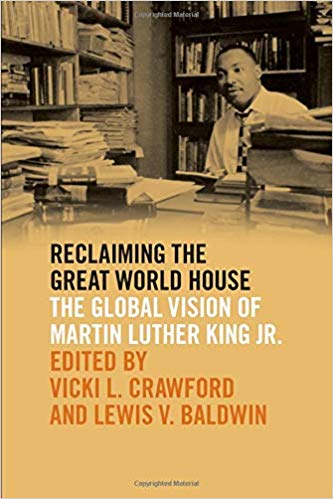
Reclaiming the Great World House - REVIEW


Reclaiming the Great World House - The Global Vision of Martin Luther King Jr.
Edited by Vicki L. Crawford and Lewis V. Baldwin
The Morehouse College King Collection Series on Civil and Human Rights

A global context for understanding the intellectual and sociopolitical legacy of MLK in the twenty-first century. The burgeoning terrain of Martin Luther King Jr. studies is leading to a new appreciation of his thought and its meaningfulness for the emergence and shaping of the twenty-first-century world This volume brings together an impressive array of scholars from various backgrounds and disciplines to explore the global significance of King - then. now, and in the future.

Employing King's metaphor of "the great world house," the major focus is on King's appraisal of the global-human struggle in the 1950s and 1960s, his relevance for today's world, and how future generations might constructively apply or appropriate his key ideas and values in addressing racism. poverty and economic injustice, militarism. sexism, homophobia, the environmental crisis, globalization, and other challenges confronting humanity today. The contributors treat King in context and beyond context, taking seriously the historical King while also exploring how his name, activities, contributions, and legacy are still associated with a globalized rights culture.

The University of Georgia Press and Morehouse College's Martin Luther King Jr Collection are pleased to announce the Morehouse College King Collection Series on Civil and Human Rights Series, a new collaborative book series. Using the 13,000 papers of the King Collection as a foundation, books in the series will offer new scholarship that provides insightful overviews and analyses of Dr. King's intellectual, theological, and activist engagement with a variety of broad themes.

These themes include (but are not limited to) poverty, nonviolence, the Vietnam War, capitalism, racial discrimination, education, and civil rights. Along with the thematically focused works, the series will include brief critical studies on King's involvement with specific campaigns, such as the Montgomery Bus Boycott of1956-57 and the Poor People's Campaign of 1968. Though scholarly in nature, the books are intended to be accessibly written, relatively brief (50,000-70,000 words), and engaging for general readers, offering overviews of King's life and legacy through a twentieth-first-century lens.

Vicki L. Crawford is the director of the Martin Luther King Jr. Collection at Morehouse College and general editor of the Morehouse College King Collection Series on Civil and Human Rights. She is a co-editor of Women in the Civil Rights Movement: Trailblazers and Torchbearers, 1941-1965 and the author of numerous scholarly articles.

Lewis V. Baldwin is a professor emeritus of religious studies at Vanderbilt University. He is the author of many books, including Make the Wounded Whole: The Cultural Legacy of Martin Luther King Jr.; Toward the Beloved Community: Martin Luther King Jr. and South Africa; and Behind the Public Veil: The Humanness of Martin Luther King Jr.
RECLAIMING THE GREAT WORLD HOUSE
The Global Vision of Martin Luther King Jr.

Edited by Vicki L. Crawford and Lewis V. Baldwin
Paperback 978-0-8203-5604-4
Hardback 978-0-8203-5602-0
University of Georgia Press
www.ugapress.org


Sunday, April 22, 2018

Redemption: Martin Luther King, Jr.'s Last 31 Hours by Joseph Rosenbloom


    In the summer of 1968, the city of Memphis was still reeling from the shock and horror of the assassination of the Reverend Dr. Martin Luther King, Jr. As a young reporter interning at the Commercial Appeal, Joseph Rosenbloom vowed to one day write the story of the last hours leading up to King's death. Returning to Memphis between 2006 and 2014, Rosenbloom interviewed two dozen people connected to the events of that fateful day. The result is Redemption, which Charles Blow of the New York Times hails as "immersive, humanizing, and demystifying."
    Rosenbloom, a former Frontline investigative reporter, examines in detail the last thirty-one hours and twenty-eight minutes of King's life, from the bomb threat against him that delayed his flight from Atlanta on the morning of April 3, 1968 to his murder the following night. Drawing on fresh material from the recently opened King archives elucidated other facets of the story, including a lack of progress towards the launch of the Poor People's Campaign and King's state of mind in the spring of 1968. By digging into the hearing transcripts of the House Select Committee on Assassinations and the Memphis police records, Rosenbloom highlights how a previously unreported lapse in police security left King vulnerable. Police director Frank Holloman received warning calls that something was liable to happen to King in Memphis—yet he neglected to notify King of the threats and only provided security for King and his team for 6 hours after their arrival in town. All these years later, reports Rosenbloom, African-American security officer Ed Redditt, who was assigned to a surveillance team monitoring King from a distance, still feels anguish that had he been adequately guarding King, he might have been able to prevent the assassination.
    Revealing the accumulating toll the movement was taking on King, who was emotionally and physically exhausted, Rosenbloom examines the extraordinary pressure he was under to recruit volunteers and raise funds for the Poor People's Campaign, his ambitious project to eliminate poverty in the United States. He had spoken out against the Vietnam War and was facing blowback from the Johnson administration and dissension within his staff, while rioting had spread throughout the nation's cities and there was a growing perception that King was "old news" compared to the new Black Power movement.
    Rosenbloom underscores how dangerous it was for King and his associates to venture into Memphis. King knew little of the city’s political and racial environment, yet he was determined to organize a peaceful march. At the same time, he was trying to broker talks with a local Black Power group, the Invaders, In the hopes that they would not only keep the peace, but also provide security as parade marshals during a violence-free march. Rosenbloom details how King, his mood increasingly darkening, was unable to convince the invaders to commit unequivocally to nonviolence. "He was trying to redeem his reputation as a nonviolent leader by leading a nonviolent march in Memphis," reflects Rosenbloom. "He was drawing deeply on his faith in the redemptive power of sacrifice for a noble cause, as he risked his life—a faith rooted In the biblical example of Jesus."
In vivid detail, Rosenbloom recreates the city of Memphis, the Lorraine Hotel, and the cast of characters surrounding King. There is Mayor Henry Loeb, who was unwilling to negotiate a settlement to end the garbage workers' strike; King's legendary local lawyer, Lucius Burch, who worked with King to fight the federal injunction against his proposed march; his brother, A.D.; his wife Coretta Scott King with whom he regularly talked on the phone; and his staff and fellow activists, including Dorothy Cotton, Ralph Abernathy, Bernard Lee, Andrew Young, and Jesse Jackson. Rosenbloom also writes of then-Senator Georgia Davis, who arrived in the pre-dawn hours of April 4^'^ and spent the king with King, momentarily lifting his spirits.
    Rosenbloom also traces the story of James Earl Ray, a petty criminal and drifter who tracks King through news reports and eerily makes his way to Memphis. There, writes Rosenbloom, Ray set up the perfect sniper's nest in the bathroom of a derelict rooming house across from the Lorraine Hotel. Crouching near the window, Ray posed a Gamemaster 760 rifle on the ledge, and waited to kill the nation's foremost civil rights leader.
    The book culminates with King's now-famous and prophetic "From the Mountaintop" speech at Mason Temple, during which he was often overcome with emotion as he exhorted his audience to understand that the choice today was between nonviolence and "nonexistence." Then his speech took a highly personal turn, notes Rosenbloom. "it was unusual for King to dwell openly on the depth of his despair as he pondered his own death. This night in Memphis, however, he seemed near panic, anxious that he might be the target of an assassin's bullet at any moment."

About the Author
: Joseph Rosenbloom is an award-winning journalist who has been a staff reporter for the Boston Globe, an investigative reporter for Frontline, and a senior editor for Inc. magazine. He has written for the Wall Street Journal, New York Times, American Prospect, among other publications, and lives in Newton, Massachusetts.