Showing posts with label #BLM. Show all posts

Thursday, July 30, 2026

Assemblies of Sorrow: Performances of Black Endangerment in the Jim Crow Era - REVIEW


by Samuel Ng

During the Jim Crow era, Black activists appealed to a diverse population of migrating Black Americans by making them viscerally feel that the threat of anti-Black violence continued to afflict them as a group and to undergird blackness itself. To this end, they organized public gatherings, mostly comprised of Black people, that fostered fears of looming physical harm.

Samuel Galen Ng illuminates this Black consciousness as it emanated from feelings of collective endangerment. The dissemination and intensification of such feelings became a pivotal way of solidifying a national Black consciousness on the eve of the Civil Rights Movement. Ng examines how performances of Black endangerment performed political work that provided Black people with important means of political organizing and insurgency. As Ng shows, the grief and mourning that took place at the performances provided public spaces for individuals and communities to observe specific losses capable of impacting Americans across the country.

Ambitious and interdisciplinary, Assemblies of Sorrow explores an overlooked facet of Black organizing and protest and traces how activists shaped fear and grief into political action.

Samuel Galen Ng is an associate professor of Africana studies at Smith College.

University of Illinois Press
ISBN-13: 978-0252089404

Monday, May 18, 2026

Integration at Second Base: Jackie Robinson and the Quest for Black Citizenship - REVIEW


by Peter Eisenstadt

Jackie Robinson is one of the most enduring icons of the great American pastime―the man who broke baseball’s color line in the twentieth century, opening the door for his fellow professionals and allowing rising generations to dream of fame and glory on the diamond. But for number 42, playing for the Dodgers was just a beginning. As Peter Eisenstadt demonstrates in this compelling new biography, Robinson’s trailblazing journey was more than a role that fate thrust on him―it was politically informed and consciously connected in Robinson’s mind to a vision of integration and full Black citizenship.

When he ventured out of the Negro Leagues and into the majors, as the league’s sole Black player, his triumph could have stopped at mere tokenism. Eisenstadt reveals a more ambitious goal on Robinson’s part, as well as a side to the great sports hero we have never fully appreciated. This book explores the political and spiritual roots of Jackie Robinson’s quest for Black citizenship from his boyhood in Pasadena to his service days―during which he was court-martialed for refusing to change seats on a segregated bus―to a transcendent athletic career that included an MVP award, a World Series victory, and eventually a place in the Hall of Fame. In his life after baseball, Robinson went on to serve as a civil rights leader, columnist, and political advocate.

The determination that spurred his great achievements was always accompanied by an understanding of just how far society still needed to go: despite his success, at the end of his life he was convinced that he “never had it made.” In telling the story of Robinson’s remarkable life, this book sheds invaluable light on the complex meanings of integration.

Peter Eisenstadt is Affiliate Professor of History at Clemson University and the author of Against the Hounds of Hell: A Life of Howard Thurman.

University of Virginia Press
ISBN-13: 978-0813955001


Friday, May 01, 2026

Black Evidence: A History and a Warning - REVIEW


by Candis Watts Smith

From Reconstruction to Redemption, from the enactment of landmark civil rights legislation to the execution of the Southern strategy, from 2020’s multiracial protests to the swift elimination of policies etching out a more inclusive society, Americans regularly experience periods of racial reckoning followed by walloping retrenchment.

In Black Evidence, political scientist Candis Watts Smith shows that this pattern is the result of an American habit: denying the truths about our society that Black people experience and remember. Smith then delivers a warning: the effects of this habit ripple out, dulling our ability to identify the signs of authoritarianism and heightening our tolerance for cruelty. Still, she shows how these same truths offer models to overcome our repeated predicament.

Through a curation of critical moments across four centuries, Smith invites us to review the evidence that has been obscured, distorted, and denied. She rigorously investigates the practices that turn Black witnesses into liars in the court room, Black patients into superbodies that don’t feel pain in health care settings, Black people into subhumans in scientific experiments, and Black children into superpredators. She reveals what happens when Black voices are subject to exclusion―their communities are terrorized, their memories are refuted, and their resistance is pathologized.

Written with compassion and tempered optimism, Black Evidence prescribes a cure and encourages readers to practice the skills needed to build a truly multiracial democracy: confront our past, acknowledge the damage of inequality in our present, and listen to the voices of those who experience the problems we wish to solve for an equitable future.

Candis Watts Smith is professor of political science at Duke University. She is the author or coauthor of dozens of articles and books, including Stay Woke: A People’s Guide to Making All Black Lives Matter and Racial Stasis: The Millennial Generation and the Stagnation of Racial Attitudes in Americans Politics. Her research has been supported by the National Science Foundation. Smith is a cohost of the Democracy Works podcast, and her TEDx talk on myths about racism has been viewed over two million times. She lives in Durham, North Carolina.

W.W. Norton & Company
ISBN-13: 978-1324036272


Saturday, March 01, 2025

You Have to Be Prepared to Die Before You Can Begin to Live - REVIEW


Ten Weeks in Birmingham That Changed America

by Paul Kix

From journalist Paul Kix, the riveting story, never before fully told, of the 1963 Birmingham Campaign―ten weeks that would shape the course of the Civil Rights Movement and the future of America.

It’s one of the iconic photographs of American history: A Black teenager, a policeman and his lunging German Shepherd. Birmingham, Alabama, May of 1963. In May of 2020, as reporter Paul Kix stared at a different photo–that of a Minneapolis police officer suffocating George Floyd–he kept returning to the other photo taken half a century earlier, haunted by its echoes. What, Kix wondered, was the full legacy of the Birmingham photo? And of the campaign it stemmed from?

In You Have To Be Prepared To Die Before You Can Begin To Live, Paul Kix takes the reader behind the scenes as he tells the story of the Southern Christian Leadership Conference’s pivotal 10 week campaign in 1963 to end segregation in Birmingham, Alabama. At the same time, he also provides a window into the minds of the four extraordinary men who led the campaign―Martin Luther King, Jr., Wyatt Walker, Fred Shuttlesworth, and James Bevel. With page-turning prose that read like a thriller, Kix’s book is the first to zero in on the ten weeks of Project C, as it was known―its specific history and its echoes sounding throughout our culture now. It’s about Where It All Began, for sure, but it’s also the key to understanding Where We Are Now and Where We Will Be. As the fight for equality continues on many fronts, Project C is crucial to our understanding of our own time and the impact that strategic activism can have.

Celadon Books
ISBN-13 978-1250378088

Monday, December 02, 2024

Black Revolutionaries: A History of the Black Panther Party - REVIEW


by Joe Street

Black Revolutionaries is an accessible yet rigorously argued history of the Black Panther Party (BPP), one of the emblematic organizations of the 1960s. Joe Street highlights the complexity of the BPP’s history through three key themes: the BPP’s intellectual history, its political and social activism, and the persecution its members endured. Together, these themes confirm the BPP’s importance in understanding Black America’s response to white oppression in the 1960s and 1970s.

Based on a wealth of archival material, Black Revolutionaries reveals the enduring importance of leftist political philosophy to 1960s and 1970s radicalism, and how the BPP helps us to understand more deeply the role of public space and public protest in the 1960s.Street shows how the BPP were key to the transformation of political activism in the post-civil rights era. As the BPP faced the psychological and organizational impacts of FBI surveillance, police repression, and imprisonment, Street examines how these negative forces helped to shape and destroy the BPP.

Most significantly, Black Revolutionaries demonstrates that an understanding of African American grassroots politics and protest, racial injustice, and police brutality in the post-civil rights era is only comprehensible through engagement with the BPP’s history.

University of Georgia Press
ISBN-13: 978-0820366944

Friday, November 01, 2024

Higher Flight: Refocusing Black/Africana Studies for the 21st Century - REVIEW


by James B. Stewart

In the open access book Higher Flight, pre-eminent scholar and activist James B. Stewart offers a much-needed critical assessment of the current state of Black/Africana studies in order to chart a path forward. In three equally groundbreaking sections, Stewart clarifies and refines the distinctive approaches that currently define the field; shows how creative production in particular can serve as a unique means of cultural analysis and political mobilization; and suggests how to restore the balance between intellectual inquiry and direct action in order to improve the actual lived experiences of people of African descent. Each section incorporates various forms of expression, including Stewart’s essays, speeches, and poems, and the book as a whole covers a vast range of figures, issues, and phenomena, from W.E.B, Du Bois to James Baldwin, from conscious hip-hop to the Black Lives Matter movement, from Hurricane Katrina to Covid-19, and very much in between. Written with an accessible authoritativeness few Black/Africana scholar-activists can match, Stewart offers a must-read not only for researchers, but also for graduate students and advanced undergraduate students interested in Black/Africana studies, diaspora studies, ethnic studies, Black womanist/feminist studies, and American studies, as well as in African American history, culture, politics, economics, literature, and philosophy.

James B. Stewart is Professor Emeritus of African and African American Studies at Penn State University, USA. He previously served as Vice Provost for Educational Equity and Director of the Black studies Program at Penn State, as President of the National Council for Black Studies, as President of the Association for the Study of African American Life and History, and as Editor of The Review of Black Political Economy. He has published numerous articles and books, including the field-defining Introduction to Black Studies: Transdisciplinary Approaches and Implications (1992) and Flight in Search of Vision (2004).

Zed Books
ISBN-13 978-1350380295

Monday, October 14, 2024

Allow Me to Retort: A Black Guy’s Guide to the Constitution - REVIEW

by Elie Mystal

Allow Me to Retort is an easily digestible argument about what rights we have, what rights Republicans are trying to take away, and how to stop them. Mystal explains how to protect the rights of women and people of color instead of cowering to the absolutism of gun owners and bigots. He explains the legal way to stop everything from police brutality to political gerrymandering, just by changing a few judges and justices. He strips out all of the fancy jargon conservatives like to hide behind and lays bare the truth of their project to keep America forever tethered to its slaveholding past.

Mystal brings his trademark humor, expertise, and rhetorical flair to explain concepts like substantive due process and the right for the LGBTQ community to buy a cake, and to arm readers with the knowledge to defend themselves against conservatives who want everybody to live under the yoke of eighteenth-century white men. The same tactics Mystal uses to defend the idea of a fair and equal society on MSNBC and CNN are in this book, for anybody who wants to deploy them on social media.

You don’t need to be a legal scholar to understand your own rights. You don’t need to accept the “whites only” theory of equality pushed by conservative judges. You can read this book to understand that the Constitution is trash, but doesn’t have to be.

Elie Mystal is The Nation’s legal analyst and justice correspondent, an Alfred Knobler Fellow at the Type Media Center, and the legal editor of the More Perfect podcast on the Supreme Court for Radiolab. He is a graduate of Harvard College and Harvard Law School, the former executive editor of Above the Law, a former associate at Debevoise & Plimpton, and a frequent guest on MSNBC and Sirius XM. The author of Allow Me to Retort (The New Press), he lives in New York.

The New Press
ISBN-13: 978-1620976814

Saturday, October 12, 2024

On a Move: Philadelphia's Notorious Bombing and a Native Son's Lifelong Battle for Justice - REVIEW


by Mike Africa Jr.

The incredible story of MOVE, the revolutionary Black civil liberties group that Philadelphia police bombed in 1985, killing 11 civilians—by one of the few people born into the organization, raised during the bombing's tumultuous aftermath, and entrusted with repairing what was left of his family.

"As necessary and powerful as it is captivating." – Michael Harriot, New York Times bestselling author of Black AF History

"Searing and urgent." – Bakari Sellers, New York Times bestselling author of My Vanishing Country and The Moment

Before police dropped a bomb on a residential neighborhood on May 13, 1985, few people outside Philadelphia were aware that a Black-led civil liberties organization had taken root there. Founded in 1972 by a charismatic ideologue called John Africa, MOVE’s mission was to protect all forms of life from systemic oppression. They drew their ideology from the Black Panther Party and pre-dated animal and environmental rights groups like PETA and Earth First. MOVE emerged in an era when Black Philadelphians suffered under devastating policies brought by the long, doomed war in Vietnam, Mayor Frank Rizzo’s overtly racist police surveillance, and, eventually, President Ronald Reagan's War on Drugs. MOVE members lived together in a collection of West Philadelphia row houses and took the surname Africa out of admiration for the group's founder.

But in MOVE's lifestyle, city officials saw threats to their status quo. Their bombing of MOVE homes shocked the nation and made international news. Eleven people were killed, including five children. And the City of Brotherly Love became known as the City That Bombed Itself.

Among the children most affected by the bombing was Mike Africa Jr. Born in jail following a police attack on MOVE that led to his parents’ decades-long incarcerations, Mike was six years old and living with his grandmother when MOVE was bombed. In the ensuing years, Mike sought purpose in the ashes left behind. He began learning about the law as a teenager and became adept at speaking and inspiring public support with the help of other MOVE members. In 2018, at age 40, he finally succeeded in getting his parents released from prison.

On a Move is one of the most unimaginable stories of injustice and resilience in recent American history. But it is not only one of tragedy. It is about coming-of-age for a young activist, the strong ties of family, and, against all odds, learning how to take indignities on the chin and to work within the very system that created them. At once a harrowing personal account and an impassioned examination of racism and police violence, On a Move testifies to the power of love and hope, in the face of astonishing wrongdoing.

Mike Africa Jr. is a sought-after speaker and writer who has been featured in The New York Times, The Washington Post, The Guardian and on NPR. He starred in the HBO documentary 40 Years a Prisoner and was featured in the Audible original docu-series about the MOVE bombing, Summer of ’85, produced by Kevin Hart and Charlamagne tha God, and narrated by Hart. As a keynote speaker, Mike has been invited to speak everywhere from the Smithsonian and the University of Pennsylvania to the 55 Year Anniversary of the Black Panther Party.

D. Watkins is the New York Times bestselling and award-winning author of The Beast Side, The Cook Up, and Black Boy Smile, as well as coauthor of Where Tomorrows Aren’t Promised. He is also editor at large for Salon and a college lecturer at the University of Baltimore. 

Mariner Books
ISBN-13: 978-0063318878

Wednesday, September 11, 2024

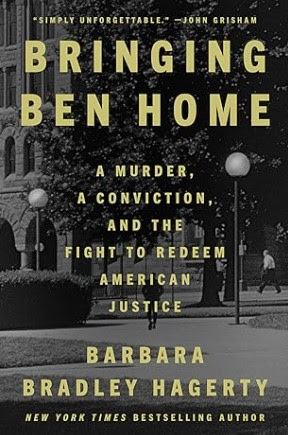
Bringing Ben Home: A Murder, a Conviction, and the Fight to Redeem American Justice - REVIEW


by Barbara Bradley Hagerty

How states are making their legal systems more equitable, seen through the story of a Black man falsely imprisoned for thirty years for murder.

In 1987, Ben Spencer, a twenty-two-year-old Black man from Dallas, was convicted of murdering white businessman Jeffrey Young—a crime he didn’t commit. From the day of his arrest, Spencer insisted that it was “an awful mistake.” The Texas legal system didn’t see it that way. It allowed shoddy police work, paid witnesses, and prosecutorial misconduct to convict Spencer of murder, and it ignored later efforts to correct this error. The state’s bureaucratic intransigence caused Spencer to spend more than half his life in prison.

Eventually independent investigators, new witness testimony, the foreman of the jury that convicted him, and a new Dallas DA convinced a Texas judge that Spencer had nothing to do with the killing, and in 2021 he was released from prison.

As Spencer’s fight to clear himself demonstrates, our legal systems are broken: expedience is more important than the truth. That is starting to change as states across the country implement new efforts to reduce wrongful convictions, and one of the states leading the way is Texas.

Award-winning journalist Barbara Bradley Hagerty has spent years digging into this issue, and she has immersed herself in Spencer’s case. She has combed police files and court records, interviewed dozens of witnesses, and had extensive conversations with Spencer, and in Bringing Ben Home she threads together two narratives: how an innocent Black man got caught up in and couldn’t escape a legal system that refused to admit its mistakes; and what Texas and other states are doing to address wrongful convictions to make the legal process more equitable for everyone.

By turns fascinating and enraging, personal and provocative, Bringing Ben Home is the powerful story of one innocent man who refused to admit that he was guilty of murder, and how his plight became part of a paradigm shift in how the legal system thinks about innocence as it institutes new methods to overturn wrongful convictions to better protect people like Ben Spencer.

Barbara Bradley Hagerty is an award-winning journalist at The Atlantic and formerly of National Public Radio. She is the author of the New York Times–bestselling Fingerprints of God and Life Reimagined, and her work has also appeared in The Washington Post, Los Angeles Times, Vogue, and The Christian Science Monitor. She has received the Templeton-Cambridge Journalism Fellowship in Science and Religion and a Knight Fellowship at Yale Law School. She lives with her husband in Washington, D.C.

Riverhead Books
ISBN-13 978-0593420089

Friday, April 12, 2024

The State of Black Progress: Confronting Government and Judicial Obstacles - REVIEW


Edited by Star Parker

Black Americans have arguably arrived at the height of their cultural prominence. In politics, entertainment, academia, and nearly every sphere of influence, “black issues” dominate the national discussion. Yet many black Americans are suffering more than ever from the blight of poverty, physical and mental health struggles, lack of opportunity, and failing schools.

This edited volume, sponsored by the Center for Urban Renewal and Education and featuring contributions from W.B. Allen, Judge Janice Rogers Brown (ret.), Ian Rowe, Sally Pipes, Stephen Moore, and others, addresses this question in light of American values and the history of constitutional jurisprudence. In the 1860s, black America was promised emancipation but continued to experience subjugation. In the 1960s, black America was promised equality but was frequently exploited. Racial discrimination played a role, but in the intervening decades misguided progressive policies and the normalization of victimhood rhetoric has proven even more disastrous. By failing to live up to American ideals, our nation denied many black Americans their chance at the American Dream.

The scholars and luminaries who contributed to this volume believe that what has been lost can be recovered. If our nation recognizes the history of our current predicament, embraces the founding principles that made America an economic powerhouse, and commits to an agenda of empowering fiscal, educational, and faith and family-affirming policies, then black Americans can overcome the obstacles that most hamper progress in their communities.

Star Parker is President of the Center for Urban Renewal and Education (CURE), which she founded in 1995. She serves on the US Commission on Civil Rights California Advisory Committee and previously served on the US Frederick Douglass Bicentennial Commission. In 2017, Parker joined the White House Opportunity Initiative advisory team and has served on the board of directors of the National Religious Broadcasters and the Leadership Institute.

Parker is a nationally syndicated columnist and the author of several books, including Uncle Sam's Plantation: How Big Government Enslaves America's Poor and What We Can Do About It; White Ghetto: How Middle-Class America Reflects Inner City Decay; and Pimps, Whores and Welfare Brats: From Welfare Cheat to Conservative Messenger.

Encounter Books
ISBN-13 978-1641773416

Wednesday, November 29, 2023

Black in White Space: The Enduring Impact of Color in Everyday Life - REVIEW

by Elijah Anderson

A birder strolling in Central Park. A college student lounging on a university quad. Two men sitting in a coffee shop. Perfectly ordinary actions in ordinary settings—and yet, they sparked jarring and inflammatory responses that involved the police and attracted national media coverage. Why? In essence, Elijah Anderson would argue, because these were Black people existing in white spaces.

In Black in White Space, Anderson brings his immense knowledge and ethnography to bear in this timely study of the racial barriers that are still firmly entrenched in our society at every class level. He focuses in on symbolic racism, a new form of racism in America caused by the stubbornly powerful stereotype of the ghetto embedded in the white imagination, which subconsciously connects all Black people with crime and poverty regardless of their social or economic position. White people typically avoid Black space, but Black people are required to navigate the "white space" as a condition of their existence.

An unwavering truthteller in our national conversation on race, Anderson has shared intimate and sharp insights into Black life for decades. Vital and eye-opening, Black in White Space will be a must-listen for anyone hoping to understand the lived realities of Black people and the structural underpinnings of racism in America.

University of Chicago Press
ISBN-13: 978-0226657233

Thursday, October 05, 2023

To Build a Black Future: The Radical Politics of Joy, Pain, and Care - REVIEW


by Christopher Paul Harris

An incisive portrait of how the new Black politics can forge a future centered on collective action, community, and care

When #BlackLivesMatter emerged in 2013, it animated the most consequential Black-led mobilization since the civil rights and Black power era. Today, the hashtag turned rallying cry is but one expression of a radical reorientation toward Black politics, protest, and political thought. To Build a Black Future examines the spirit and significance of this insurgency, offering a revelatory account of a new political culture-responsive to pain, suffused with joy, and premised on care-emerging from the centuries-long arc of Black rebellion, a tradition that traces back to the Black slave.

Drawing on his own experiences as an activist and organizer, Christopher Paul Harris takes readers inside the Movement for Black Lives (M4BL) to chart the propulsive trajectory of Black politics and thought from the Middle Passage to the present historical moment. Carefully attending to the social forces that produce Black struggle and the contradictions that arise within it, Harris illustrates how M4BL gives voice to an abolitionist praxis that bridges the past, present, and future, outlining a political project at once directed inward to the Black community while issuing an outward challenge to the world.

Essential reading for the age of #BlackLivesMatter, this visionary and provocative book reveals how the radical politics of joy, pain, and care, in sharp contrast to liberal political thought, can build a Black future that transcends ideology and pushes the boundaries of our political imagination.

Princeton University Press
ISBN-13 978-0691219066


Wednesday, July 12, 2023

For the Culture: The Power Behind What We Buy, What We Do, and Who We Want to Be - REVIEW


by Marcus Collins

The architect of some of the most famous ad campaigns of the last decade argues that culture is the most powerful vehicle for influencing behavior, and shows readers how to harness culture to inspire other people to share their vision. 

We all try to influence others in our daily lives. Whether you are a manager motivating your team, an employee making a big presentation, an activist staging a protest, or an artist promoting your music, you are in the business of getting people to take action. In For the Culture, Marcus Collins argues true cultural engagement is the most powerful vehicle for influencing behavior. If you want to get people to move, you must first understand the underlying cultural forces that make them tick.

Collins uses stories from his own work as an award-winning marketer—from spearheading digital strategy for Beyoncé, to working on Apple and Nike collaborations, to the successful launch of the Brooklyn Nets NBA team—to break down the ways in which culture influences behavior and how readers can do the same. With a deep perspective, and built on a century’s worth of data, For the Culture gives readers the tools they need to inspire collective change by leveraging the cheat codes used by some of the biggest brands in the world. This is the only book you’ll need if you want to influence people to take action.

PublicAffairs
ISBN-13 978-1541700963

Thursday, June 29, 2023

The Fire This Time: A New Generation Speaks about Race - REVIEW


by Jesmyn Ward

In this bestselling, widely lauded collection, Jesmyn Ward gathers our most original thinkers and writers to speak on contemporary racism and race, including Carol Anderson, Jericho Brown, Edwidge Danticat, Kevin Young, Claudia Rankine, and Honoree Jeffers. “An absolutely indispensable anthology” (Booklist, starred review), The Fire This Time shines a light on the darkest corners of our history, wrestles with our current predicament, and imagines a better future.

Envisioned as a response to The Fire Next Time, James Baldwin’s groundbreaking 1963 essay collection, these contemporary writers reflect on the past, present, and future of race in America. We’ve made significant progress in the fifty-odd years since Baldwin’s essays were published, but America is a long and painful distance away from a “post-racial society”—a truth we must confront if we are to continue to work towards change. Baldwin’s “fire next time” is now upon us, and it needs to be talked about; The Fire This Time “seeks to place the shock of our own times into historical context and, most importantly, to move these times forward” (Vogue).

Scribner
ISBN-13 978-1501126352

Monday, June 05, 2023

The Second: Race and Guns in a Fatally Unequal America - REVIEW

by Carol Anderson

From the New York Times bestselling author of White Rage, an unflinching, critical new look at the Second Amendment-and how it has been engineered to deny the rights of African Americans since its inception.

In The Second, historian and award-winning, bestselling author of White Rage Carol Anderson powerfully illuminates the history and impact of the Second Amendment, how it was designed, and how it has consistently been constructed to keep African Americans powerless and vulnerable. The Second is neither a “pro-gun” nor an “anti-gun” book; the lens is the citizenship rights and human rights of African Americans.

From the seventeenth century, when it was encoded into law that the enslaved could not own, carry, or use a firearm whatsoever, until today, with measures to expand and curtail gun ownership aimed disproportionately at the African American population, the right to bear arms has been consistently used as a weapon to keep African Americans powerless--revealing that armed or unarmed, Blackness, it would seem, is the threat that must be neutralized and punished.

Throughout American history to the twenty-first century, regardless of the laws, court decisions, and changing political environment, the Second has consistently meant this: That the second a Black person exercises this right, the second they pick up a gun to protect themselves (or the second that they don’t), their life--as surely as Philando Castile’s, Tamir Rice’s, Alton Sterling’s--may be snatched away in that single, fatal second. Through compelling historical narrative merging into the unfolding events of today, Anderson’s penetrating investigation shows that the Second Amendment is not about guns but about anti-Blackness, shedding shocking new light on another dimension of racism in America.

Bloomsbury Publishing
ISBN-13: 978-1635574258


Thursday, October 27, 2022

Teaching White Supremacy: America's Democratic Ordeal and the Forging of Our National Identity - REVIEW


by Donald Yacovone

A powerful exploration of the past and present arc of America’s white supremacy—from the country’s inception and Revolutionary years to its 19th century flashpoint of civil war; to the Civil Rights movement of the 1960s and today’s Black Lives Matter.

Donald Yacovone shows us the clear and damning evidence of white supremacy’s deep-seated roots in our nation’s educational system through a fascinating, in-depth examination of America’s wide assortment of texts, from primary readers to college textbooks, from popular histories to the most influential academic scholarship. Sifting through a wealth of materials from the colonial era to today, Yacovone reveals the systematic ways in which this ideology has infiltrated all aspects of American culture and how it has been at the heart of our collective national identity.

Yacovone lays out the arc of America’s white supremacy from the country’s inception and Revolutionary War years to its nineteenth-century flashpoint of civil war to the civil rights movement of the 1960s and today’s Black Lives Matter. In a stunning reappraisal, the author argues that it is the North, not the South, that bears the greater responsibility for creating the dominant strain of race theory, which has been inculcated throughout the culture and in school textbooks that restricted and repressed African Americans and other minorities, even as Northerners blamed the South for its legacy of slavery, segregation, and racial injustice.

A major assessment of how we got to where we are today, of how white supremacy has suffused every area of American learning, from literature and science to religion, medicine, and law, and why this kind of thinking has so insidiously endured for more than three centuries.

Pantheon
ISBN-13 978-0593316634

Wednesday, October 12, 2022

African American Novels in the Black Lives Matter Era: Transgressive Performativity of Black Vulnerability as Praxis in Everyday Life - REVIEW


by E. Lâle Demirtürk

African American Novels in the Black Lives Matter Era: Transgressive Performativity of Black Vulnerability as Praxis in Everyday Life explores the undoing of whiteness by black people, who dissociate from scripts of black criminality through radical performative reiterations of black vulnerability. It studies five novels that challenge the embodied discursive practices of whiteness in interracial social encounters, showing how they use strategic performances of Blackness to enable subversive practices in everyday life, which is constructed and governed by white mechanisms of racialized control. The agency portrayed in these novels opens up alternative spaces of Blackness to impact the social world and effects transformative change as a forceful critique of everyday life. African American Novels in the Black Lives Matter Era shows how these novels reformulate the problem of black vulnerability as a constitutive source of the right to life in their refusal of subjection to vulnerability, enacted by white institutional and individual forms of violence. It positions a white-black-encounter-oriented reading of these “neo-resistance novels” of the Black Lives Matter era as a critique of everyday life in an effort to explore spaces of radical performativity of blackness to make happen social change and transformation.

Lexington Books
ISBN-13 978-1498596213

Friday, March 18, 2022

Black Paper: Writing in a Dark Time - REVIEW


by Teju Cole

“Darkness is not empty,” writes Teju Cole in Black Paper, a book that meditates on what it means to sustain our humanity—and witness the humanity of others—in a time of darkness. One of the most celebrated essayists of his generation, Cole here plays variations on the essay form, modeling ways to attend to experience—not just to take in but to think critically about what we sense and what we don’t.

Wide-ranging but thematically unified, the essays address ethical questions about what it means to be human and what it means to bear witness, recognizing how our individual present is informed by a collective past. Cole’s writings in Black Paper approach the fractured moment of our history through a constellation of interrelated concerns: confrontation with unsettling art, elegies both public and private, the defense of writing in a time of political upheaval, the role of the color black in the visual arts, the use of shadow in photography, and the links between literature and activism. Throughout, Cole gives us intriguing new ways of thinking about blackness and its numerous connotations. As he describes the carbon-copy process in his epilogue: “Writing on the top white sheet would transfer the carbon from the black paper onto the bottom white sheet. Black transported the meaning.”

University of Chicago Press
ISBN-13 978-0226641355

The Harlem Uprising: Segregation and Inequality in Postwar New York City - REVIEW


by Christopher Hayes

In July 1964, after a white police officer shot and killed an African American teenage boy, unrest broke out in Harlem and then Bedford-Stuyvesant. Protests rose up to call for an end to police brutality and the unequal treatment of Black people in a city that viewed itself as liberal. A week of upheaval ensued, including looting and property damage as well as widespread police violence, in what would be the first of the 1960s urban uprisings.

Christopher Hayes examines the causes and consequences of the uprisings, from the city’s history of racial segregation in education, housing, and employment to the ways in which the police both neglected and exploited Black neighborhoods. While the national civil rights movement was securing substantial victories in the 1950s and 1960s, Black New Yorkers saw little or uneven progress. Faced with a lack of economic opportunities, pervasive discrimination, and worsening quality of life, they felt a growing sense of disenchantment with the promises of city leaders. Turning to the aftermath of the uprising, Hayes demonstrates that the city’s power structure continued its refusal to address structural racism. In the most direct local outcome, a broad, interracial coalition of activists called for civilian review of complaints against the police. The NYPD’s rank and file fought this demand bitterly, further inflaming racial tensions. The story of the uprisings and what happened next reveals the white backlash against civil rights in the north and crystallizes the limits of liberalism.

Drawing on a range of archives, this book provides a vivid portrait of postwar New York City, a new perspective on the civil rights era, and a timely analysis of deeply entrenched racial inequalities.

Columbia University Press
ISBN-13 978-0231181877

Sunday, October 10, 2021

Love For Liberation: African Independence, Black Power, and a Diaspora Underground by Robin J. Hayes - REVIEW


During the height of the Cold War, passionate idealists across the US and Africa came together to fight for Black self-determination and the antiracist remaking of society. Beginning with the 1957 Ghanaian independence celebration, the optimism and challenges of African independence leaders were publicized to African Americans through community-based newspapers and Historically Black Colleges and Universities. Inspired by African independence―and frustrated with the slow pace of civil rights reforms in the US―a new generation of Black Power activists embarked on nonviolent direct action campaigns and built alternative institutions designed as spaces of freedom from racial subjugation.

Featuring interviews with activists, extensive archival research, and media analysis, Robin Hayes reveals how Black Power and African independence activists created a diaspora underground, characterized by collaboration and reciprocal empowerment. Together, they redefined racial discrimination as an international human rights issue requiring education, sustained collective action, and global solidarity―laying the groundwork for future transnational racial justice movements, such as Black Lives Matter.