Showing posts with label white supremacy. Show all posts

Monday, May 18, 2026

The Secret War Against Hate: American Resistance to Antisemitism and White Supremacy - REVIEW


by Steven J. Ross

Americans today like to believe that the end of World War II brought a new era of tolerance in the United States. But antisemitism and racism went up-not down-after the war's end. Violence broke out in cities across the country, and the number of organized hate groups more than doubled from 1940 to 1946. In this shocking account of a resurgence of White Supremacy in America, celebrated historian Steven J. Ross reveals how four key leaders-Emory Burke, J. B. Stoner, James Madole, and George Lincoln Rockwell-worked together to “finish the job Hitler had begun,” launching deadly attacks on Jews and African Americans and building a network of terrorists across the U.S. In response to this “war of hate,” three men-Arnold Forster of the Anti-­Defamation League, George Mintzer of the American Jewish Committee, and James Sheldon of the Non-­Sectarian Anti­-Nazi League-along with dozens of men and women, launched a multipronged effort: They infiltrated, monitored, and undermined these hate groups, putting their own safety on the line and scoring important victories that, today, have been all but forgotten.

Tracing the extraordinary work of these unsung heroes, The Secret War Against Hate provides a groundbreaking reconsideration of the legacy of the “Good War,” and essential reading on how America today can beat hate once again and build a just and united nation.

Steven J. Ross is a Distinguished Professor of History at the University of Southern California and Director of the Casden Institute for the Study of the Jewish Role in American Life. He is the author of Hitler in Los Angeles, a Los Angeles Times bestseller and Pulitzer Prize finalist, Hollywood Left and Right, which received the Academy of Motion Picture Arts and Sciences' Film Scholars Award, and Working-Class Hollywood, named a Best Book of the Year by the Los Angeles Times. He lives in Southern California.

Bloomsbury Publishing
ISBN-13: 978-1635578003

Wednesday, August 20, 2025

We Refuse: A Forceful History of Black Resistance - REVIEW


by Kellie Carter Jackson

Black resistance to white supremacy is often reduced to a simple binary, between Dr. Martin Luther King Jr.’s nonviolence and Malcolm X’s “by any means necessary.” In We Refuse, historian Kellie Carter Jackson urges us to move past this false choice, offering an unflinching examination of the breadth of Black responses to white oppression, particularly those pioneered by Black women.  

The dismissal of “Black violence” as an illegitimate form of resistance is itself a manifestation of white supremacy, a distraction from the insidious, unrelenting violence of structural racism. Force—from work stoppages and property destruction to armed revolt—has played a pivotal part in securing freedom and justice for Black people since the days of the American and Haitian Revolutions. But violence is only one tool among many. Carter Jackson examines other, no less vital tactics that have shaped the Black struggle, from the restorative power of finding joy in the face of suffering to the quiet strength of simply walking away. 

Clear-eyed, impassioned, and ultimately hopeful, We Refuse offers a fundamental corrective to the historical record, a love letter to Black resilience, and a path toward liberation.

Kellie Carter Jackson is the Michael and Denise Kellen ’68 Associate Professor and Chair of Africana Studies at Wellesley College. Her book Force and Freedom was a finalist for the Frederick Douglass Book Prize and the Museum of African American History Stone Book Award. She is the cohost of the Radiotopia podcast “This Day in Esoteric Political History.” She lives outside of Boston with her husband and three children. 

Seal Press
ISBN-13: 978-1541602908

Friday, August 15, 2025

Blood at the Root: A Racial Cleansing in America - REVIEW


by Patrick Phillips

Forsyth County, Georgia, at the turn of the twentieth century, was home to a large African American community that included ministers and teachers, farmers and field hands, tradesmen, servants, and children. But then in September of 1912, three young black laborers were accused of raping and murdering a white girl. One man was dragged from a jail cell and lynched on the town square, two teenagers were hung after a one-day trial, and soon bands of white “night riders” launched a coordinated campaign of arson and terror, driving all 1,098 black citizens out of the county. The charred ruins of homes and churches disappeared into the weeds, until the people and places of black Forsyth were forgotten.

National Book Award finalist Patrick Phillips tells Forsyth’s tragic story in vivid detail and traces its long history of racial violence all the way back to antebellum Georgia. Recalling his own childhood in the 1970s and ’80s, Phillips sheds light on the communal crimes of his hometown and the violent means by which locals kept Forsyth “all white” well into the 1990s. In precise, vivid prose, Blood at the Root delivers a "vital investigation of Forsyth’s history, and of the process by which racial injustice is perpetuated in America" (Congressman John Lewis).

Patrick Phillips is an award-winning poet, translator, and professor. A Guggenheim and NEA Fellow, his poetry collection, Elegy for a Broken Machine, was a finalist for the National Book Award. Phillips teaches at Stanford University.

W.W. Norton & Company
ISBN-13: 978-0393354737

Friday, March 14, 2025

Somewhere Toward Freedom: Sherman's March and the Story of America's Largest Emancipation - REVIEW

by Bennett Parten

A groundbreaking account of Sherman’s March to the Sea—the critical Civil War campaign that destroyed the Confederacy—told for the first time from the perspective of the tens of thousands of enslaved people who fled to the Union lines and transformed Sherman’s march into the biggest liberation event in American history.

In the fall of 1864, Gen. William T. Sherman led his army through Atlanta, Georgia, burning buildings of military significance—and ultimately most of the city—along the way. From Atlanta, they marched across the state to the most important city at the time: Savannah.

Mired in the deep of the South with no reliable supply lines, Sherman’s army had to live off the land and the provisions on the plantations they seized along the way. As the army marched to the east, plantation owners fled, but even before they did so, slaves self-emancipated to Union lines. By the time the army seized Savannah in December, as many as 20,000 enslaved people had attached themselves to Sherman’s army. They endured hardships, marching as much as twenty miles a day—often without food or shelter from the winter weather—and at times Union commanders discouraged and even prevented the self-emancipated from staying with the army. Racism was not confined to the Confederacy.

In Somewhere Toward Freedom, historian Bennett Parten brilliantly reframes this seminal episode in Civil War history. He not only helps us understand how Sherman’s March impacted the war, and what it meant to the enslaved, but also reveals how it laid the foundation for the fledging efforts of Reconstruction. When the war ended, Sherman and various government and private aid agencies seized plantation lands—particularly in the sea islands off the Georgia and South Carolina coasts—in order to resettle the newly emancipated. They were fed, housed, and in some instances, taught to read and write. This first real effort at Reconstruction was short-lived, however. As federal troops withdrew to the north, Confederate sympathizers and Southern landowners eventually brought about the downfall of this program.

Sherman’s march has remained controversial to this day. But as Parten reveals, it played a significant role in ending the Civil War, due in no small part to the efforts of the tens of thousands of enslaved people who became a part of it. In Somewhere Toward Freedom, this critical moment in American history has finally been given the attention it deserves.

Bennett Parten is an assistant professor of history at Georgia Southern University whose area of expertise is the Civil War period. He is a native of Royston, Georgia, and completed his PhD in history at Yale University. His writing has appeared in The Washington Post, Los Angeles Review of Books, Zocalo Public Square, and The Civil War Monitor, among others. He currently lives in Savannah, Georgia.

Simon & Schuster
ISBN-13: 978-1668034682

Monday, October 14, 2024

Allow Me to Retort: A Black Guy’s Guide to the Constitution - REVIEW

by Elie Mystal

Allow Me to Retort is an easily digestible argument about what rights we have, what rights Republicans are trying to take away, and how to stop them. Mystal explains how to protect the rights of women and people of color instead of cowering to the absolutism of gun owners and bigots. He explains the legal way to stop everything from police brutality to political gerrymandering, just by changing a few judges and justices. He strips out all of the fancy jargon conservatives like to hide behind and lays bare the truth of their project to keep America forever tethered to its slaveholding past.

Mystal brings his trademark humor, expertise, and rhetorical flair to explain concepts like substantive due process and the right for the LGBTQ community to buy a cake, and to arm readers with the knowledge to defend themselves against conservatives who want everybody to live under the yoke of eighteenth-century white men. The same tactics Mystal uses to defend the idea of a fair and equal society on MSNBC and CNN are in this book, for anybody who wants to deploy them on social media.

You don’t need to be a legal scholar to understand your own rights. You don’t need to accept the “whites only” theory of equality pushed by conservative judges. You can read this book to understand that the Constitution is trash, but doesn’t have to be.

Elie Mystal is The Nation’s legal analyst and justice correspondent, an Alfred Knobler Fellow at the Type Media Center, and the legal editor of the More Perfect podcast on the Supreme Court for Radiolab. He is a graduate of Harvard College and Harvard Law School, the former executive editor of Above the Law, a former associate at Debevoise & Plimpton, and a frequent guest on MSNBC and Sirius XM. The author of Allow Me to Retort (The New Press), he lives in New York.

The New Press
ISBN-13: 978-1620976814

Friday, May 10, 2024

Without Sanctuary: Lynching Photography in America - REVIEW

by James Allen

“Many people today, despite the evidence, will not believe-don't want to believe-that such atrocities happened in America not so very long ago. These photographs bear witness to . . . an American holocaust." –John Lewis, US Congressman

The Tuskegee Institute records the lynching of 3,436 Black Americans between 1882 and 1950. Many times, a photographer was present to capture these events. Without Sanctuary preserves these harrowing, death-marked depictions, saving them so that we may recognize the terrorism unleashed on America’s African American community. Editor James Allen, an American antique collector, includes nearly 100 images of lynchings in America from his own collection, including battleground cases such as the 1911 murders of Laura and Lawrence Nelson in Okemah, Oklahoma the lynching of Rubin Stacy in Fort Lauderdale, Florida in 1935, and the infamous 1915 execution of Jewish factory manager Leo Frank in Marietta, Georgia. These images are accompanied by Allen’s own notes, as well as texts from the late US congressman and civil rights leader John Lewis, the late slavery and Reconstruction historian Leon Litwack, and writer and theater critic Hilton Als, professor at University of California in Berkeley and Columbia University. Now in its 17th printing, Without Sanctuary remains a singular testament to the camera’s ability to make us remember what we often choose to forget.

James Allen (born 1954) is an American collector best known for his vast collection of photographs of lynchings in America. Some of his collected items are now located in the Smithsonian and the High Museum of Art.

Leon Litwack (1929–2021) was a professor of American History at the University of California in Berkeley from 1964 to 2007. He specialized in the Reconstruction Era and the aftermath of slavery in the late 19th and early 20th centuries. His 1979 book Been in the Storm So Long won the Pulitzer Prize for History, the Francis Parkman Prize and the National Book Award.

Hilton Als (born 1960) is a writer and theater critic. He holds professorial positions at the University of California in Berkeley and Columbia University, and serves as a staff writer and theater critic for the New Yorker. In 2017 he won the Pulitzer Prize for criticism. Als has also curated several group art exhibitions including Forces in Nature at Victoria Miro Gallery and Alice Neel: Uptown at David Zwirner Gallery.

John Lewis (1940–2020) became involved in the Civil Rights movement when he was still a teenager. He was introduced to both Rosa Parks and Martin Luther King Jr., and participated in the 1960 Nashville sit-ins as well as the 1961 Freedom Rides. As chairman of the Student Nonviolent Coordinating Committee (SNCC) from 1963 to 1966, he was one of the “Big Six” civil rights leaders who coordinated the March on Washington. He represented Georgia’s 5th District in the U.S. House of Representatives from 1987 until his death in 2020.

Twin Palms Publishers
Fifteenth Edition, 2021 (November 1, 1999)
2021 edition includes foreword by John Lewis
ISBN-13 978-0944092699

Friday, April 12, 2024

Circulating Jim Crow: The Saturday Evening Post and the War Against Black Modernity - REVIEW


by Adam McKible

In the early twentieth century, the Saturday Evening Post was perhaps the most popular and influential magazine in the United States, establishing literary reputations and shaping American culture. In the popular imagination, it is best remembered for Norman Rockwell’s covers, which nostalgically depicted a wholesome and idyllic American way of life. But beneath those covers lurked a more troubling reality. Under the direction of its longtime editor, George Horace Lorimer, the magazine helped justify racism and white supremacy. It published works by white authors that made heavy use of paternalistic tropes and demeaning humor, portraying Jim Crow segregation and violence as simple common sense.

Circulating Jim Crow demonstrates how the Post used stereotypical dialect fiction to promulgate white supremacist ideology and dismiss Black achievements, citizenship, and humanity. Adam McKible tells the story of Lorimer’s rise to prominence and examines the white authors who provided the editor and his readers with the caricatures they craved. He also explores how Black writers of the Harlem Renaissance pushed back against the Post and its commodified racism. McKible places the erstwhile household names who wrote for the magazine in conversation with figures such as Paul Laurence Dunbar, F. Scott Fitzgerald, Ann Petry, W. E. B. Du Bois, and William Faulkner. Revealing the role of the Saturday Evening Post in normalizing racism for millions of readers, this book also offers a new understanding of how Black writers challenged Jim Crow ideology.

Columbia University Press
ISBN-13 978-0231212649

Wednesday, November 29, 2023

Black in White Space: The Enduring Impact of Color in Everyday Life - REVIEW

by Elijah Anderson

A birder strolling in Central Park. A college student lounging on a university quad. Two men sitting in a coffee shop. Perfectly ordinary actions in ordinary settings—and yet, they sparked jarring and inflammatory responses that involved the police and attracted national media coverage. Why? In essence, Elijah Anderson would argue, because these were Black people existing in white spaces.

In Black in White Space, Anderson brings his immense knowledge and ethnography to bear in this timely study of the racial barriers that are still firmly entrenched in our society at every class level. He focuses in on symbolic racism, a new form of racism in America caused by the stubbornly powerful stereotype of the ghetto embedded in the white imagination, which subconsciously connects all Black people with crime and poverty regardless of their social or economic position. White people typically avoid Black space, but Black people are required to navigate the "white space" as a condition of their existence.

An unwavering truthteller in our national conversation on race, Anderson has shared intimate and sharp insights into Black life for decades. Vital and eye-opening, Black in White Space will be a must-listen for anyone hoping to understand the lived realities of Black people and the structural underpinnings of racism in America.

University of Chicago Press
ISBN-13: 978-0226657233

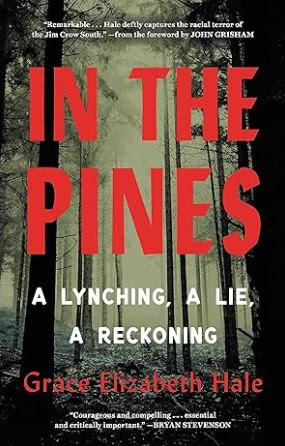
In the Pines: A Lynching, A Lie, A Reckoning - REVIEW


by Grace Elizabeth Hale

An award-winning scholar of white supremacy tackles her toughest research assignment yet: the unsolved murder of a Black man in rural Mississippi while her grandfather was the local sheriff—a cold case that sheds new light on the hidden legacy of racial terror in America.

Grace Hale was home from college when she first heard the family legend. In 1947, while her beloved grandfather had been serving as a sheriff in the Piney Woods of south-central Mississippi, he prevented a lynch mob from killing a Black man who was in his jail on suspicion of raping a white woman—only for the suspect to die the next day during an escape attempt. It was a tale straight out of To Kill a Mockingbird, with her grandfather as the tragic hero. This story, however, hid a dark truth.

Years later, as a rising scholar of white supremacy, Hale revisited the story about her grandfather and Versie Johnson, the man who died in his custody. The more she learned about what had happened that day, the less sense she could make of her family's version of events. With the support of a Carnegie fellowship, she immersed herself in the investigation. What she discovered would upend everything she thought she knew about her family, the tragedy, and this haunted strip of the South—because Johnson's death, she found, was actually a lynching. But guilt did not lie with a faceless mob.

A story of obsession, injustice, and the ties that bind, In the Pines casts an unsparing eye over this intimate terrain, driven by a deep desire to set straight the historical record and to understand and subvert white racism, along with its structures, costs, and consequences—and the lies that sustain it.

Little, Brown and Company
ISBN-13: 978-0316564748

Sunday, February 12, 2023

The Absolutely Indispensable Man: Ralph Bunche, the United Nations, and the Fight to End Empire - REVIEW

by Kal Raustiala

A legendary diplomat, scholar, and civil rights leader, Ralph Bunche was one of the most prominent Black Americans of the twentieth century. The first African American to obtain a political science Ph.D. from Harvard and a celebrated diplomat at the United Nations, he was once so famous he handed out the Best Picture award at the Oscars. Yet today Ralph Bunche is largely forgotten.

In The Absolutely Indispensable Man, Kal Raustiala restores Bunche to his rightful place in history. He shows that Bunche was not only a singular figure in midcentury America; he was also one of the key architects of the postwar international order. Raustiala tells the story of Bunche's dramatic life, from his early years in prewar Los Angeles to UCLA, Harvard, the State Department, and the heights of global diplomacy at the United Nations. After narrowly avoiding assassination Bunche received the Nobel Peace Prize for his ground-breaking mediation of the first Arab-Israeli conflict, catapulting him to popular fame. A central player in some of the most dramatic crises of the Cold War, he pioneered conflict management and peacekeeping at the UN. But as Raustiala argues, his most enduring achievement was his work to dismantle European empire. Bunche perceptively saw colonialism as the central issue of the 20th century and decolonization as a project of global racial justice.

From marching with Martin Luther King to advising presidents and prime ministers, Ralph Bunche shaped our world in lasting ways. This definitive biography gives him his due. It also reminds us that postwar decolonization not only fundamentally transformed world politics, but also powerfully intersected with America's own civil rights struggle.

Oxford University Press
ISBN-13: 978-0197602232

Thursday, October 27, 2022

Teaching White Supremacy: America's Democratic Ordeal and the Forging of Our National Identity - REVIEW


by Donald Yacovone

A powerful exploration of the past and present arc of America’s white supremacy—from the country’s inception and Revolutionary years to its 19th century flashpoint of civil war; to the Civil Rights movement of the 1960s and today’s Black Lives Matter.

Donald Yacovone shows us the clear and damning evidence of white supremacy’s deep-seated roots in our nation’s educational system through a fascinating, in-depth examination of America’s wide assortment of texts, from primary readers to college textbooks, from popular histories to the most influential academic scholarship. Sifting through a wealth of materials from the colonial era to today, Yacovone reveals the systematic ways in which this ideology has infiltrated all aspects of American culture and how it has been at the heart of our collective national identity.

Yacovone lays out the arc of America’s white supremacy from the country’s inception and Revolutionary War years to its nineteenth-century flashpoint of civil war to the civil rights movement of the 1960s and today’s Black Lives Matter. In a stunning reappraisal, the author argues that it is the North, not the South, that bears the greater responsibility for creating the dominant strain of race theory, which has been inculcated throughout the culture and in school textbooks that restricted and repressed African Americans and other minorities, even as Northerners blamed the South for its legacy of slavery, segregation, and racial injustice.

A major assessment of how we got to where we are today, of how white supremacy has suffused every area of American learning, from literature and science to religion, medicine, and law, and why this kind of thinking has so insidiously endured for more than three centuries.

Pantheon
ISBN-13 978-0593316634

Saturday, November 20, 2021

The Black President: Hope and Fury in the Age of Obama - REVIEW


The Black President: Hope and Fury in the Age of Obama
by Claude A. Clegg III

In The Black President, the first interpretative, comprehensive history of Barack Obama's presidency in its entirety, Claude A. Clegg III situates the former president in his dynamic, inspirational, yet contentious political context. He captures the America that made Obama's White House years possible, while insightfully rendering the America that resolutely resisted the idea of a Black chief executive, thus making conceivable the ascent of the most unlikely of his successors.

In elucidating the Obama moment in American politics and culture, this book is also, at its core, a sweeping exploration of the Obama presidency's historical environment, impact, and meaning for African Americans--the tens of millions of people from every walk of life who collectively were his staunchest group of supporters and who most starkly experienced both the euphoric triumphs and dispiriting shortcomings of his years in office. In Obama's own words, his White House years were "the best of times and worst of times" for Black America. Clegg is vitally concerned with the veracity of this claim, along with how Obama engaged the aspirations, struggles, and disappointments of his most loyal constituency and how representative segments of Black America engaged, experienced, and interpreted his historic presidency.

Clegg draws on an expansive archive of materials, including government records and reports, interviews, speeches, memoirs, and insider accounts, in order to examine Obama's complicated upbringing and early political ambitions, his delicate navigation of matters of race, the nature and impacts of his administration's policies and politics, the inspired but also carefully choreographed symbolism of his presidency (and Michelle Obama's role),and the spectrum of allies and enemies that he made along the way. The successes and the aspirations of the Obama era, Clegg argues, are explicitly connected to our current toxic political discourse. Combining lively prose with a balanced, nonpartisan portrait of Obama's successes and failures, The Black President will be required reading not only for historians, politics junkies, and Obama fans but also for anyone seeking to understand America's contemporary struggles with inequality, prejudice, and fear.

Claude A. Clegg III is the Lyle V. Jones Professor of History and African American Studies at the University of North Carolina at Chapel Hill. He is the author of An Original Man: The Life and Times of Elijah Muhammad and Troubled Ground: A Tale of Murder; Lynching, and Reckoning in the New South.

John Hopkins University Press

ISBN: 978-1-4214-4188-7

#BlackInSchool - REVIEW


#BlackInSchool
by Habiba Cooper Diallo

The prevalence of anti-Black racism and its many faces, from racial profiling to police brutality, in North America is indisputable. How do we stop racist ideas and violence if the very foundation of our society is built upon white supremacy? How do we end systemic racism if the majority do not experience it or question its existence? Do our schools instill children with the ideals of equality and tolerance, or do they reinforce differences and teach children of colour that they don’t belong?

#BlackInSchool is Habiba Cooper Diallo’s high school journal, in which she documents, processes, and resists the systemic racism, microaggressions, stereotypes, and outright racism she experienced in Canada’s education system.

A firsthand account of systemic anti-Black racism in Canadian schools. Powerful and eye-opening, Cooper Diallo illustrates how our schools reinforce rather than erode racism: the handcuffing and frisking of students of colour by police at school, one-dimensional, tokenistic curricula of Black people, and the constant barrage of overt racism from students and staff alike. She shows how systemic racism works, how it alienates and seeks to destroys a child’s sense of self. She shows how our institutions work to erase the lived experiences of Black youth and tries to erase Black youth themselves.

Cooper Diallo’s words will resonate with some, but should shock, appall, and animate a great many more into action towards a society that is truly equitable for all.

University of Regina Press
ISBN: 978-0-8897-7818-4

Thursday, April 15, 2021

Wilmington's Lie: The Murderous Coup of 1898 and the Rise of White Supremacy - REVIEW


Wilmington's Lie: The Murderous Coup of 1898 and the Rise of White Supremacy
by David Zucchino

     From Pulitzer Prize-winner David Zucchino comes a searing account of the Wilmington riot and coup of 1898, an extraordinary event unknown to most Americans

     By the 1890s, Wilmington was North Carolina’s largest city and a shining example of a mixed-race community. It was a bustling port city with a burgeoning African American middle class and a Fusionist government of Republicans and Populists that included black aldermen, police officers and magistrates. There were successful black-owned businesses and an African American newspaper, The Record. But across the state―and the South―white supremacist Democrats were working to reverse the advances made by former slaves and their progeny.

     In 1898, in response to a speech calling for white men to rise to the defense of Southern womanhood against the supposed threat of black predators, Alexander Manly, the outspoken young Record editor, wrote that some relationships between black men and white women were consensual. His editorial ignited outrage across the South, with calls to lynch Manly.

     But North Carolina’s white supremacist Democrats had a different strategy. They were plotting to take back the state legislature in November “by the ballot or bullet or both,” and then use the Manly editorial to trigger a “race riot” to overthrow Wilmington’s multi-racial government. Led by prominent citizens including Josephus Daniels, publisher of the state’s largest newspaper, and former Confederate Colonel Alfred Moore Waddell, white supremacists rolled out a carefully orchestrated campaign that included raucous rallies, race-baiting editorials and newspaper cartoons, and sensational, fabricated news stories.

     With intimidation and violence, the Democrats suppressed the black vote and stuffed ballot boxes (or threw them out), to win control of the state legislature on November eighth. Two days later, more than 2,000 heavily armed Red Shirts swarmed through Wilmington, torching the Record office, terrorizing women and children, and shooting at least sixty black men dead in the streets. The rioters forced city officials to resign at gunpoint and replaced them with mob leaders. Prominent blacks―and sympathetic whites―were banished. Hundreds of terrified black families took refuge in surrounding swamps and forests.

     This brutal insurrection is a rare instance of a violent overthrow of an elected government in the U.S. It halted gains made by blacks and restored racism as official government policy, cementing white rule for another half century. It was not a “race riot,” as the events of November 1898 came to be known, but rather a racially motivated rebellion launched by white supremacists.

     In Wilmington’s Lie, Pulitzer Prize-winner David Zucchino uses contemporary newspaper accounts, diaries, letters and official communications to create a gripping and compelling narrative that weaves together individual stories of hate and fear and brutality. This is a dramatic and definitive account of a remarkable but forgotten chapter of American history.

Wilmington's Lie: The Murderous Coup of 1898 and the Rise of White Supremacy
by David Zucchino
Grove Press, 448 pages
ISBN: 978-0802148650

Wednesday, October 07, 2020

The Omni-Americans: Some Alternatives to the Folklore of White Supremacy - REVIEW

 “The United States is in actuality not a nation of black people and white people… American culture, even in its most rigidly segregated precincts, is patently and irrevocably composite. It is, regardless of all the hysterical protestations of those who would have it otherwise, incontestably mulatto.”

These words, written by Albert Murray at the height of the Black Power movement, cut against the grain of their moment, announcing the arrival of a new kind of “militant integrationist.”  Against narratives of marginalization and racial pathology, Murray argued that black art and culture, particularly jazz and blues, stand at the very headwaters of the American mainstream – that “American culture” and “black American culture” were one and the same.  As Henry Louis Gates, Jr., makes clear in his foreword, Murray’s poetic voice, impassioned argumentation, and pluralistic vision have only become more urgently needed today.

Albert Murray (1916-2013) was the author of Train Whistle Guitar, The Spyglass Tree, The Seven League Boots, The Magic Keys, and Stomping the Blues, among many other works.  His collected writings are published in two volumes by Library of America.

Henry Louis Gates, Jr., is the Alphonse Fletcher University Professor and Director of the Hutchins Center for African American Research at Harvard University and an award-winning filmmaker, literary scholar, journalist, culture critic, and institution builder.

Tuesday, September 01, 2020

Humane Insights: Looking at Images of African American Suffering and Death - REVIEW


      Americans have long viewed historical images of the mortal, wounded, and dead black body from a safe distance. Questioning the relationship between spectator and victim, Courtney R. Baker urges viewers to move beyond the safety of the “gaze” to cultivate a capacity for humane insight toward representations of human suffering. She utilizes the visual studies concept termed the “look” to examine how people articulated and recognized notions of humanity in oft-referenced moments within the African American experience: the graphic brutality of the 1834 Lalaurie affair;
Without Sanctuary, the groundbreaking photographic exhibition of lynching; Emmett Till’s murder and funeral; and the devastation caused by Hurricane Katrina. Contemplating these and other episodes, Baker traces how proponents of black freedom and dignity use the visual display of violence against the black body to galvanize action against racial injustice.

An innovative cultural study that connects visual theory to African American history, Humane Insight asserts the importance of ethics in our analysis of race and visual culture, and reveals how representations of pain can become the currency of black liberation from injustice.

“With perceptive and original analysis, Baker moves us through a series of historical moments when images of black pain and death made black suffering legible to a wider public.”
-Amy Louise Wood, author of Lynching and Spectacle; Witnessing Racial Violence in America, 1890-1940

“This groundbreaking book is a corrective to recent arguments that have misunderstood the role of representations of black suffering and death in empowering a people. With insight and keen observation, it illuminates how proponents of black freedom and dignity employed difficult images to alter public opinion and spur change.”
-Maurice Berger, University of Maryland, Baltimore County

Courtney R. Baker is an associate professor of American studies and Black studies at Occidental College.

Humane Insights: Looking at Images of African American Suffering and Death
ISBN: 978-0-252-08299-3
University of Illinois Press, 139 pages


Thursday, August 20, 2020

Tacit Racism - REVIEW

 
Every time we interact with another human being, we unconsciously draw on a set of expectations to guide us through the encounter. What many of us in the United States-especially White people-do not recognize is that centuries of institutional racism have inescapably molded those expectations into taken-for-granted practices that reproduce the biases in our society. These practices can shape everything from how we greet our neighbors to whether we take a second look at a resume. That is tacit racism, and it is one of the most pernicious threats to our nation.

In Tacit Racism, Anne Warfield Rawls and Waverly Duck draw on real-world examples to illustrate the many ways in which racism is coded into the everyday social expectations of Americans, in what they call Interaction Orders of Race. They argue that these interactions can produce racial inequality, whether the people involved are aware of it or not, and that by overlooking tacit racism in favor of the fiction of a “color-blind” nation, we are harming not only our society’s most disadvantaged-but endangering society itself. Ultimately, by exposing this legacy of racism in ordinary social interactions, Rawls and Duck hope to stop us from merely pretending we are a democratic society and show us how we can truly become one.

Anne Warfield Rawls is professor of sociology at Bentley University, research professor of socio-informatics at the University of Siegen, German, and senior fellow with the Yale Urban Ethnography Project. She is the author of Epistemology and Practice: Durkheim’s “The Elementary Forms of Religious Life” and the editor of Harold Garfinkle’s work Towards a Sociological Theory of Information; Seeing Sociologically; and Parsons’ Primer.

Waverly Duck is associate professor of sociology and director of urban studies at the University of Pittsburgh. He is the author of No Way Out: Precarious Living in the Shadow of Poverty and Drug Dealing, published by the University of Chicago Press.

Tacit Racism
The University of Chicago Press, 289 pages.
ISBN: 978-0-226-70369-5

Thursday, August 13, 2020

The Collaborators: What Causes People to Abandon Their Principles in Support of a Corrupt Regime? And How do They Find Their Way Back?


The Collaborators: What Causes People to Abandon Their Principles in Support of a Corrupt Regime? And How do They Find Their Way Back?

by Anne Applebaum. The Atlantic, July 2020 (excerpt)

     This instinct has an American variation. Politicians here who have spent their lives following rules and watching their words, calibrating their language, giving pious speeches about morality and governance, may feel a sneaking admiration for someone like Trump, who breaks all the rules and gets away with it. He lies; he cheats; he extorts; he refuses to show compassion, sympathy, or empathy; he does not pretend to believe in anything or to abide by any moral code. He simulates patriotism, with flags and gestures, but he does not behave like a patriot; his campaign scrambled to get help from Russia in 2016 (“If it’s what you say, I love it,” replied Donald Trump Jr., when offered Russian “dirt” on Hillary Clinton), and Trump himself called on Russia to hack his opponent. And for some of those at the top of his administration, and of his party, these character traits might have a deep, unacknowledged appeal: If there is no such thing as moral and immoral, then everyone is implicitly released from the need to obey any rules. If the president doesn’t respect the Constitution, then why should I? If the president can cheat in elections, then why can’t I? If the president can sleep with porn stars, then why shouldn’t I?

     This, of course, was the insight of the “alt-right,” which understood the dark allure of amorality, open racism, anti-Semitism, and misogyny long before many others in the Republican Party. Mikhail Bakhtin, the Russian philosopher and literary critic, recognized the lure of the forbidden a century ago, writing about the deep appeal of the carnival, a space where everything banned is suddenly allowed, where eccentricity is permitted, where profanity defeats piety. The Trump administration is like that: Nothing means anything, rules don’t matter, and the president is the carnival king.

     My side might be flawed, but the political opposition is much worse. When Marshal Philippe Pétain, the leader of collaborationist France, took over the Vichy government, he did so in the name of the restoration of a France that he believed had been lost. Pétain had been a fierce critic of the French Republic, and once he was in control, he replaced its famous creed—Liberté, égalité, fraternité, or “Liberty, equality, fraternity” — with a different slogan: Travail, famille, patrie, or “Work, family, fatherland.” Instead of the “false idea of the natural equality of man,” he proposed bringing back “social hierarchy” — order, tradition, and religion. Instead of accepting modernity, Pétain sought to turn back the clock.

     By Pétain’s reckoning, collaboration with the Germans was not merely an embarrassing necessity. It was crucial, because it gave patriots the ability to fight the real enemy: the French parliamentarians, socialists, anarchists, Jews, and other assorted leftists and democrats who, he believed, were undermining the nation, robbing it of its vitality, destroying its essence. “Rather Hitler than Blum,” the saying went — Blum having been France’s socialist (and Jewish) prime minister in the late 1930s. One Vichy minister, Pierre Laval, famously declared that he hoped Germany would conquer all of Europe. Otherwise, he asserted, “Bolshevism would tomorrow establish itself everywhere.”

     To Americans, this kind of justification should sound very familiar; we have been hearing versions of it since 2016. The existential nature of the threat from “the left” has been spelled out many times. “Our liberal-left present reality and future direction is incompatible with human nature,” wrote Michael Anton, in “The Flight 93 Election.” The FoxNews anchor Laura Ingraham has warned that “massive demographic changes” threaten us too: “In some parts of the country it does seem like the America that we know and love doesn’t exist anymore.” This is is the Vichy logic: the nation is dead or dying—so anything you can do to restore it is justifed. Whatever criticisms might be made of Trump, whatever harm he has done to democracy and the rule of law, whatever corrupt deals he might make while in the White House—all of these shrink in comparison to the horrific alternative: the liberalism, socialism, moral decadence, demographic change, and cultural degradation that would have been the inevitable result of Hillary Clinton’s presidency.

     The three most important members of Trump’s Cabinet—Vice President Mike Pence, Secretary of State Mike Pompeo, and Attorney General William Barr—are all profoundly shaped by Vichyite apocalyptic thinking. All three are clever enough to understand what Trumpism really means, that it has nothing to do with God or faith, that it is self-serving, greedy, and unpatriotic. Nevertheless, a former member of the administration (one of the few who did decide to resign) told me that both Pence and Pompeo “have convinced themselves that they are in a biblical moment.” All of the things they care about— outlawing abortion and same-sex marriage, and (though this is never said out loud) maintaining a white majority in America — are under threat. Time is growing short. They believe that “we are approaching the Rapture, and this is a moment of deep religious signicance.” Barr, in a speech at Notre Dame, has also described his belief that “militant secularists” are destroying America, that “irreligion and secular values are being forced on people of faith.” Whatever evil Trump does, whatever he damages or destroys, at least he enables Barr, Pence, and Pompeo to save America from a far worse fate. If you are convinced we are living in the End Times, then anything the president does can be forgiven.

Sunday, August 09, 2020

Race to the Bottom - How Racial Appeals Work in American Politics - REVIEW

Race to the Bottom by LaFleur Stephen-Dougan

   African American voters are a key demographic to the modern Democratic base, and conventional wisdom has it that there is political cost to racialized “dog whistles,” especially for Democratic candidates. However, politicians from both parties and from all racial backgrounds continually appeal to negative racial attitudes for political gain.
   Challenging what we think we know about race and politics, LaFleur Stephen-Dougan argues that candidates across the racial and political spectrum engage in “racial distancing,” or using negative racial appeals to communicate to racially moderate and conservative whites – the overwhelming majority of white – that they will not disrupt the racial status quo.  Race to the Bottom closely examines empirical data on racialized partisan stereotypes to show that engaging in racial distancing through political platforms that do not address the needs of nonwhite communities and charged rhetoric that targets African Americans, immigrants, and others can be politically advantageous. Radicalized communication persists as a well-worn campaign strategy because it has real electoral value for both white and black politicians seeking to broaden their coalitions. Stephen-Dougan reveals that claims of racial progress have been overstated as out politicians are incentivized to employ racial prejudices at the expense of the most marginalized in our society.
   “Stephen-Dougan lays out a novel theoretical framework for understanding how candidates and politicians might strategically use racial messaging to gain the support of white voters. Departing from earlier research on racial priming, which examined the use of racial messaging primarily by white Republican candidates, Stephen-Dougan argues that the electoral incentives that exist for candidates to engage in racially inflammatory messaging are so great that even candidates of color running in these districts often find racially derogatory campaign appeals effective. This title makes an important contribution to the study of American political behavior and race and ethnic politics.” Ismail K. White, Duke University
LaFleur
   Stephen-Dougan is assistant professor in the Department of Politics at Princeton University.

Friday, September 20, 2019

The Princeton Fugitive Slave by Lolita Inniss - REVIEW


I never got no free papers. Princeton College bought me; Princeton College owns me. 


James Collins Johnson made his name by escaping slavery in Maryland and fleeing to Princeton, New Jersey, where he built a life in a bustling community of African Americans working at what is now Princeton University. After only four years, he was recognized by a student from Maryland~ arrested, and subjected to a trial for extradition under the 1793 Fugitive Slave Act. On the eve of his rendition, after attempts to free Johnson by force had failed, a local aristocratic white woman purchased Johnson's freedom, allowing him to avoid re­enslavement. The Princeton Fugitive Slave reconstructs James Collins Johnson's life, from birth and enslaved life in Maryland to his daring escape, sensational trial for re-enslavement, and last-minute change of fortune, and through to the end of his life in Princeton, where he remained a figure of local fascination. 


Stories of Johnson's life in Princeton often describe him as a contented, jovial soul, beloved on campus and memorialized on his gravestone as "The Students Friend." But these familiar accounts come from student writings and sentimental recollections in alumni reports-stories from elite, predominantly white, often southern sources whose relationships with Johnson were hopelessly distorted by differences in race and social standing. In interrogating these stories against archival records, newspaper accounts, courtroom narratives, photographs, and family histories, author Lolita Buckner Inniss builds a picture of Johnson on his own terms, piecing together the sparse evidence and disaggregating him from the other black vendors with whom he was sometimes confused. 

By telling Johnson's story and examining the relationship between antebellum Princeton's black residents and the economic engine that supported their community, the book questions the distinction between employment and servitude that shrinks and threatens to disappear when an individual's freedom is circumscribed by immobility, lack of opportunity, and contingency on local interpretations of a hotly contested body of law. 

About the Author - Lolita Buckner Inniss, J.D., LL.M., Ph.D., is a professor at Southern Methodist University Dedman School of Law, where she is a Robert G. Storey Distinguished Faculty Fellow. Her research addresses historic, geographic, metaphoric, and visual norms of law, especially in the context of race, gender, and comparative constitutionalism. 

The Princeton Fugitive Slave: The Trials of James Collins Johnson by Lolita Buckner Inniss

Fordham University Press
Hardcover - 3 September 2019 - ISBN: 918-0-8232-8534-l
$29.95, 272 pages, 14 b/w illustrations eBook Available