Showing posts with label racial justice. Show all posts

Wednesday, February 25, 2026

The Black Presidency: Barack Obama and the Politics of Race in America - REVIEW


by Michael Eric Dyson

Michael Eric Dyson explores the powerful, surprising way the politics of race have shaped Barack Obama’s identity and groundbreaking presidency. How has President Obama dealt publicly with race—as the national traumas of Tamir Rice, Trayvon Martin, Michael Brown, Eric Garner, Freddie Gray, and Walter Scott have played out during his tenure? What can we learn from Obama's major race speeches about his approach to racial conflict and the black criticism it provokes? 

Dyson explores whether Obama’s use of his own biracialism as a radiant symbol has been driven by the president’s desire to avoid a painful moral reckoning on race. And he sheds light on identity issues within the black power structure, telling the fascinating story of how Obama has spurned traditional black power brokers, significantly reducing their leverage. 

President Obama’s own voice—from an Oval Office interview granted to Dyson for this book—along with those of Eric Holder, Al Sharpton, Jesse Jackson, Andrew Young, and Maxine Waters, among others, add unique depth to this profound tour of the nation’s first black presidency.

Michael Eric Dyson is a New York Times op-ed contributor, a Georgetown University professor, an MSNBC political analyst, and best-selling author of seventeen books, including the American Book Award-winning Come Hell or High Water: Hurricane Katrina and the Color of Disaster. He lives in Washington, D.C.

Houghton Mifflin Harcourt
ISBN-13: 978-0544387669

Saturday, December 13, 2025

One Man’s Freedom: Goldwater, King, and the Struggle over an American Ideal - REVIEW


by Nicholas Buccola

From the acclaimed author of The Fire Is Upon Us, the dramatic untold story of Barry Goldwater and Martin Luther King Jr.’s decade-long clash over the meaning of freedom—and how their conflicting visions still divide American politics

In the mid-1950s, Barry Goldwater and Martin Luther King Jr. emerged as the leaders of two diametrically opposed freedom movements that changed the course of American history—and still divide American politics. King mobilized civil rights activists under the banner of “freedom now,” insisting that true freedom would not be realized until all people—regardless of race—were empowered politically, economically, and socially. Goldwater rallied conservatives to the cause of “extremism in defense of liberty,” advocating radical individualism. In One Man’s Freedom, Nicholas Buccola tells the compelling story of Goldwater and King’s dramatic decade-long debate over the meaning of an all-important American ideal.

Part dual biography, part history, One Man’s Freedom traces the actions and words of Goldwater and King over a crucial and eventful decade, from their dizzying rise through 1964, which ended with Goldwater’s landslide defeat in the presidential election and King’s Nobel Peace Prize. The book chronicles why Goldwater and King, who never met in person, came to view each other as perhaps the greatest threat to freedom in America. It explains how their ideas of freedom could be so vastly different, yet both so deeply rooted in American history and their times. And it shows how their disagreement continues to shape and explain politics today, when the bitter divisions between Republicans and Democrats often come down to the question of what kind of freedom Americans want—the one defined by Goldwater or by King?

Nicholas Buccola is professor of government and the Jules L. Whitehill Professor of Humanism and Ethics at Claremont McKenna College. He is the author of The Fire Is upon Us: James Baldwin, William F. Buckley Jr., and the Debate over Race in America (Princeton), which was a New York Times Book Review Editors’ Choice, and The Political Thought of Frederick Douglass.

Princeton University Press
ISBN-13: 978-0691230306


Wednesday, August 20, 2025

We Refuse: A Forceful History of Black Resistance - REVIEW


by Kellie Carter Jackson

Black resistance to white supremacy is often reduced to a simple binary, between Dr. Martin Luther King Jr.’s nonviolence and Malcolm X’s “by any means necessary.” In We Refuse, historian Kellie Carter Jackson urges us to move past this false choice, offering an unflinching examination of the breadth of Black responses to white oppression, particularly those pioneered by Black women.  

The dismissal of “Black violence” as an illegitimate form of resistance is itself a manifestation of white supremacy, a distraction from the insidious, unrelenting violence of structural racism. Force—from work stoppages and property destruction to armed revolt—has played a pivotal part in securing freedom and justice for Black people since the days of the American and Haitian Revolutions. But violence is only one tool among many. Carter Jackson examines other, no less vital tactics that have shaped the Black struggle, from the restorative power of finding joy in the face of suffering to the quiet strength of simply walking away. 

Clear-eyed, impassioned, and ultimately hopeful, We Refuse offers a fundamental corrective to the historical record, a love letter to Black resilience, and a path toward liberation.

Kellie Carter Jackson is the Michael and Denise Kellen ’68 Associate Professor and Chair of Africana Studies at Wellesley College. Her book Force and Freedom was a finalist for the Frederick Douglass Book Prize and the Museum of African American History Stone Book Award. She is the cohost of the Radiotopia podcast “This Day in Esoteric Political History.” She lives outside of Boston with her husband and three children. 

Seal Press
ISBN-13: 978-1541602908

Friday, March 14, 2025

Somewhere Toward Freedom: Sherman's March and the Story of America's Largest Emancipation - REVIEW

by Bennett Parten

A groundbreaking account of Sherman’s March to the Sea—the critical Civil War campaign that destroyed the Confederacy—told for the first time from the perspective of the tens of thousands of enslaved people who fled to the Union lines and transformed Sherman’s march into the biggest liberation event in American history.

In the fall of 1864, Gen. William T. Sherman led his army through Atlanta, Georgia, burning buildings of military significance—and ultimately most of the city—along the way. From Atlanta, they marched across the state to the most important city at the time: Savannah.

Mired in the deep of the South with no reliable supply lines, Sherman’s army had to live off the land and the provisions on the plantations they seized along the way. As the army marched to the east, plantation owners fled, but even before they did so, slaves self-emancipated to Union lines. By the time the army seized Savannah in December, as many as 20,000 enslaved people had attached themselves to Sherman’s army. They endured hardships, marching as much as twenty miles a day—often without food or shelter from the winter weather—and at times Union commanders discouraged and even prevented the self-emancipated from staying with the army. Racism was not confined to the Confederacy.

In Somewhere Toward Freedom, historian Bennett Parten brilliantly reframes this seminal episode in Civil War history. He not only helps us understand how Sherman’s March impacted the war, and what it meant to the enslaved, but also reveals how it laid the foundation for the fledging efforts of Reconstruction. When the war ended, Sherman and various government and private aid agencies seized plantation lands—particularly in the sea islands off the Georgia and South Carolina coasts—in order to resettle the newly emancipated. They were fed, housed, and in some instances, taught to read and write. This first real effort at Reconstruction was short-lived, however. As federal troops withdrew to the north, Confederate sympathizers and Southern landowners eventually brought about the downfall of this program.

Sherman’s march has remained controversial to this day. But as Parten reveals, it played a significant role in ending the Civil War, due in no small part to the efforts of the tens of thousands of enslaved people who became a part of it. In Somewhere Toward Freedom, this critical moment in American history has finally been given the attention it deserves.

Bennett Parten is an assistant professor of history at Georgia Southern University whose area of expertise is the Civil War period. He is a native of Royston, Georgia, and completed his PhD in history at Yale University. His writing has appeared in The Washington Post, Los Angeles Review of Books, Zocalo Public Square, and The Civil War Monitor, among others. He currently lives in Savannah, Georgia.

Simon & Schuster
ISBN-13: 978-1668034682

Friday, October 18, 2024

Racial Domination - REVIEW

by Loïc Wacquant

Race is arguably the single most troublesome and volatile concept of the social sciences in the early 21st century. It is invoked to explain all manner of historical phenomena and current issues, from slavery to police brutality to acute poverty, and it is also used as a term of civic denunciation and moral condemnation. In this erudite and incisive book based on a panoramic mining of comparative and historical research from around the globe, Loïc Wacquant pours cold analytical water on this hot topic and infuses it with epistemological clarity, conceptual precision, and empirical breadth.

Drawing on Gaston Bachelard, Max Weber, and Pierre Bourdieu, Wacquant first articulates a series of reframings, starting with dislodging the United States from its Archimedean position, in order to capture race-making as a form of symbolic violence. He then forges a set of novel concepts to rethink the nexus of racial classification and stratification: the continuum of ethnicity and race as disguised ethnicity, the diagonal of racialization and the pentad of ethnoracial domination, the checkerboard of violence and the dialectic of salience and consequentiality. This enables him to elaborate a meticulous critique of such fashionable notions as “structural racism” and “racial capitalism” that promise much but deliver little due to their semantic ambiguity and rhetorical malleability-notions that may even hamper the urgent fight against racial inequality.

Wacquant turns to deploying this conceptual framework to dissect two formidable institutions of ethnoracial rule in America: Jim Crow and the prison. He draws on ethnographies and historiographies of white domination in the postbellum South to construct a robust analytical concept of Jim Crow as caste terrorism erected in the late 19th century. He unravels the deadly symbiosis between the black hyperghetto and the carceral archipelago that has coproduced and entrenched the material and symbolic marginality of the African-American precariat in the metropolis of the late 20th century. Wacquant concludes with reflections on the politics of knowledge and pointers on the vexed question of the relationship between social epistemology and racial justice.

Both sharply focused and wide ranging, synthetic yet controversial, Racial Domination will be of interest to students and scholars of race and ethnicity, power and inequality, and epistemology and theory across the social sciences and humanities.

Loïc Wacquant is Professor of Sociology at the University of California, Berkeley, and Research Associate at the Centre de sociologie européenne, Paris.

Polity
ISBN-13: 978-1509563029

Friday, May 10, 2024

Without Sanctuary: Lynching Photography in America - REVIEW

by James Allen

Many people today, despite the evidence, will not believe-don't want to believe-that such atrocities happened in America not so very long ago. These photographs bear witness to . . . an American holocaust." –John Lewis, US Congressman

The Tuskegee Institute records the lynching of 3,436 Black Americans between 1882 and 1950. Many times, a photographer was present to capture these events. Without Sanctuary preserves these harrowing, death-marked depictions, saving them so that we may recognize the terrorism unleashed on America’s African American community. Editor James Allen, an American antique collector, includes nearly 100 images of lynchings in America from his own collection, including battleground cases such as the 1911 murders of Laura and Lawrence Nelson in Okemah, Oklahoma the lynching of Rubin Stacy in Fort Lauderdale, Florida in 1935, and the infamous 1915 execution of Jewish factory manager Leo Frank in Marietta, Georgia. These images are accompanied by Allen’s own notes, as well as texts from the late US congressman and civil rights leader John Lewis, the late slavery and Reconstruction historian Leon Litwack, and writer and theater critic Hilton Als, professor at University of California in Berkeley and Columbia University. Now in its 17th printing, Without Sanctuary remains a singular testament to the camera’s ability to make us remember what we often choose to forget.

James Allen (born 1954) is an American collector best known for his vast collection of photographs of lynchings in America. Some of his collected items are now located in the Smithsonian and the High Museum of Art.

Leon Litwack (1929–2021) was a professor of American History at the University of California in Berkeley from 1964 to 2007. He specialized in the Reconstruction Era and the aftermath of slavery in the late 19th and early 20th centuries. His 1979 book Been in the Storm So Long won the Pulitzer Prize for History, the Francis Parkman Prize and the National Book Award.

Hilton Als (born 1960) is a writer and theater critic. He holds professorial positions at the University of California in Berkeley and Columbia University, and serves as a staff writer and theater critic for the New Yorker. In 2017 he won the Pulitzer Prize for criticism. Als has also curated several group art exhibitions including Forces in Nature at Victoria Miro Gallery and Alice Neel: Uptown at David Zwirner Gallery.

John Lewis (1940–2020) became involved in the Civil Rights movement when he was still a teenager. He was introduced to both Rosa Parks and Martin Luther King Jr., and participated in the 1960 Nashville sit-ins as well as the 1961 Freedom Rides. As chairman of the Student Nonviolent Coordinating Committee (SNCC) from 1963 to 1966, he was one of the “Big Six” civil rights leaders who coordinated the March on Washington. He represented Georgia’s 5th District in the U.S. House of Representatives from 1987 until his death in 2020.

Twin Palms Publishers
Fifteenth Edition, 2021 (November 1, 1999)
2021 edition includes foreword by John Lewis
ISBN-13 978-0944092699

Thursday, April 18, 2024

Abolition Geography: Essays Towards Liberation - REVIEW


by Ruth Wilson Gilmore

The first collection of writings from one of the foremost contemporary critical thinkers on racism, geography and incarceration

Gathering together Ruth Wilson Gilmore’s work from over three decades, Abolition Geography presents her singular contribution to the politics of abolition as theorist, researcher, and organizer, offering scholars and activists ways of seeing and doing to help navigate our turbulent present.

Abolition Geography moves us away from explanations of mass incarceration and racist violence focused on uninterrupted histories of prejudice or the dull compulsion of neoliberal economics. Instead, Gilmore offers a geographical grasp of how contemporary racial capitalism operates through an “anti-state state” that answers crises with the organized abandonment of people and environments deemed surplus to requirement. Gilmore escapes one-dimensional conceptions of what liberation demands, who demands liberation, or what indeed is to be abolished. Drawing on the lessons of grassroots organizing and internationalist imaginaries, Abolition Geography undoes the identification of abolition with mere decarceration, and reminds us that freedom is not a mere principle but a place.

Edited with an introduction by Brenna Bhandar and Alberto Toscano.

Ruth Wilson Gilmore is Professor of Earth & Environmental Sciences, and American Studies at the Graduate Center of the City University of New York, where she is also Director of the Center for Place, Culture, and Politics. She is the author of Golden Gulag: Prisons, Surplus, Crisis, and Opposition in Globalizing California. Honors include the American Studies Association Angela Y. Davis Award for Public Scholarship (2012); the Association of American Geographers' Harold Rose Award for Anti-Racist Research and Practice (2014); the SUNY-Purchase College Eugene V. Grant Distinguished Scholar Prize for Social and Environmental Justice (2015-16); and the American Studies Association Richard A Yarborough Mentorship Award (2017).

Verso
ISBN-13 978-1839761706

Sunday, March 03, 2024

See Justice Done: The Problem of Law in the African American Literary Tradition - REVIEW


by Christopher Michael Brown

In See Justice Done: The Problem of Law in the African American Literary Tradition, author Christopher Michael Brown argues that African American literature has profound and deliberate legal roots. Tracing this throughline from the eighteenth century to the present, Brown demonstrates that engaging with legal culture in its many forms—including its conventions, paradoxes, and contradictions—is paramount to understanding Black writing.

Brown begins by examining petitions submitted by free and enslaved Blacks to colonial and early republic legislatures. A virtually unexplored archive, these petitions aimed to demonstrate the autonomy and competence of their authors. Brown also examines early slave autobiographies such as Olaudah Equiano’s Interesting Narrative and Mary Prince’s History, which were both written in the form of legal petitions. These works invoke scenes of Black competence and of Black madness, repeatedly and simultaneously.

Early Black writings reflect how a Black Atlantic world, organized by slavery, refused to acknowledge Black competence. By including scenes of Black madness, these narratives critique the violence of the law and predict the failure of future legal counterparts, such as Plessy v. Ferguson, to remedy injustice. Later chapters examine the works of more contemporary writers, such as Sutton E. Griggs, George Schuyler, Toni Morrison, and Edward P. Jones, and explore varied topics from American exceptionalism to the legal trope of "colorblindness." In chronicling these interactions with jurisprudential logics, See Justice Done reveals the tensions between US law and Black experiences of both its possibilities and its perils.

Christopher Michael Brown is assistant professor of English at Wake Forest University, where he teaches courses on African American literature and legal culture. His research has been supported by fellowships from the American Council of Learned Societies and the Ford Foundation.

University Press of Mississippi
ISBN-13 978-1496848192


Thursday, February 15, 2024

Ghosts of Segregation: American Racism, Hidden in Plain Sight - REVIEW


by Richard Frishman and B. Brian Foster

From award-winning photojournalist Richard Frishman comes a collection of photographs documenting America’s history of segregation, slavery, and institutional racism hidden in plain sight, accompanied by hard-hitting personal essays from University of Virginia professor of sociology and Black culture B. Brian Foster and with a foreword by National Book Award winner Imani Perry.

Beginning in 2018, Richard Frishman embarked on a 35,000-mile journey, crossing the United States several times, traveling from his home state of Washington to Maine, from Mississippi to Michigan, and everywhere in between. Frishman was driven by a deep concern for capturing traces of the nation’s history of segregation, slavery, and institutional racism embedded in everyday American architecture. Frishman spent the next five years capturing photographs of structures like the New Orleans Slave Exchange, old “colored entrances” at movie theaters in Seattle and Texas, formerly segregated beaches in Los Angeles, and the former site of New York City’s slave market.

As Frishman was traveling the country, his collaborator, noted sociologist Dr. B. Brian Foster, was writing about economic development, Black community life, and the blues in his home state of Mississippi. Foster adds to this collection seven essays of stirring prose and intimate storytelling. Whether reflecting on his relationship to his grandmother and her archive of family photos or chronicling his experiences working as a professor at the University of Mississippi and the University of Virginia, Foster adds layers of emotional resonance and sharp insight to the photographic collection with his essays, speaking to the shared memories, living histories, rippling beauty, and ongoing struggles of Black life in the United States.

Within this immersive collection, readers will witness and learn of histories startling, stirring, and thought-provoking: Histories of white supremacist violence and systemic racism. Histories of segregated bathrooms, beaches, churches, dining areas, doors, hospitals, hotels, waiting rooms, and water. Histories of Black aliveness and aspiration. Histories of Black migration, Black entrepreneurship, Black protest and organizing, Black singing and dancing, and Black placemaking.

This remarkable book brings home a powerful truth: these ghosts of segregation haunt us because they are very much alive. It also reveals how our surroundings bear witness to history, reminding us where we have been, where we are now, and crucially asking, Where do we go from here?

Celadon Books
ISBN-13 978-1250831682

Wednesday, November 29, 2023

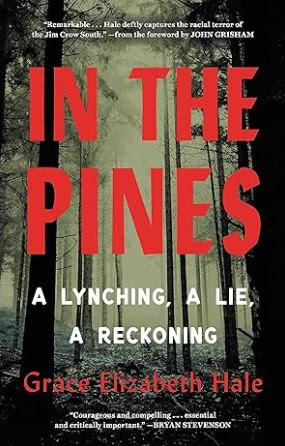
In the Pines: A Lynching, A Lie, A Reckoning - REVIEW


by Grace Elizabeth Hale

An award-winning scholar of white supremacy tackles her toughest research assignment yet: the unsolved murder of a Black man in rural Mississippi while her grandfather was the local sheriff—a cold case that sheds new light on the hidden legacy of racial terror in America.

Grace Hale was home from college when she first heard the family legend. In 1947, while her beloved grandfather had been serving as a sheriff in the Piney Woods of south-central Mississippi, he prevented a lynch mob from killing a Black man who was in his jail on suspicion of raping a white woman—only for the suspect to die the next day during an escape attempt. It was a tale straight out of To Kill a Mockingbird, with her grandfather as the tragic hero. This story, however, hid a dark truth.

Years later, as a rising scholar of white supremacy, Hale revisited the story about her grandfather and Versie Johnson, the man who died in his custody. The more she learned about what had happened that day, the less sense she could make of her family's version of events. With the support of a Carnegie fellowship, she immersed herself in the investigation. What she discovered would upend everything she thought she knew about her family, the tragedy, and this haunted strip of the South—because Johnson's death, she found, was actually a lynching. But guilt did not lie with a faceless mob.

A story of obsession, injustice, and the ties that bind, In the Pines casts an unsparing eye over this intimate terrain, driven by a deep desire to set straight the historical record and to understand and subvert white racism, along with its structures, costs, and consequences—and the lies that sustain it.

Little, Brown and Company
ISBN-13: 978-0316564748

Wednesday, August 30, 2023

Reckoning with Race: An Unfinished Journey - REVIEW


by Frederick Allen

In his fifty-year career as an award-winning journalist, CNN commentator, and author of multiple books, Rick Allen has had a front-row seat on dramatic change in race relations in America. In Reckoning with Race, a collection of eighteen essays, he explores his ongoing efforts to understand the struggle of black and white Americans to navigate a shared history at once wicked and intimate, full of love and hate, as they seek to level an uneven playing field. Allen examines issues from the era of Reconstruction through Jim Crow, the Civil Rights movement, the rhythms of resistance and progress, into today’s contentious debates over redlining, reparations, and critical race theory.

Starting as a reporter with the Atlanta Constitution in 1972, Allen got to know and befriend legendary black political figures including Julian Bond, John Lewis, Andy Young, Hosea Williams, Maynard Jackson, Jesse Jackson, and Daddy King, the father of Martin Luther King, Jr. He also encountered ardent white segregationists, some of whom saw the light and others who took their racism to the grave. Drawing on his experience covering politics, he examines presidents from LBJ and Jimmy Carter to Obama and Trump. He explores the symbolism of Confederate flags, the controversy over Uncle Remus, the election of Atlanta’s first black mayor, Maynard Jackson, and the tragic case of the Atlanta Child Murders. He has had first-hand encounters with white supremacy and violent black protest alike.

Throughout Reckoning with Race, Allen is candid about his own shortcomings as a white native Northerner learning gradually about the complexities of race in his adoptive South. The essays highlight his continuing journey toward understanding the forces that both hinder and promote equality and harmony between the races.

Frederick Allen is the author of three books. His history of the Coca-Cola Company, Secret Formula, was published by HarperCollins in 1994 and has been translated into seven languages. Atlanta Rising, a history of modern Atlanta, was published by Longstreet in 1996 and is taught at several colleges. A Decent, Orderly Lynching, Allen’s account of the vigilantes of Montana, was published in 2004 by University of Oklahoma Press. His research into vigilante symbolism was cited by the Western History Association.

Forefront Books
ISBN-13 978-1637631522


Sunday, August 27, 2023

The Darkened Light of Faith: Race, Democracy, and Freedom in African American Political Thought - REVIEW


by Melvin L. Rogers

Could the African American political tradition save American democracy? African Americans have had every reason to reject America’s democratic experiment. Yet African American activists, intellectuals, and artists who have sought to transform the United States into a racially just society have put forward some of the most original and powerful ideas about how to make America live up to its democratic ideals. In The Darkened Light of Faith, Melvin Rogers provides a bold new account of African American political thought through the works and lives of individuals who built this vital tradition-a tradition that is urgently needed today.

The book reexamines how figures as diverse as David Walker, Frederick Douglass, Anna Julia Cooper, Ida B. Wells, W.E.B. Du Bois, Billie Holiday, and James Baldwin thought about the politics, people, character, and culture of a society that so often dominated them. Sharing a light of faith darkened but not extinguished by the tragic legacy of slavery, they resisted the conclusion that America would always be committed to white supremacy. They believed that democracy is always in the process of becoming and that they could use it to reimagine society. But they also saw that achieving racial justice wouldn’t absolve us of the darkest features of our shared past, and that democracy must be measured by how skillfully we confront a history that will forever remain with us.

An ambitious account of the profound ways African Americans have reimagined democracy, The Darkened Light of Faith offers invaluable lessons about how to grapple with racial injustice and make democracy work.

Is democracy beyond repair in the United States? As Melvin L. Rogers writes in the opening pages of The Darkened Light of Faith: "Given how frequently the police kill African Americans, the ongoing structural inequality they experience, and housing and food insecurity suffered by so many. . . it may seem more appropriate to interpret the United States as working according to plan." The reality of institutional racism is undeniable, and it "often undercuts moments of hope."

In this urgent account of the African American political tradition of the 19th and 20th centuries, Rogers draws on the life and work of Black abolitionists (David Walker, Frederick Douglass, Maria Stewart) political activists (W.E.B. Du Bois, Ida B. Wells), and artists (Billie Holiday, James Baldwin) who put their faith in the elements of democracy that work: a capacity for improvement; an openness to the future. Even though the terrible legacy of slavery challenged their resolve, this cohort of Black intellectuals dared to imagine ways in which America could live up to its democratic ideals.

From the abolitionist David Walker's 1829 Appeal to the Colored Citizens of the World that called upon enslaved men and women to resist subjugation and claim their right to American citizenship to James Baldwin's insistence on a full reckoning with the lingering trauma of slavery, Rogers skillfully illustrates a strand of African American political thought: one that turns towards the horrors of the past instead of shrinking away from it.

Though the path to racial justice is long and winding, it is, in The Darkened Light of Faith, a cause well worth fighting for, even if all we can hope for is an uneasy peace with the past and ourselves.

Melvin L. Rogers is professor of political science and associate director of the Center for Philosophy, Politics, and Economics at Brown University. He is the author of The Undiscovered Dewey: Religion, Morality, and the Ethos of Democracy, coeditor of African American Political Thought: A Collected History, and editor of John Dewey’s The Public and Its Problems.

Princeton University Press
ISBN-13 978-0691219134


Sunday, February 12, 2023

The Absolutely Indispensable Man: Ralph Bunche, the United Nations, and the Fight to End Empire - REVIEW

by Kal Raustiala

A legendary diplomat, scholar, and civil rights leader, Ralph Bunche was one of the most prominent Black Americans of the twentieth century. The first African American to obtain a political science Ph.D. from Harvard and a celebrated diplomat at the United Nations, he was once so famous he handed out the Best Picture award at the Oscars. Yet today Ralph Bunche is largely forgotten.

In The Absolutely Indispensable Man, Kal Raustiala restores Bunche to his rightful place in history. He shows that Bunche was not only a singular figure in midcentury America; he was also one of the key architects of the postwar international order. Raustiala tells the story of Bunche's dramatic life, from his early years in prewar Los Angeles to UCLA, Harvard, the State Department, and the heights of global diplomacy at the United Nations. After narrowly avoiding assassination Bunche received the Nobel Peace Prize for his ground-breaking mediation of the first Arab-Israeli conflict, catapulting him to popular fame. A central player in some of the most dramatic crises of the Cold War, he pioneered conflict management and peacekeeping at the UN. But as Raustiala argues, his most enduring achievement was his work to dismantle European empire. Bunche perceptively saw colonialism as the central issue of the 20th century and decolonization as a project of global racial justice.

From marching with Martin Luther King to advising presidents and prime ministers, Ralph Bunche shaped our world in lasting ways. This definitive biography gives him his due. It also reminds us that postwar decolonization not only fundamentally transformed world politics, but also powerfully intersected with America's own civil rights struggle.

Oxford University Press
ISBN-13: 978-0197602232