Tuesday, September 17, 2024

American Dark Age: Racial Feudalism and the Rise of Black Liberalism - REVIEW


by Keidrick Roy

Though the United States has been heralded as a beacon of democracy, many nineteenth-century Americans viewed their nation through the prism of the Old World. What they saw was a racially stratified country that reflected not the ideals of a modern republic but rather the remnants of feudalism. American Dark Age reveals how defenders of racial hierarchy embraced America’s resemblance to medieval Europe and tells the stories of the abolitionists who exposed it as a glaring blemish on the national conscience.

Against those seeking to maintain what Frederick Douglass called an “aristocracy of the skin,” Keidrick Roy shows how a group of Black thinkers, including Frances Ellen Watkins Harper, Hosea Easton, and Harriet Jacobs, challenged the medievalism in their midst—and transformed the nation’s founding liberal tradition. He demonstrates how they drew on spiritual insight, Enlightenment thought, and a homegrown political philosophy that gave expression to their experiences at the bottom of the American social order. Roy sheds new light on how Black abolitionist writers and activists worked to eradicate the pernicious ideology of racial feudalism from American liberalism and renew the country’s commitment to values such as individual liberty, social progress, and egalitarianism.

American Dark Age reveals how the antebellum Black liberal tradition holds vital lessons for us today as hate groups continue to align themselves with fantasies of a medieval past and openly call for a return of all-powerful monarchs, aristocrats, and nobles who rule by virtue of their race.

Keidrick Roy is a Junior Fellow at the Harvard Society of Fellows. In 2025, he will be Assistant Professor of Government at Dartmouth College. He has received national attention through media outlets such as CBS News Sunday Morning and the Chicago Review of Books and appears in the HBO documentary Frederick Douglass: In Five Speeches. He has curated two major exhibitions at the American Writers Museum in Chicago on Black American figures, including Frederick Douglass, Ida B. Wells, and Ralph Ellison.

Princeton University Press
ISBN-13 978-0691252360

Wednesday, September 11, 2024

The Truths We Hold: An American Journey - REVIEW

by Kamala Harris 

The daughter of immigrants and civil rights activists, Vice President Kamala Harris was raised in an Oakland, California, community that cared deeply about social justice. As she rose to prominence as one of the political leaders of our time, her experiences would become her guiding light as she grappled with an array of complex issues and learned to bring a voice to the voiceless. 

In The Truths We Hold, she reckons with the big challenges we face together. Drawing on the hard-won wisdom and insight from her own career and the work of those who have most inspired her, she communicates a vision of shared struggle, shared purpose, and shared values as we confront the great work of our day.

Kamala D. Harris is the Vice President of the United States of America. She began her career in the Alameda County District Attorney's Office, then was elected district attorney of San Francisco. As California's attorney general, Harris prosecuted transnational gangs, big banks, Big Oil, and for-profit colleges, and fought against attacks on the Affordable Care Act. She also fought to reduce elementary school truancy, pioneered the nation's first open data initiative to expose racial disparities in the criminal justice system, and implemented implicit bias training for police officers. The second Black woman ever elected to the U.S. Senate and the first female, first Black, and first Indian-American Vice President, Harris has worked to reform our criminal justice system, raise the minimum wage, make higher education tuition-free for the majority of Americans, and protect the legal rights of refugees and immigrants.

Penguin Publishing Group
ISBN-13 978-0525560739

The Age of Reconstruction: How Lincoln’s New Birth of Freedom Remade the World - REVIEW


by Don H. Doyle

A sweeping history of how Union victory in the American Civil War inspired democratic reforms, revolutions, and emancipation movements in Europe and the Americas

The Age of Reconstruction looks beyond post–Civil War America to tell the story of how Union victory and Lincoln’s assassination set off a dramatic international reaction that drove European empires out of the Americas, hastened the end of slavery in Latin America, and ignited a host of democratic reforms in Europe.

In this international history of Reconstruction, Don Doyle chronicles the world events inspired by the Civil War. Between 1865 and 1870, France withdrew from Mexico, Russia sold Alaska to the United States, and Britain proclaimed the new state of Canada. British workers demanded more voting rights, Spain toppled Queen Isabella II and ended slavery in its Caribbean colonies, Cubans rose against Spanish rule, France overthrew Napoleon III, and the kingdom of Pope Pius IX fell before the Italian Risorgimento. Some European liberals, including Victor Hugo and Giuseppe Mazzini, even called for a “United States of Europe.” Yet for all its achievements and optimism, this “new birth of freedom” was short-lived. By the 1890s, Reconstruction had been undone in the United States and abroad and America had become an exclusionary democracy based on white supremacy—and a very different kind of model to the world.

At home and abroad, America’s Reconstruction was, as W.E.B. Du Bois wrote, “the greatest and most important step toward world democracy of all men of all races ever taken in the modern world.” The Age of Reconstruction is a bracing history of a remarkable period when democracy, having survived the great test of the Civil War, was ascendant around the Atlantic world.

Don H. Doyle, is McCausland Professor of History emeritus at the University of South Carolina. He grew up near Berkley, California, graduated from the University of California, Davis, and earned his PhD in history at Northwestern University. He was a Fulbright professor in Rome, Genoa, and Rio de Janeiro and taught at Leeds University in England. He is retired from teaching and lives in Folly Beach, South Carolina. 

"My fascination with the past began one summer in California when my mother brought home a shoebox full of letters from my great-great grandfather, a drummer boy from Vermont who served in the Civil War and wrote home to his parents. Without quite realizing it, I became a historian that summer." 

His new book, The Age of Reconstruction: How Lincoln's New Birth of Freedom Remade the World (Princeton, 2024) breaks out of the usual focus on American events to examine the Reconstruction era within a larger international context. This book is a sequel to his acclaimed The Cause of All Nations: An International History of the American Civil War (Basic, 2015), which offered a bold new interpretation of what America's Civil War meant to the wider world.

Princeton University Press
ISBN-13 978-0691256092

A Southern Underground Railroad: Black Georgians and the Promise of Spanish Florida and Indian Country - REVIEW

by Paul M. Pressly

Despite its apparent isolation as an older region of the country, the Southeast provided a vital connecting link between the Black self-emancipation that occurred during the American Revolution and the growth of the Underground Railroad in the final years of the antebellum period. From the beginning of the revolutionary war to the eve of the First Seminole War in 1817, hundreds and eventually several thousand Africans and African Americans in Georgia, and to a lesser extent South Carolina, crossed the borders and boundaries that separated the Lowcountry from the British and Spanish in coastal Florida and from the Seminole and Creek people in the vast interior of the Southeast. Even in times of peace, there remained a steady flow of individuals moving south and southwest, reflecting the aspirations of a captive people.

A Southern Underground Railroad constitutes a powerful counter-narrative in American history, a tale of how enslaved men and women found freedom and human dignity not in Jefferson’s “Empire of Liberty” but outside the expanding boundaries of the United States. It is a potent reminder of the strength of Black resistance in the post-revolutionary South and the ability of this community to influence the balance of power in a contested region. Paul M. Pressly’s research shows that their movement across borders was an integral part of the sustained struggle for dominance in the Southeast not only among the Great Powers but also among the many different racial, ethnic, and religious groups that inhabited the region and contended for control.

University of Georgia Press
ISBN-13 978-0820366852

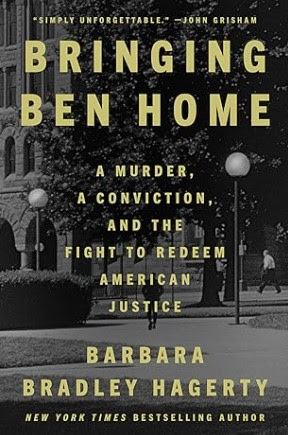
Bringing Ben Home: A Murder, a Conviction, and the Fight to Redeem American Justice - REVIEW


by Barbara Bradley Hagerty

How states are making their legal systems more equitable, seen through the story of a Black man falsely imprisoned for thirty years for murder.

In 1987, Ben Spencer, a twenty-two-year-old Black man from Dallas, was convicted of murdering white businessman Jeffrey Young—a crime he didn’t commit. From the day of his arrest, Spencer insisted that it was “an awful mistake.” The Texas legal system didn’t see it that way. It allowed shoddy police work, paid witnesses, and prosecutorial misconduct to convict Spencer of murder, and it ignored later efforts to correct this error. The state’s bureaucratic intransigence caused Spencer to spend more than half his life in prison.

Eventually independent investigators, new witness testimony, the foreman of the jury that convicted him, and a new Dallas DA convinced a Texas judge that Spencer had nothing to do with the killing, and in 2021 he was released from prison.

As Spencer’s fight to clear himself demonstrates, our legal systems are broken: expedience is more important than the truth. That is starting to change as states across the country implement new efforts to reduce wrongful convictions, and one of the states leading the way is Texas.

Award-winning journalist Barbara Bradley Hagerty has spent years digging into this issue, and she has immersed herself in Spencer’s case. She has combed police files and court records, interviewed dozens of witnesses, and had extensive conversations with Spencer, and in Bringing Ben Home she threads together two narratives: how an innocent Black man got caught up in and couldn’t escape a legal system that refused to admit its mistakes; and what Texas and other states are doing to address wrongful convictions to make the legal process more equitable for everyone.

By turns fascinating and enraging, personal and provocative, Bringing Ben Home is the powerful story of one innocent man who refused to admit that he was guilty of murder, and how his plight became part of a paradigm shift in how the legal system thinks about innocence as it institutes new methods to overturn wrongful convictions to better protect people like Ben Spencer.

Barbara Bradley Hagerty is an award-winning journalist at The Atlantic and formerly of National Public Radio. She is the author of the New York Times–bestselling Fingerprints of God and Life Reimagined, and her work has also appeared in The Washington Post, Los Angeles Times, Vogue, and The Christian Science Monitor. She has received the Templeton-Cambridge Journalism Fellowship in Science and Religion and a Knight Fellowship at Yale Law School. She lives with her husband in Washington, D.C.

Riverhead Books
ISBN-13 978-0593420089

Wednesday, July 17, 2024

The Mothers: A Novel - REVIEW


by Brit Bennett

From the New York-Times bestselling author of The Vanishing Half, the beloved novel about young love and a big secret in a small community. 

Set within a contemporary black community in Southern California, Brit Bennett's mesmerizing first novel is an emotionally perceptive story about community, love, and ambition. It begins with a secret.

"All good secrets have a taste before you tell them, and if we'd taken a moment to swish this one around our mouths, we might have noticed the sourness of an unripe secret, plucked too soon, stolen and passed around before its season."

It is the last season of high school life for Nadia Turner, a rebellious, grief-stricken, seventeen-year-old beauty. Mourning her own mother's recent suicide, she takes up with the local pastor's son. Luke Sheppard is twenty-one, a former football star whose injury has reduced him to waiting tables at a diner. They are young; it's not serious. But the pregnancy that results from this teen romance—and the subsequent cover-up—will have an impact that goes far beyond their youth. As Nadia hides her secret from everyone, including Aubrey, her God-fearing best friend, the years move quickly. Soon, Nadia, Luke, and Aubrey are full-fledged adults and still living in debt to the choices they made that one seaside summer, caught in a love triangle they must carefully maneuver, and dogged by the constant, nagging question: What if they had chosen differently? The possibilities of the road not taken are a relentless haunt.

In entrancing, lyrical prose, The Mothers asks whether a "what if" can be more powerful than an experience itself. If, as time passes, we must always live in servitude to the decisions of our younger selves, to the communities that have parented us, and to the decisions we make that shape our lives forever.

Riverhead Books
ISBN-13 978-0399184529

Thursday, July 11, 2024

The United States Governed by Six Hundred Thousand Despots: A True Story of Slavery; A Rediscovered Narrative, with a Full Biography - REVIEW


by John Swanson Jacobs, edited by Jonathan D. S. Schroeder

Lost on the other side of the world since 1855, the story of John Swanson Jacobs finally returns to America.

For one hundred and sixty-nine years, a first-person slave narrative written by John Swanson Jacobs—brother of Harriet Jacobs—was buried in a pile of newspapers in Australia. Jacobs’s long-lost narrative, The United States Governed by Six Hundred Thousand Despots, is a startling and revolutionary discovery. A document like this—written by an ex-slave and ex-American, in language charged with all that can be said about America outside America, untampered with and unedited by white abolitionists—has never been seen before. A radical abolitionist, sailor, and miner, John Jacobs has a life story that is as global as it is American. Born into slavery, by 1855, he had fled both the South and the United States altogether, becoming a stateless citizen of the world and its waters. That year, he published his life story in an Australian newspaper, far from American power and its threats. Unsentimental and unapologetic, Jacobs radically denounced slavery and the state, calling out politicians and slaveowners by their names, critiquing America’s founding documents, and indicting all citizens who maintained the racist and intolerable status quo.

Reproduced in full, this narrative—which entwines with that of his sister and with the life of their friend Frederick Douglass—here opens new horizons for how we understand slavery, race, and migration, and all that they entailed in nineteenth-century America and the world at large. The second half of the book contains a full-length, nine-generation biography of Jacobs and his family by literary historian Jonathan Schroeder. This new guide to the world of John Jacobs will transform our sense of it—and of the forces and prejudices built into the American project. To truly reckon with the lives of John Jacobs is to see with new clarity that in 1776, America embarked on two experiments at once: one in democracy, the other in tyranny.

"The rediscovery of a long-forgotten slave narrative would be notable enough. But this one, scholars who have seen it say, is unique for its global perspective and its uncensored fury, from a man living far outside the trans-Atlantic network of white abolitionists who often limited what the formerly enslaved could write about their experiences." -- Jennifer Schuessler - New York Times

About the author, John Swanson Jacobs was an abolitionist, miner, sailor, and citizen of the world.

Jonathan D. S. Schroeder is a literary historian and lecturer at the Rhode Island School of Design.

University of Chicago Press
ISBN-13 978-0226684307

Tuesday, July 09, 2024

Fifteen Cents on the Dollar: How Americans Made the Black-White Wealth Gap - REVIEW


by Louise Story and Ebony Reed

A sweeping, narrative history of Black wealth and the economic discrimination embedded in America’s financial system. 

The early 2020s will long be known as a period of racial reflection. In the wake of the police killing of George Floyd, Americans of all backgrounds joined together in historic demonstrations in the streets, discussions in the workplace, and conversations at home about the financial gaps that remain between white and Black Americans. This deeply investigated book shows the scores of setbacks that have held the Black-white wealth gap in place—from enslavement to redlining to banking discrimination—and, ultimately, the reversals that occurred in the mid-2020s as the push for racial equity became a polarized political debate.

Fifteen Cents on the Dollar follows the lives of four Black Millennial professionals and a banking company founded with the stated mission of closing the Black-white wealth gap. That company, known as Greenwood, a reference to the historic Black Wall Street district in Tulsa, Oklahoma, generated immense excitement and hope among people looking for new ways of business that might lead to greater equity. But the twists and turns of Greenwood’s journey also raise tough questions about what equality really means.

Seasoned journalist-academics Louise Story and Ebony Reed present a nuanced portrait of Greenwood’s founders—the entertainment executive Ryan Glover; the Grammy-winning rapper Michael Render, better known as Killer Mike; and the Civil Rights leader and two-term Atlanta mayor, Andrew Young—along with new revelations about their lives, careers, and families going back to the Civil War. Equally engaging are the stories of the lesser-known individuals—a female tech employee from rural North Carolina trying to make it in a big city; a rising leader at the NAACP whose father is in prison; an owner of a BBQ stand in Atlanta fighting to keep his home; and a Black man in a biracial marriage grappling with his roots when his father is shot by the police.

In chronicling these staggering injustices, Fifteen Cents on the Dollar shows why so little progress has been made on the wealth gap and provides insights Americans should consider if they want lasting change.

Louise Story is a prize-winning investigative journalist who spent more than 15 years at the New York Times and the Wall Street Journal, where she was the top masthead editor running coverage strategy. Her work investigating corruption led to the largest kleptocracy case in U.S. history, a case known as the 1MDB case. Her work investigating Wall Street and the derivatives market led to a multi-billion dollar settlement. And her work investigating Goldman Sachs during the 2008 financial crisis led to that bank’s S.E.C. settlement. Projects she led received industry honors including Emmy Awards, and Pulitzer Prize finalist citations, and Online News Association awards. Louise’s film The Kleptocrats aired on the BBC, Apple and Amazon. She teaches at The Yale School of Management.

Ebony Reed began her career as a reporter at The Plain Dealer, covering Cleveland public schools, documenting public education’s inequities. The Investigative Reporters & Editors organization recognized her examination of how social promotion impacted the district’s majority Black and brown students. At the Detroit News, she managed the local coverage during the 2008 economic crisis. Now the Chief Strategy Officer at The Marshall Project, she has held other senior roles at the Associated Press, Boston Business Journal, and the Wall Street Journal. She’s taught at more than a half dozen institutions, including The Yale School of Management.

Harper
ISBN-13 978-0063234727

Fifteen cents on the dollar. Fifteen cents - the data virtually stuck where it was generations ago - is the amount of wealth that typical Black families have compared to one dollar of the typical white family's wealth. This Black-white wealth ratio remains almost as stark as it was in the years after the Civil War, when it stood at 1.8 cents on the dollar. The gap initially narrowed quickly in the late 1800s, but then its progress was slowed. Further improvements in the later 1900s were reversed in the 2000s. Hundreds of years into our national history, and despite the recent racial reckoning, Black Americans continue to encounter structural barriers that were long ago designed to restrict their economic success. Most Black Americans are still born into comparative economic disadvantage and face near-impossible odds to achieve equality. But why has this number been stuck in place so long, and how can Americans better understand the role racial wealth gaps play in the world around them?

Now, in FIFTEEN CENTS ON THE DOLLAR: How Americans Made the Black-White Wealth Gap, seasoned journalist-academics Louise Story and Ebony Reed offer a comprehensive, deeply human narrative history of Black wealth and the economic discrimination embedded in America's financial system through public and private policies that created today's Black-white wealth gap. Following the lives of seven Black Americans-some famous and some not well-known- of different economic levels, ages, and professions during the three years following the police killing of George Floyd, the authors bring data, research, and history to life. The trail of these families connects events after the Civil War and throughout the twentieth century to the lives of individual s today. FIFTEEN CENTS ON THE DOLLAR explains the scores of setbacks that have held the Black-white wealth gap in place - from enslavement, redlining , and banking discrimination to, ultimately, failures that occurred in the mid-2020s as the push for racial equity became a polarized political debate. 

"America, and Americans, made the Black-white wealth gap," write Story and Reed. "And our society continues to hold it in place." Signs of incremental progress have been hollow victories against generations-old systemic injustice. FIFTEEN CENTS ON THE DOLLAR provides crucial insight into American economic equity, Black business ownership, and political and busine ss practices that leave Black Americans behind. In chronicling these staggering injustices, the authors also reveal some pathways to lasting change.

SUGGESTIONS FOR CHANGE

The authors also can offer suggestions that they believe will help close the Black-white wealth gap. These suggestions are predicated on accepting two things: (1) That it's important to lift more Black families on the ladder of wealth and (2) That we do not want wealth gaps that are racialized or specific to demographics.

First, support more transparency into the wealth distribution in our country. The Department of Labor regularly reports on employment levels and the Department of Commerce reports on GDP. To help close the wealth gap, the United States would also benefit from a regular "wealth report" examining where the wealth is accruing and where it is not.

Second, ask who benefits from new government or company policies. Push policymakers to ensure that benefits are reaching the people who they are intended to reach and that benefits are inclusive of the neediest people. To create inclusive policies, it is important to have people of different backgrounds in all levels of leadership in the government and in education, companies, and nonprofits. And because of historic injustices, Black Americans and other minorities need extra follow-up reviews to see whether they are receiving benefits as intended. Think about how Black Americans did not receive full access to New Deal and GI benefits.

Third, pay attention to conversations around risk and pricing. In business and in government, practices were developed more than one hundred years ago that supported charging higher prices to "riskier" people, which makes economic sense, particularly for businesses. But as a society we need to ask are we trying to hold less advantaged people back or help them move forward? Are there instances where we can find room for the government or a third party to help defray the cost of that risk.

Fourth, when someone says they want to close a wealth gap, ask "For which people?" Depending on which measures you look at, you could close some gaps without helping lots of people. With the Black-white wealth gap, for instance, if you measure all dollars in the hands of white Americans versus all dollars in the hands of Black Americans, concentrating more money in the hands of the wealthiest Black Americans appears to be a valid way to close the gap. But would that be right? Ask about the who as well as the how. Ask yourself whose opportunity you' re fighting for.

Fifth, be open to change. If you want a more equitable, it may mean that more affordable housing is built near your home; it may change the way your company decides who gets promoted; it may mean that the way your children's school handles grading is reevaluated. Have discussions with the goal of finding a path forward that opens doors for more people. Listen out for money-over-morals arguments, where people say they are in favor of something that is more inclusive but then back away for fear it will cost them money.

Sixth, partner with someone different from you. The authors are themselves an example of partnering across racial lines. They believe that if more people took on large projects partnered with someone with very different backgrounds from their own, that could spread greater societal understanding and empathy for others.

Tuesday, July 02, 2024

Scattered and Fugitive Things: How Black Collectors Created Archives and Remade History - REVIEW

by Laura Helton

During the first half of the twentieth century, a group of collectors and creators dedicated themselves to documenting the history of African American life. At a time when dominant institutions cast doubt on the value or even the idea of Black history, these bibliophiles, scrapbookers, and librarians created an enduring set of African diasporic archives. In building these institutions and amassing abundant archival material, they also reshaped Black public culture, animating inquiry into the nature and meaning of Black history.

Scattered and Fugitive Things tells the stories of these Black collectors, traveling from the parlors of the urban north to HBCU reading rooms and branch libraries in the Jim Crow south. Laura E. Helton chronicles the work of six key figures: bibliophile Arturo Schomburg, scrapbook maker Alexander Gumby, librarians Virginia Lee and Vivian Harsh, curator Dorothy Porter, and historian L. D. Reddick. Drawing on overlooked sources such as book lists and card catalogs, she reveals the risks collectors took to create Black archives. This book also explores the social life of collecting, highlighting the communities that used these collections from the South Side of Chicago to Roanoke, Virginia. In each case, Helton argues, archiving was alive in the present, a site of intellectual experiment, creative abundance, and political possibility. Offering new ways to understand Black intellectual and literary history, Scattered and Fugitive Things reveals Black collecting as a radical critical tradition that reimagines past, present, and future.

Laura E. Helton is an assistant professor of English and history at the University of Delaware. She is a coeditor of the digital humanities project “Remaking the World of Arturo Schomburg.”

Columbia University Press
ISBN-13 978-0231212748

Saturday, June 22, 2024

Glad to the Brink of Fear: A Portrait of Ralph Waldo Emerson - REVIEW

by James Marcus

More than two centuries after his birth, Ralph Waldo Emerson remains one of the presiding spirits in American culture. Yet his reputation as the starry-eyed prophet of self-reliance has obscured a much more complicated figure who spent a lifetime wrestling with injustice, philosophy, art, desire, and suffering. James Marcus introduces readers to this Emerson, a writer of self-interrogating genius whose visionary flights are always grounded in Yankee shrewdness.

This Emerson is a rebel. He is also a lover, a friend, a husband, and a father. Having declared his great topic to be “the infinitude of the private man,” he is nonetheless an intensely social being who develops Transcendentalism in the company of Henry David Thoreau, Margaret Fuller, Bronson Alcott, and Theodore Parker. And although he resists political activism early on—hoping instead for a revolution in consciousness—the burning issue of slavery ultimately transforms him from cloistered metaphysician to fiery abolitionist.

Drawing on telling episodes from Emerson’s life alongside landmark essays like “Self-Reliance,” “Experience,” and “Circles,” Glad to the Brink of Fear reveals how Emerson shares our preoccupations with fate and freedom, race and inequality, love and grief. It shows, too, how his desire to see the world afresh, rather than accepting the consensus view, is a lesson that never grows old.

James Marcus was born in the literary hotbed of Paterson, NJ, and grew up in the New York area. He is the author of "Amazonia: Five Years at the Epicenter of the Dot-Com Juggernaut" and a half-dozen translations from the Italian, the most recent being Giacomo Casanova's "The Duel." His work has appeared many publications, including the Atlantic, the Los Angeles Times Book Review, Salon, the Nation, Raritan, the Paris Review, and the Village Voice, and his essay "Faint Music" was selected for "Best American Essays 2009."

He is Deputy Editor at Harper's Magazine, after a three-year tenure at the Columbia Journalism Review. He blogs about books, music, and miscellaneous stuff at House of Mirth. A collection of essays from CJR called "Second Read," which he edited and introduced, will be published by Columbia University Press in November.

Princeton University Press
ISBN-13 978-0691254333

Monday, June 10, 2024

The Jazzmen: How Duke Ellington, Louis Armstrong, and Count Basie Transformed America - REVIEW


by Larry Tye

From the New York Times bestselling author of Satchel and Bobby Kennedy, a sweeping and spellbinding portrait of the longtime kings of jazz—Duke Ellington, Louis Armstrong, and Count Basie—who, born within a few years of one another, overcame racist exclusion and violence to become the most popular entertainers on the planet.

This is the story of three revolutionary American musicians, the maestro jazzmen who orchestrated the chords that throb at the soul of twentieth-century America.

Duke Ellington, the grandson of slaves who was christened Edward Kennedy Ellington, was a man whose story is as layered and nuanced as his name suggests and whose music transcended category.

Louis Daniel Armstrong was born in a New Orleans slum so tough it was called The Battlefield and, at age seven, got his first musical instrument, a ten-cent tin horn that drew buyers to his rag-peddling wagon and set him on the road to elevating jazz into a pulsating force for spontaneity and freedom.

William James Basie, too, grew up in a world unfamiliar to white fans—the son of a coachman and laundress who dreamed of escaping every time the traveling carnival swept into town, and who finally engineered his getaway with help from Fats Waller.

What is far less known about these groundbreakers is that they were bound not just by their music or even the discrimination that they, like nearly all Black performers of their day, routinely encountered. Each defied and ultimately overcame racial boundaries by opening America’s eyes and souls to the magnificence of their music. In the process they wrote the soundtrack for the civil rights movement.

Based on more than 250 interviews, this exhaustively researched book brings alive the history of Black America in the early-to-mid 1900s through the singular lens of the country’s most gifted, engaging, and enduring African-American musicians.

Larry Tye is the New York Times bestselling author of Bobby Kennedy and Satchel, as well as Demagogue, Superman, The Father of Spin, Home Lands, and Rising from the Rails, and coauthor, with Kitty Dukakis, of Shock. Previously an award-winning reporter at the Boston Globe and a Nieman fellow at Harvard University, he now runs the Boston-based Health Coverage Fellowship. He lives on Cape Cod.

Mariner Books
ISBN-13 978-0358380436

Friday, May 17, 2024

Proverb Masters: Shaping the Civil Rights Movement - REVIEW


by Raymond Summerville

In Proverb Masters: Shaping the Civil Rights Movement, author Raymond Summerville explores how proverbs and proverbial language played a significant role in the long civil rights era. Proverbs have been used throughout history to share and disseminate brief, powerful statements of truth and philosophical insight. Oftentimes, these sayings have helped unite people in struggles for social justice, serving as rallying cries for just causes. During the civil rights era, proverbs allowed leaders to craft powerful and evocative messages. These statements needed to be made implicitly, as explicit messages were often met with retaliation and even violence.

Looking at the autobiographies, biographies, speeches, diaries, letters, and critical texts of Charles W. Chesnutt, Ida B. Wells, A. Philip Randolph, Bob Dylan, Malcom X, Stokely Carmichael, and Septima Clark, the volume analyzes how these figures employed proverbs in support of social justice causes and in civil rights struggles. Summerville argues that these individuals generated enough print material embedded with proverbs and proverbial language that they should be considered proverb masters. With chapters dedicated to each figure, Summerville reveals their adept uses of this powerful linguistic tool.

Raymond Summerville is professor of English at Fayetteville State University. He has published in Proverbium, the Journal of Folklore and Education, and other publications.

University Press of Mississippi
ISBN-13 978-1496852557

Friday, May 10, 2024

Without Sanctuary: Lynching Photography in America - REVIEW

by James Allen

“Many people today, despite the evidence, will not believe-don't want to believe-that such atrocities happened in America not so very long ago. These photographs bear witness to . . . an American holocaust." –John Lewis, US Congressman

The Tuskegee Institute records the lynching of 3,436 Black Americans between 1882 and 1950. Many times, a photographer was present to capture these events. Without Sanctuary preserves these harrowing, death-marked depictions, saving them so that we may recognize the terrorism unleashed on America’s African American community. Editor James Allen, an American antique collector, includes nearly 100 images of lynchings in America from his own collection, including battleground cases such as the 1911 murders of Laura and Lawrence Nelson in Okemah, Oklahoma the lynching of Rubin Stacy in Fort Lauderdale, Florida in 1935, and the infamous 1915 execution of Jewish factory manager Leo Frank in Marietta, Georgia. These images are accompanied by Allen’s own notes, as well as texts from the late US congressman and civil rights leader John Lewis, the late slavery and Reconstruction historian Leon Litwack, and writer and theater critic Hilton Als, professor at University of California in Berkeley and Columbia University. Now in its 17th printing, Without Sanctuary remains a singular testament to the camera’s ability to make us remember what we often choose to forget.

James Allen (born 1954) is an American collector best known for his vast collection of photographs of lynchings in America. Some of his collected items are now located in the Smithsonian and the High Museum of Art.

Leon Litwack (1929–2021) was a professor of American History at the University of California in Berkeley from 1964 to 2007. He specialized in the Reconstruction Era and the aftermath of slavery in the late 19th and early 20th centuries. His 1979 book Been in the Storm So Long won the Pulitzer Prize for History, the Francis Parkman Prize and the National Book Award.

Hilton Als (born 1960) is a writer and theater critic. He holds professorial positions at the University of California in Berkeley and Columbia University, and serves as a staff writer and theater critic for the New Yorker. In 2017 he won the Pulitzer Prize for criticism. Als has also curated several group art exhibitions including Forces in Nature at Victoria Miro Gallery and Alice Neel: Uptown at David Zwirner Gallery.

John Lewis (1940–2020) became involved in the Civil Rights movement when he was still a teenager. He was introduced to both Rosa Parks and Martin Luther King Jr., and participated in the 1960 Nashville sit-ins as well as the 1961 Freedom Rides. As chairman of the Student Nonviolent Coordinating Committee (SNCC) from 1963 to 1966, he was one of the “Big Six” civil rights leaders who coordinated the March on Washington. He represented Georgia’s 5th District in the U.S. House of Representatives from 1987 until his death in 2020.

Twin Palms Publishers
Fifteenth Edition, 2021 (November 1, 1999)
2021 edition includes foreword by John Lewis
ISBN-13 978-0944092699

Thursday, May 02, 2024

An Unholy Traffic: Slave Trading in the Civil War South - REVIEW


by Robert K.D. Colby

The Confederate States of America was born in defense of slavery and, after a four-year struggle to become an independent slaveholding republic, died as emancipation dawned. Between Fort Sumter to Appomattox, Confederates bought and sold thousands African American men, women, and children. These transactions in humanity made the internal slave trade a cornerstone of Confederate society, a bulwark of the Rebel economy, and a central part of the experience of the Civil War for all inhabiting the American South.

As An Unholy Traffic shows, slave trading helped Southerners survive and fight the Civil War, as well as to build the future for which they fought. They mitigated the crises the war spawned by buying and selling enslaved people, using this commerce to navigate food shortages, unsettled gender roles, the demands of military service, and other hardships on the homefront. Some Rebels speculated wildly in human property, investing in slaves to ward off inflation and to buy shares in the slaveholding nation they hoped to create. Others traded people to counter the advance of emancipation. Given its centrality to their nationhood, Confederates went to great lengths to prolong the slave trade, which, in turn, supported the Confederacy. For those held in slavery, the surviving slave trade dramatically shaped their pursuit of freedom, inserting a retrograde movement into some people's journeys toward liberty while inspiring others to make the risky decision to escape.

Offering an original perspective on the intersections of slavery, capitalism, the Civil War, and emancipation, Robert K.D. Colby illuminates the place of the peculiar institution within the Confederate mind, the ways in which it underpinned the CSA's war effort, and its impact on those attempting to seize their freedom.

Robert K.D. Colby is an Assistant Professor of History at the University of Mississippi. His research on the domestic slave trade has won multiple awards, including the Allan Nevins Prize of the Society of American Historians.

Oxford University Press
ISBN-13 978-0197578261

Influence, New and Expanded: The Psychology of Persuasion Hardcover – REVIEW

by Robert B Cialdini

In the new edition of this highly acclaimed bestseller, Robert Cialdini—New York Times bestselling author of Pre-Suasion and the seminal expert in the fields of influence and persuasion—explains the psychology of why people say yes and how to apply these insights ethically in business and everyday settings. Using memorable stories and relatable examples, Cialdini makes this crucially important subject surprisingly easy. With Cialdini as a guide, you don’t have to be a scientist to learn how to use this science.

You’ll learn Cialdini’s Universal Principles of Influence, including new research and new uses so you can become an even more skilled persuader—and just as importantly, you’ll learn how to defend yourself against unethical influence attempts. You may think you know these principles, but without understanding their intricacies, you may be ceding their power to someone else.

Cialdini’s Principles of Persuasion:

  • Reciprocation
  • Commitment and Consistency
  • Social Proof 
  • Liking 
  • Authority
  • Scarcity
  • Unity, the newest principle for this edition

Understanding and applying the principles ethically is cost-free and deceptively easy. Backed by Dr. Cialdini’s 35 years of evidence-based, peer-reviewed scientific research—including a three-year field study on what leads people to change—Influence is a comprehensive guide to using these principles to move others in your direction.

Harper Business
ISBN-13 978-0062937650

Saturday, April 27, 2024

James: A Novel - REVIEW


by Percival Everett 

A brilliant, action-packed reimagining of Adventures of Huckleberry Finn, both harrowing and darkly humorous, told from the enslaved Jim's point of view. From the “literary icon” (Oprah Daily) and Pulitzer Prize Finalist whose novel Erasure is the basis for Cord Jefferson’s critically acclaimed film American Fiction.

When the enslaved Jim overhears that he is about to be sold to a man in New Orleans, separated from his wife and daughter forever, he decides to hide on nearby Jackson Island until he can formulate a plan. Meanwhile, Huck Finn has faked his own death to escape his violent father, recently returned to town. As all readers of American literature know, thus begins the dangerous and transcendent journey by raft down the Mississippi River toward the elusive and too-often-unreliable promise of the Free States and beyond.

While many narrative set pieces of Adventures of Huckleberry Finn remain in place (floods and storms, stumbling across both unexpected death and unexpected treasure in the myriad stopping points along the river’s banks, encountering the scam artists posing as the Duke and Dauphin…), Jim’s agency, intelligence and compassion are shown in a radically new light.

Brimming with the electrifying humor and lacerating observations that have made Everett a “literary icon” (Oprah Daily), and one of the most decorated writers of our lifetime, James is destined to be a major publishing event and a cornerstone of twenty-first century American literature.

Percival Everett is a Distinguished Professor of English at USC. His most recent books include Dr. No (finalist for the NBCC Award for Fiction and winner of the PEN/ Jean Stein Book Award), The Trees (finalist for the Booker Prize and the PEN/Faulkner Award for Fiction), Telephone (finalist for the Pulitzer Prize), So Much Blue, Erasure, and I Am Not Sidney Poitier. He has received the NBCC Ivan Sandrof Life Achievement Award and The Windham Campbell Prize from Yale University. American Fiction, the feature film based on his novel Erasure, was released in 2023 and was awarded the Academy Award for Best Adapted Screenplay. He lives in Los Angeles with his wife, the writer Danzy Senna, and their children

Doubleday
ISBN-13 978-0385550369

Friday, April 26, 2024

The Grift: The Downward Spiral of Black Republicans from the Party of Lincoln to the Cult of Trump - REVIEW

by Clay Cane

Part history and part cultural analysis, The Grift chronicles the nuanced history of Black Republicans. Clay Cane lays out how Black Republicanism has been mangled by opportunists who are apologists for racism.

After the Civil War, the pillars of Black Republicanism were a balanced critique of both political parties, civil rights for all Americans, reinventing an economy based on exploitation, and, most importantly, building thriving Black communities. How did Black Republicanism devolve from revolutionaries like Frederick Douglass to the puppets in the Trump era?

Whether it's radical conservatives like South Carolina Senator Tim Scott or Supreme Court Justice Clarence Thomas, they are consistently viral news and continuously upholding egregious laws at the expense of their Black brethren. Black faces in high places providing cover for explicit bigotry is one of the greatest threats to the liberation of Black and brown people. By studying these figures and their tactics, Cane exposes the grift and lays out a plan to emancipate our future.

Clay Cane is an award-winning journalist, writer, radio host, and political commentator. A graduate of Rutgers University with a degree in African-American Studies, his work on race, culture, and politics have appeared in national publications, including the Washington Post, CNN, and The Grio. He is the director of the original BET documentary Holler If You Hear Me: Black and Gay in the Church, which was screened at the Obama White House. In 2017, The Clay Cane Show launched on SiriusXM Urban View channel 126. Clay is a regular political commentator on MSNBC. The Grift is his second book, his first being Live Through This: Surviving the Intersections of Sexuality, God, and Race. ClayCane.net, @claycane

Sourcebooks
ISBN-13 978-1728290225

Thursday, April 18, 2024

Abolition Geography: Essays Towards Liberation - REVIEW


by Ruth Wilson Gilmore

The first collection of writings from one of the foremost contemporary critical thinkers on racism, geography and incarceration

Gathering together Ruth Wilson Gilmore’s work from over three decades, Abolition Geography presents her singular contribution to the politics of abolition as theorist, researcher, and organizer, offering scholars and activists ways of seeing and doing to help navigate our turbulent present.

Abolition Geography moves us away from explanations of mass incarceration and racist violence focused on uninterrupted histories of prejudice or the dull compulsion of neoliberal economics. Instead, Gilmore offers a geographical grasp of how contemporary racial capitalism operates through an “anti-state state” that answers crises with the organized abandonment of people and environments deemed surplus to requirement. Gilmore escapes one-dimensional conceptions of what liberation demands, who demands liberation, or what indeed is to be abolished. Drawing on the lessons of grassroots organizing and internationalist imaginaries, Abolition Geography undoes the identification of abolition with mere decarceration, and reminds us that freedom is not a mere principle but a place.

Edited with an introduction by Brenna Bhandar and Alberto Toscano.

Ruth Wilson Gilmore is Professor of Earth & Environmental Sciences, and American Studies at the Graduate Center of the City University of New York, where she is also Director of the Center for Place, Culture, and Politics. She is the author of Golden Gulag: Prisons, Surplus, Crisis, and Opposition in Globalizing California. Honors include the American Studies Association Angela Y. Davis Award for Public Scholarship (2012); the Association of American Geographers' Harold Rose Award for Anti-Racist Research and Practice (2014); the SUNY-Purchase College Eugene V. Grant Distinguished Scholar Prize for Social and Environmental Justice (2015-16); and the American Studies Association Richard A Yarborough Mentorship Award (2017).

Verso
ISBN-13 978-1839761706

Friday, April 12, 2024

The State of Black Progress: Confronting Government and Judicial Obstacles - REVIEW


Edited by Star Parker

Black Americans have arguably arrived at the height of their cultural prominence. In politics, entertainment, academia, and nearly every sphere of influence, “black issues” dominate the national discussion. Yet many black Americans are suffering more than ever from the blight of poverty, physical and mental health struggles, lack of opportunity, and failing schools.

This edited volume, sponsored by the Center for Urban Renewal and Education and featuring contributions from W.B. Allen, Judge Janice Rogers Brown (ret.), Ian Rowe, Sally Pipes, Stephen Moore, and others, addresses this question in light of American values and the history of constitutional jurisprudence. In the 1860s, black America was promised emancipation but continued to experience subjugation. In the 1960s, black America was promised equality but was frequently exploited. Racial discrimination played a role, but in the intervening decades misguided progressive policies and the normalization of victimhood rhetoric has proven even more disastrous. By failing to live up to American ideals, our nation denied many black Americans their chance at the American Dream.

The scholars and luminaries who contributed to this volume believe that what has been lost can be recovered. If our nation recognizes the history of our current predicament, embraces the founding principles that made America an economic powerhouse, and commits to an agenda of empowering fiscal, educational, and faith and family-affirming policies, then black Americans can overcome the obstacles that most hamper progress in their communities.

Star Parker is President of the Center for Urban Renewal and Education (CURE), which she founded in 1995. She serves on the US Commission on Civil Rights California Advisory Committee and previously served on the US Frederick Douglass Bicentennial Commission. In 2017, Parker joined the White House Opportunity Initiative advisory team and has served on the board of directors of the National Religious Broadcasters and the Leadership Institute.

Parker is a nationally syndicated columnist and the author of several books, including Uncle Sam's Plantation: How Big Government Enslaves America's Poor and What We Can Do About It; White Ghetto: How Middle-Class America Reflects Inner City Decay; and Pimps, Whores and Welfare Brats: From Welfare Cheat to Conservative Messenger.

Encounter Books
ISBN-13 978-1641773416

The Cambridge Companion to Contemporary African American Literature - REVIEW


Edited by Yogita Goyal

African American literature has changed in startling ways since the end of the Black Arts Era. The last five decades have generated new paradigms of racial formation and novel patterns of cultural production, circulation, and reception. This volume takes up the challenge of mapping the varied and changing field of contemporary African American writing. Balancing the demands of historical and political context with attention to aesthetic innovation, it considers the history, practice, and future directions of the field. Examining various historical forces shaping the creation of innovative genres, the turn to the afterlife of slavery, the pull toward protest, and the impact of new and expanded geographies and methods, this Companion provides an invaluable point of reference for readers seeking rigorous and cutting-edge analyses of contemporary African American literature.

Yogita Goyal is Professor of African American Studies and English at UCLA and author of Romance, Diaspora, and Black Atlantic Literature (2010) and Runaway Genres: The Global Afterlives of Slavery (2019; winner of ACLA's René Wellek Prize). She edited The Cambridge Companion to Transnational American Literature (2017) and has published widely on African diaspora, postcolonial, and US literature.

Cambridge University Press
ISBN-13 978-1009159715

Circulating Jim Crow: The Saturday Evening Post and the War Against Black Modernity - REVIEW


by Adam McKible

In the early twentieth century, the Saturday Evening Post was perhaps the most popular and influential magazine in the United States, establishing literary reputations and shaping American culture. In the popular imagination, it is best remembered for Norman Rockwell’s covers, which nostalgically depicted a wholesome and idyllic American way of life. But beneath those covers lurked a more troubling reality. Under the direction of its longtime editor, George Horace Lorimer, the magazine helped justify racism and white supremacy. It published works by white authors that made heavy use of paternalistic tropes and demeaning humor, portraying Jim Crow segregation and violence as simple common sense.

Circulating Jim Crow demonstrates how the Post used stereotypical dialect fiction to promulgate white supremacist ideology and dismiss Black achievements, citizenship, and humanity. Adam McKible tells the story of Lorimer’s rise to prominence and examines the white authors who provided the editor and his readers with the caricatures they craved. He also explores how Black writers of the Harlem Renaissance pushed back against the Post and its commodified racism. McKible places the erstwhile household names who wrote for the magazine in conversation with figures such as Paul Laurence Dunbar, F. Scott Fitzgerald, Ann Petry, W. E. B. Du Bois, and William Faulkner. Revealing the role of the Saturday Evening Post in normalizing racism for millions of readers, this book also offers a new understanding of how Black writers challenged Jim Crow ideology.

Columbia University Press
ISBN-13 978-0231212649

The Little Liar: A Novel - REVIEW


by Mitch Albom 

Eleven-year-old Nico Krispis has never told a lie. His schoolmate, Fannie, loves him because of it. Nico’s older brother Sebastian resents him for both these facts. When their young lives are torn apart during the war, it will take them decades to find each other again.

Nico’s innocence and goodness is used against his tightly knit community when a German officer barters Nico’s reputation for honesty into a promise to save his loved ones. When Nico realizes the consequences of the betrayal, he can never tell the truth again. He will spend the rest of this life changing names, changing locations and identities, desperate to find a way to forgiveness—for himself and from the people he loves most.

Albom’s extraordinary storytelling is at its powerful best in his first novel to confront the destruction that lying can wreak both on the world stage as well as on the individual lives that get caught up in it. As The Stranger in the Lifeboat spoke to belief, The Little Liar speaks to hope, in a breathless work that will break your heart open and fill it with the power of the human spirit and the goodness that lies within us all.

Mitch Albom is the author of numerous books of fiction and nonfiction, which have collectively sold more than forty million copies in forty-seven languages worldwide. He has written seven number-one New York Times bestsellers – including Tuesdays with Morrie, the bestselling memoir of all time, which topped the list for four straight years – award-winning TV films, stage plays, screenplays, a nationally syndicated newspaper column, and a musical. Through his work at the Detroit Free Press, he was inducted into both the National Sports Media Association and Michigan Sports halls of fame and is the recipient of the 2010 Red Smith Award for lifetime achievement. After bestselling memoir Finding Chika and “Human Touch,” the weekly serial written and published online in real-time to raise funds for pandemic relief, his latest work is a return to fiction with The Stranger in the Lifeboat (Harper, November 2021). He founded and oversees SAY Detroit, a consortium of nine different charitable operations in his hometown, including a nonprofit dessert shop and food product line to fund programs for Detroit’s most underserved citizens. He also operates an orphanage in Port-Au-Prince, Haiti, which he visits monthly. He lives with his wife, Janine, in Michigan. Learn more at www.mitchalbom.com, www.saydetroit.org, and www.havefaithaiti.org.

Harper
ISBN-13 978-0062406651

The Violin Conspiracy: A Novel - REVIEW


by Brendan Slocumb

Ray McMillian is a Black classical musician on the rise—undeterred by the pressure and prejudice of the classical music world—when a shocking theft sends him on a desperate quest to recover his great-great-grandfather’s heirloom violin on the eve of the most prestigious musical competition in the world.

Growing up Black in rural North Carolina, Ray McMillian’s life is already mapped out. But Ray has a gift and a dream—he’s determined to become a world-class professional violinist, and nothing will stand in his way. Not his mother, who wants him to stop making such a racket; not the fact that he can’t afford a violin suitable to his talents; not even the racism inherent in the world of classical music. 

When he discovers that his beat-up, family fiddle is actually a priceless Stradivarius, all his dreams suddenly seem within reach, and together, Ray and his violin take the world by storm. But on the eve of the renowned and cutthroat Tchaikovsky Competition—the Olympics of classical music—the violin is stolen, a ransom note for five million dollars left in its place. Without it, Ray feels like he's lost a piece of himself. As the competition approaches, Ray must not only reclaim his precious violin, but prove to himself—and the world—that no matter the outcome, there has always been a truly great musician within him.

Vintage
ISBN-13 978-0593315422

Monday, March 25, 2024

Devil Is Fine: A Novel - REVIEW


by John Vercher

From acclaimed novelist John Vercher, a profoundly moving novel of what it means to be a father, a son, a writer, and a biracial American fighting to reconcile the past.

Reeling from the sudden death of his teenage son, our narrator receives a letter from an attorney: he has just inherited a plot of land from his estranged grandfather. He travels to a beach town several hours south of his home with the intention of immediately selling the land. But upon inspection, what lies beneath the dirt is much more than he can process in the throes of grief. As a biracial Black man struggling with the many facets of his identity, he’s now the owner of a former plantation passed down by the men on his white mother’s side of the family.

Vercher deftly blurs the lines between real and imagined, past and present, tragedy and humor, and fathers and sons in this story of discovery-and a fight for reclamation-of a painful past. With the wit of Paul Beatty’s The Sellout and the nuance of Zadie Smith’s On Beauty, Devil Is Fine is a darkly funny and brilliantly crafted dissection of the legacies we leave behind and those we inherit.

John Vercher lives in the Philadelphia region with his wife and two sons. He has a Bachelor’s in English from the University of Pittsburgh and an MFA in Creative Writing from the Mountainview Master of Fine Arts program. John serves as an Assistant Teaching Professor in the Department of English & Philosophy at Drexel University and was the inaugural Wilma Dykeman writer-in-residence at the University of North Carolina, Asheville. His debut novel, Three-Fifths, was named one of the best books of the year by the Chicago Tribune and Booklist. It was nominated for the Edgar and Strand Magazine Critics’ Awards for Best First Novel. His second novel, After the Lights Go Out, called “shrewd and explosive” by The New York Times, was named a Best Book of Summer 2022 by BookRiot and Publishers Weekly, and named a Booklist Editor’s Choice Best Book of 2022.

Celadon Books
ISBN-13 978-1250894489

Tuesday, March 19, 2024

The Double V Campaign: African Americans Fighting for Freedom at Home and Abroad - REVIEW


by Lea Lyon

The rousing story of the Double V Campaign, started during World War II to encourage Black Americans to fight for freedom overseas and at home.

When the United States entered World War II, young African Americans across the country faced a difficult dilemma. Why should they risk their lives fighting for freedoms in other nations that they did not have at home? The solution: fight two wars at once—for freedom abroad and freedom for Black people in America. A Double Victory!

In The Double V Campaign, Lea Lyon details this fascinating, little-known part of American history. A young journalist, civil service employee, and aircraft plant cafeteria worker named James G. Thompson came up with the simple yet powerful Double V slogan to represent the fight for victory against the enemy abroad and the fight for victory against racial discrimination at home. Lyon shows how the popular Black-owned newspaper the Pittsburgh Courier, along with other Black newspapers, activists, the NAACP, and others, used the Double V Campaign to push for changes in the segregation and discriminatory practices in the military and defense industry, and how the campaign influenced and enhanced the Civil Rights Movement to come.

The Double V Campaign gave voice to African American communities throughout the war and inspired hundreds of thousands to continue speaking up against discrimination in the years that followed. It is a powerful story of fighting for what is right, of fighting for change and equality even when those in positions of power are telling you to stop, and the strength of a united voice to effect change.

Lea Lyon is an award-winning author and illustrator and a former Illustrator Coordinator for the Society of Children’s Book Writers and Illustrators (SCBWI) San Francisco chapter. Her most recent books include It Rained Warm Bread—a middle grade novella by Hope Anita Smith with Gloria Moskowitz-Sweet and developed and illustrated by Lyon, which garnered a starred review from Kirkus, a 2019 Best Nonfiction Book in Verse for Young Readers from Kirkus, and an ALA Notable book for 2020—and Ready to Fly: How Sylvia Townsend Became the Bookmobile Ballerina by Lyon and A. LaFaye which was picked up by Scholastic Book Club, a 2021 Bank Street Best Children's Book, and included in the Independent Bookstore Kids Next list.

Rowman & Littlefield Publishers
ISBN-13 978-1538184653

Tuesday, March 05, 2024

A Home Away from Home: Mutual Aid, Political Activism, and Caribbean American Identity - REVIEW


by Tyesha Maddox

A Home Away from Home examines the significance of Caribbean American mutual aid societies and benevolent associations to the immigrant experience, particularly their implications for the formation of a Pan-Caribbean American identity and Black diasporic politics.

At the turn of the twentieth century, New York City exploded with the establishment of mutual aid societies and benevolent associations. Caribbean immigrants, especially women, eager to find their place in a bustling new world, created these organizations, including the West Indian Benevolent Association of New York City, founded in 1884. They served as forums for discussions on Caribbean American affairs, hosted cultural activities, and provided newly arrived immigrants with various forms of support, including job and housing assistance, rotating lines of credit, help in the naturalization process, and its most popular function-sickness and burial assistance. In examining the number of these organizations, their membership, and the functions they served, Tyesha Maddox argues that mutual aid societies not only fostered a collective West Indian ethnic identity among immigrants from specific islands, but also strengthened kinship networks with those back home in the Caribbean. Especially important to these processes were Caribbean women such as Elizabeth Hendrickson, co-founder of the American West Indian Ladies’ Aid Society in 1915 and the Harlem Tenants’ League in 1928.

Immigrant involvement in mutual aid societies also strengthened the belief that their own fate was closely intertwined with the social, economic, and political welfare of the Black international community. A Home Away from Home demonstrates how Caribbean American mutual aid societies and benevolent associations in many ways became proto-Pan-Africanist organizations.

Tyesha Maddox is Assistant Professor of African & African American Studies at Fordham University.

University of Pennsylvania Press
ISBN-13 978-1512824544


Sunday, March 03, 2024

Hitler in Los Angeles: How Jews Foiled Nazi Plots Against Hollywood and America - REVIEW


by Steven J. Ross

No American city was more important to the Nazis than Los Angeles, home to Hollywood, the greatest propaganda machine in the world. The Nazis plotted to kill the city's Jews and to sabotage the nation's military installations: Plans existed for murdering twenty-four prominent Hollywood figures, such as Al Jolson, Charlie Chaplin, and Louis B. Mayer; for driving through Boyle Heights and machine-gunning as many Jews as possible; and for blowing up defense installations and seizing munitions from National Guard armories along the Pacific Coast.

U.S. law enforcement agencies were not paying close attention--preferring to monitor Reds rather than Nazis--and only attorney Leon Lewis and his daring ring of spies stood in the way. From 1933 until the end of World War II, Lewis, the man Nazis would come to call “the most dangerous Jew in Los Angeles,” ran a spy operation comprised of military veterans and their wives who infiltrated every Nazi and fascist group in Los Angeles. Often rising to leadership positions, they uncovered and foiled the Nazi's disturbing plans for death and destruction.

Featuring a large cast of Nazis, undercover agents, and colorful supporting players, the Los Angeles Times­ bestselling Hitler in Los Angeles, by acclaimed historian Steven J. Ross, tells the story of Lewis's daring spy network in a time when hate groups had moved from the margins to the mainstream.

Steven J. Ross is professor of history at the University of Southern California and director of the Casden Institute for the Study of the Jewish Role in American Life. He is the author of Hollywood Left and Right, recipient of the Academy of Motion Picture Arts and Sciences’ Film Scholars Award and nominated for a Pulitzer; Working-Class Hollywood, nominated for a Pulitzer and the National Book Award; Movies and American Society; and Workers on the Edge. He lives in Southern California. http://scalar.usc.edu/works/hitler-in-los-angeles/index

Bloomsbury
ISBN-13 978-1620405628

See Justice Done: The Problem of Law in the African American Literary Tradition - REVIEW


by Christopher Michael Brown

In See Justice Done: The Problem of Law in the African American Literary Tradition, author Christopher Michael Brown argues that African American literature has profound and deliberate legal roots. Tracing this throughline from the eighteenth century to the present, Brown demonstrates that engaging with legal culture in its many forms—including its conventions, paradoxes, and contradictions—is paramount to understanding Black writing.

Brown begins by examining petitions submitted by free and enslaved Blacks to colonial and early republic legislatures. A virtually unexplored archive, these petitions aimed to demonstrate the autonomy and competence of their authors. Brown also examines early slave autobiographies such as Olaudah Equiano’s Interesting Narrative and Mary Prince’s History, which were both written in the form of legal petitions. These works invoke scenes of Black competence and of Black madness, repeatedly and simultaneously.

Early Black writings reflect how a Black Atlantic world, organized by slavery, refused to acknowledge Black competence. By including scenes of Black madness, these narratives critique the violence of the law and predict the failure of future legal counterparts, such as Plessy v. Ferguson, to remedy injustice. Later chapters examine the works of more contemporary writers, such as Sutton E. Griggs, George Schuyler, Toni Morrison, and Edward P. Jones, and explore varied topics from American exceptionalism to the legal trope of "colorblindness." In chronicling these interactions with jurisprudential logics, See Justice Done reveals the tensions between US law and Black experiences of both its possibilities and its perils.

Christopher Michael Brown is assistant professor of English at Wake Forest University, where he teaches courses on African American literature and legal culture. His research has been supported by fellowships from the American Council of Learned Societies and the Ford Foundation.

University Press of Mississippi
ISBN-13 978-1496848192