Wednesday, April 15, 2020

"Heavy" by Kiese Laymon - REVIEW


'Heavy' Brilliantly Renders The Struggle To Become Fully Realized


Review by Martha Anne Toll (originally published 10/17/2018 www.npr.org)

I have dog-eared too many pages to close my copy of Kiese Laymon's Heavy: An American Memoir. I found something noteworthy on almost every page.
Heavy recounts growing up in a ferociously intellectual household — the only child of a single mother — as a black boy who struggles with weight. It is about the jagged, uneven road to becoming a writer and a man; it is a chronicle of daily confrontations with the twin assaults of American racism and America's weight-obsessed culture. Heavy is a compelling record of American violence and family violence, and the wide, rutted embrace of family love.
In clear, animated prose, Laymon writes in the second person, addressing himself to his mother. This fierce woman is a prominent political scientist who completed her Ph.D. and postgraduate work as Laymon was coming up in Jackson, Mississippi, and in Maryland. To raise him to excellence, she beats him regularly. She has a violent relationship with a man whom Kiese loathes and goes out of his way to avoid. She keeps a running critique of her son's weight.
Laymon's grandmother (his mother's mother) is his anchor. Grandmama is a font of wisdom and unconditional love. "I remembered forgiving you when Grandmama told me you beat me so much because something in Jackson was beating you," he writes.
Fraught and conflicted, the mother-son relationship is as close as it gets — including physically — and mother is as demanding as it gets. Laymon writes:
"You and I have ... have never been a family of tuck-ins and bedtime stories any more than we've been a family of consistent bill money, pantries, full refrigerators, washers and dryers. We have always been a bent black southern family of laughter, outrageous lies, and books.... your insistence I read, reread, write, and revise in those books, made it so I would never be intimidated ... by words, punctuation, sentences, paragraphs, chapters, and white space. You gave me a black southern laboratory to work with words."
Laymon writes daily essays that his mother appraises and insists he revise: "'The most important part of writing, and really life, you said, 'is revision.'"
Laymon intersperses stories of friends and girlfriends and teachers and books with a narrative about food — both its attraction and revulsion. His body is a character in this memoir, the body of a black man, objectified by the culture, threatened and threatening because of America's long, ugly history of racial oppression.
Laymon begins his college education at Millsaps, a predominantly white private college in Jackson, where he deals with toxic racism and is expelled for taking The Red Badge of Courage out of the library without signing it out. The college president lets Laymon's mother know that Kiese "was lucky not to be thrown in jail." Nevertheless, it is at Millsaps that Laymon discovers Toni Cade Bambara. He has found his literary forebears:
"Bambara took what Welty did best and created worlds where no one was sheltered, cloistered, or white, but everyone ... was weird, wonderful, slightly wack, and all the way black.... writing required something more than just practice, something more than reading, too. It required loads of unsentimental explorations of black love. It required an acceptance of our strange. And mostly, it required a commitment to new structures, not reformation."
Laymon's literary output reflects this view. His debut novel, Long Division, is a strange and wonderful mélange of science fiction and heartbreaking post-Katrina reportage. Laymon's essays, collected in multiple places — most recently in How to Kill Yourselves and Others Slowly in America — form a powerful indictment of America's negation of human rights.
Suffering years of what seemingly is anorexia, Laymon ultimately transfers to Oberlin, earns a Ph.D., and becomes a college professor — first at Vassar and then at the University of Mississippi, where he lovingly embraces his roots. His mother is a through line; he presents their mutual gambling addiction as a folie à deux, and gives a brutally honest portrayal of his efforts to separate from her.
Nothing is free from struggle as he pursues a demanding goal — to become his fully realized self, both as a writer and as a man — freeing himself from the culture of violence that is the soul-strangling outgrowth of racism and misogyny. "I knew Clarence Thomas was lying," he writes, "because there was no reason in the world for Anita Hill to lie, and because I'd never met one older man who treated women the way he wanted to be treated."
This is a memoir to read and reread, as Laymon recommends readers do with all books of significance. Laymon's insights into his writing life call for a freeing of memory — black memory — which we white people have assailed and suppressed for centuries too long:
"Nothing I'd read in school prepared me to think through the permanence of violence in Mississippi, Maryland, and the whole nation.... I realized telling the truth was way different from finding the truth, and finding the truth had everything to do with revisiting and rearranging words. Revisiting and rearranging words ... required will, and maybe courage. Revised word patterns were revised thought patterns. Revised thought patterns shaped memory.... I just had to rearrange, add, subtract, sit, and sift until I found a way to free the memory."
Dear white people, please read this memoir. Dear America, please read this book. Kiese Laymon is a star in the American literary firmament, with a voice that is courageous, honest, loving, and singularly beautiful. Heavy is at once a paean to the Deep South, a condemnation of our fat-averse culture, and a brilliantly rendered memoir of growing up black, and bookish, and entangled in a family that is as challenging as it is grounding.
Martha Anne Toll is the Executive Director of the Butler Family Fund; her writing is at www.marthaannetoll.com, and she tweets at @marthaannetoll.

Tuesday, March 24, 2020

America's First Freedom Rider: Elizabeth Jennings, Chester A. Arthur, and the Early Fight for Civil Rights - REVIEW


America's First Freedom Rider: Elizabeth Jennings, Chester A. Arthur, and the Early Fight for Civil Rights
by Jerry Mikorenda

In 1854, traveling was full of danger. Omnibus accidents were commonplace. Pedestrians were regularly attacked by the Five Points’ gangs. Rival police forces watched and argued over who should help. Pickpockets, drunks and kidnappers were all part of the daily street scene in old New York. Yet somehow, they endured and transformed a trading post into the Empire City.

None of this was on Elizabeth Jennings’s mind as she climbed the platform onto the Chatham Street horsecar. But her destination and that of the country took a sudden turn when the conductor told her to wait for the next car because it had “her people” in it. When she refused to step off the bus, she was assaulted by the conductor who was aided by a NY police officer. On February 22, 1855, Elizabeth Jennings v. Third Avenue Rail Road case was settled. Seeking $500 in damages, the jury stunned the courtroom with a $250 verdict in Lizzie’s favor. Future US president Chester A. Arthur was Jennings attorney and their lives would be forever onward intertwined.

This is the story of what happened that day. It’s also the story of Jennings and Arthur’s families, the struggle for equality, and race relations. It’s the history of America at its most despicable and most exhilarating. Yet few historians know of Elizabeth Jennings or the impact she had on desegregating public transit.

"Here's a story every American should know. Cleanly and smartly, Jerry Mikorenda brings burgeoning 19th-century New York alive, laying bare the connections between his heroine's courageous stand and the long struggle for civil rights. America's First Freedom Rider is an impressive and inspiring weaving of our history and a timely reminder that one person can change the world." --Stewart O'Nan, author of The Circus Fire and Everyday People "Jerry Mikorenda brings to light the little-known story of civil rights champion Elizabeth Jennings, who broke racial barriers by integrating New York's transit system a century before Rosa Parks. This is an important addition to the city's complex history and one that should not be missed." --Lisa Keller, Professor of History, Purchase College SUNY & Executive Editor of the Encyclopedia of New York City (2nd Ed.)

Jerry Mikorenda’s articles and op-eds have appeared in The New York Times, Newsday, The Boston Herald, San Francisco Chronicle, and Wall Street Journal as well as various other magazines. He is also a graduate of the prestigious Master’s Program at Syracuse University’s S.I. Newhouse School.

978-1493041343

Wednesday, March 18, 2020

Nebraska: Poems by Kwame Dawes - REVIEW


Kwame Dawes is not a native Nebraskan. Born in Ghana, he later moved to Jamaica where he spent most of his childhood and early adulthood. In 1992, he relocated to the United States and eventually found himself an American living in Lincoln, Nebraska. 

This beautiful and evocative collection of poems, Nebraska, explores a constant theme in Dawes's work-the intersection of memory, home, and artistic invention. The poems, set against the backdrop of Nebraska's discrete cycle of seasons, are meditative even as they search for a sense of place in a new landscape. While he shovels snow or walks in the bitter cold to his car, he is engulfed with memories of Kingston, and yet when he travels, he finds himself longing for the open space of the plains and the first snowfall. With a strong sense of place and haunting memories, Dawes grapples with life in Nebraska as a transplant. 

Kwame Dawes is Chancellor's Professor of English and Glenna Luschei Editor of Prairie Schooner at the University of Nebraska­ Lincoln. He is the author of twenty-one books of poetry and author or editor of numerous other books of poetry, fiction, criticism, and essays. Dawes's most recent books include the poetry collections City of Bones: A Testament and Punta de Burro and the novel Bivouac. He is director of the African Poetry Book Fund, editor of the award-winning African Poetry Book series, and artistic director of the Calabash International Literary Festival. The winner of numerous awards for his writing and service to the literary community, Dawes was elected a Chancellor for the Academy of American Poets, named a Fellow of the Royal Society of Literature in 2,018, and won the prestigious Windham/Campbell Award for Poetry in 2019. 

Nebraska: Poems by Kwame Dawes
University of Nebraska Press
ISBN 978-1-4962-2123-0 US $19.95 
nebraskapress.unl.edu

Monday, March 16, 2020

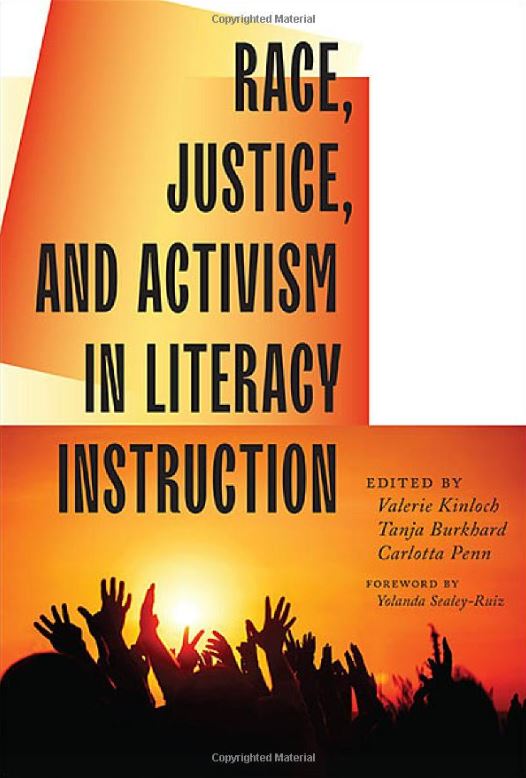
Race, Justice, and Activism in Literacy Instruction edited by Valerie Kinloch - REVIEW


This volume brings together respected scholars to examine the intersections of race, justice, and activism in direct relation to the teaching and learning of critical literacy. The authors focus on literacy praxis that reflect how stu­dents-with the loving, critical support of teachers and teacher educators­ engage in resistance work and collaborate for social change. Each chapter theorizes how students and adults initiate and/or participate in important justice work, how their engagements are situated within a critical literacy lens, and what their engagements look like in schools and communities. The authors also explore the importance of this work in the context of current sociopolitical developments, including police shootings, deportations, and persistent educational inequities. 

Contributors include Maneka D. Brooks, Tamara Butler, Gerald Campano, Limarys Caraballo, Jamila Lyiscott, Danny C. Martinez, Leigh Patel, Grace Player, Detra Price-Dennis, Elaine Richardson, Donja Thomas, Vaughn W. M. Watson. 

Valerie Kinloch is the Renee and Richard Goldman Dean of the University of Pittsburgh School of Education. Her books include Crossing Boundaries­ Teaching and Learning with Urban Youth; Urban Literacies: Critical Perspectives on Language, Learning, and Community; and Harlem on Our Minds: Place, Race, and the Literacies of Urban Youth. 

Tanja Burkhard is a postdoctoral researcher at the University of Pittsburgh School of Education. Carlotta Penn is director of community partnerships at The Ohio State University College of Education and Human Ecology. 

"This volume poweifully and convincingly centers arguments on the significance of antiracist teacher preparation, culturally responsive pedagogy, the power of engag­ing youth in their own learning, and the necessity of community activism." 
-From the Foreword by Yolanda Sealey-Ruiz, Teachers College, Columbia University 

"Race, Justice, and Activism in Literacy Instruction provides needed sustenance for literacy educators committed to joining communities toward racial justice." 
-Django Paris, James A. & Cherry A. Banks Professor of Multicultural Education, University of Washington 

Race, Justice, and Activism in Literacy Instruction
edited by Valerie Kinlock, Tanja Burkhard, and Carlotta Penn
Teachers College Press
ISBN: 978-0-8077-6321-6

Southern Literature, Cold War Culture, and the Making of Modern America by Jordan Dominy - REVIEW


During the Cold War, national discourse strove for unity through patriotism and political moderation to face a common enemy. Some authors and intellectuals supported that narrative by casting America's complicated history with race and poverty as moral rather than merely political problems. Southern Literature, Cold War Culture, and the Making of Modern America examines southern literature and the culture within the United States from the period just before the Cold War through the civil rights movement to show how this litera­ture won a significant place in Cold War culture and shaped the nation through the time of Hillbilly Elegy. 

Tackling cultural issues in the country through subtext and metaphor, the works of authors like William Faulkner, Lillian Smith, Robert Penn Warren, Eudora Welty, Ralph Ellison, Alice Walker, and Walker Percy redefined "South" as much more than a geographi­cal identity within an empire. The "South" has become a racially coded sociopolitical and cultural identity associated with white populist conservatism that breaks geographical boundaries and, as it has in the past, continues to have a disproportionate influence on the nation's future and values. 

"Southern Literature, Cold War Culture, and the Making of Modern America is an important book that adds a layer of texture and nuance to our understanding of twentieth-century southern literature. By placing key southern writers in dialogue with each other and in context with major national and international sociopolitical currents, Jordan Dominy dem­onstrates that southern writing resonates far beyond the region. In fact, the South functioned as a vital center, to use a key phrase from the book, that defined American political culture and continues to have a disproportionate influence today."
 -David A. Davis, author of World War I and Southern Modernism

Jordan J. Dominy is assistant professor of English at Savannah State University. He teaches and studies American and US southern literature and popular culture. 

Southern Literature, Cold War Culture, and the Making of Modern America
by Jordan J. Dominy
University Press of Mississippi 
www.upnss.state.ms.us
ISBN: 978-1-4968-2641-1 

Better Days Will Come Again: The Life of Arthur Briggs, Jazz Genius of Harlem, Paris, and a Nazi Prison Camp by Travis Atria - REVIEW


Born on the tiny island of Grenada, he set sail for Harlem during the Renaissance, then to Europe in the after­math of World War I, where he was among the first pioneers to introduce jazz music to the world. During the legendary Jazz Age in Paris, Briggs's trumpet provided the soundtrack while Hemingway, Fitzgerald, and the rest of the Lost Generation got drunk. By the 1930s, Briggs was considered "the Louis Armstrong of Paris," and was the peer of the greatest names of his time, from Josephine Baker to Django Reinhardt. Even during the Great Depression, he was secure as "the greatest trumpeter in Europe." He did not, however, heed warnings to leave Paris before it fell to the Nazis, and in 1940, he was arrested and sent to the prison camp at Saint Denis. What happened at that camp, and the role Briggs played in it, is truly unforgettable. 

Better Days Will Come Again, based on groundbreaking research and including unprecedented access to Briggs's oral memoir, is a crucial document of jazz history, a fast-paced epic, and an entirely original tale of survival. 

Travis Atria is the author, with Todd Mayfield, Of Traveling Soul: The Life of Curtis Mayfield. His work has appeared in Rolling Stone, Vanity Fair, Billboard, Wax Poetics, and other publications. He lives in Gainesville, Florida.

Better Days Will Come Again: The Life of Arthur Briggs, Jazz Genius of Harlem, Paris, and a Nazi Prison Camp
by Travis Atria
Chicago Review Press
ISBN: 978-0-914090-10-6

The Black Cabinet by Jill Watts - REVIEW


Offering a compelling history of the evolution, impact, and ultimate demise of a New-Deal-era hidden "cabinet" to Franklin Delano Roosevelt on racial affairs, historian Jill Watts' THE BLACK CABINET: The Untold Story of African Americans and Politics During the Age of Roosevelt (Grove Press; May 12,2020; ISBN: 978-0-8021-2910-9) illuminates the progress of black citizenship between Reconstruction and the modem Civil Rights movement. 

In 1932 in the midst of the Great Depression, Franklin Delano Roosevelt won the presidency with the help of key African American defectors from the Republican Party. At the time, most African Americans lived in poverty, denied citizenship rights and terrorized by white violence. As the New Deal began, a black Brain Trust joined the administration and began documenting and addressing the economic hardship and systemic inequalities African Americans faced. They became known as the Black Cabinet, but the environment they faced was reluctant, often hostile, to change. 

"Will the New Deal be a square deal for the Negro?" The black press wondered The Black Cabinet set out to devise solutions to the widespread exclusion of black people from its programs, whether by inventing tools to measure discrimination or by calling attention to the administration's failures. Led by Mary McLeod Bethune, an educator and friend of Eleanor Roosevelt, they were instrumental to Roosevelt's continued success with black voters. Operating mostly behind the scenes, they helped push Roosevelt to sign an executive order that outlawed discrimination in the defense industry. They saw victories—jobs and collective agriculture programs that lifted many from poverty—and defeats—the bulldozing of black neighborhoods to build public housing reserved only for whites; Roosevelt's refusal to get behind federal anti-lynching legislation. The Black Cabinet never won official recognition from the president, and with his death, it disappeared from view. But it had changed history. Eventually, one of its members would go on to be the first African American cabinet secretary; another, the first African American federal judge and mentor to Thurgood Marshall. 

Masterfully researched and dramatically told, THE BLACK CABINET brings to life a forgotten generation of leaders who fought post-Reconstruction racial apartheid and whose work served as a bridge that Civil Rights activists traveled to achieve the victories of the 1950s and '60s. 

Jill Watts is the author of Hattie McDaniel: Black Ambition, White Hollywood, Mae West: An Icon in Black and White, and God, Harlem USA: The Father Divine Story. She teaches in the History department at California State University San Marcos. 

"A well-researched, urgent, and necessary history of black folks during the New Deal that excavates the too often ignored history of black female genius behind racial progress."
 - Michael Eric Dyson, York Times bestselling author 

THE BLACK CABINET: The Untold Story of African Americans and Politics During the Age of Roosevelt
by Jill Watts
Grove Press
ISBN: 978-0-8021-2910-9

The Splendid and the Vile by Erik Larson - REVIEW


New York Times bestselling author Erik Larson is known for expertly transporting readers to past worlds; even stories we think we know come to life in a different way in his hands. With his remarkable new work of nonfiction, The Splendid and the Vile, Larson once again turns history into a thriller, taking us into the heart of war-torn England for the period of May 10, 1940, through May 10, 1941 — Winston Churchill's first year as prime minister. 

The inspiration for The Splendid and the Vile came when Larson moved to Manhattan a few years ago. "It was only then that I came to understand, with sudden clarity, how different the experience of September 11, 2001, was for New Yorkers, since it was their city that was under attack," says Larson. Almost immediately, he wondered how Londoners could have endured Germany's aerial assault of 1940-41: fifty-seven consecutive nights of bombing, followed by an intensifying series of night time raids over the next six months. "In particular, I thought about Winston Churchill, who had to lead his country through such horror while aware that it was likely only a preamble to worse," Larson says. "I decided to look into how he, his family and advisors withstood it," Larson says.

The Splendid and the Vile is not meant to be a definitive account of Churchill, as that has been done. What it is instead is an intimate account of how Churchill and his inner circle went about surviving on a daily basis during the year when Churchill became Churchill, the cigar-smoking bulldog we all think we know. Drawing on diaries, original archival documents, and once-secret intelligence reports—some released only recently—Larson provides a new lens on London's darkest year through the day-to-day experiences of Churchill; his wife, Clementine; their youngest daughter, Mary, who chafes against her parents' wartime protectiveness; their son, Randolph, and his beautiful, unhappy wife, Pamela; her illicit lover, a dashing American emissary; and the cadre of close advisors who comprised Churchill's "Secret Circle," including his love-struck private secretary, John Colville; newspaper baron Lord Beaverbrook; and the Rasputin-like Frederick Lindemann. 
Like his monumental In the Garden of Beasts and Dead Wake, the result is a captivating book that is rich in atmosphere and personal stories. Thrillingly told and full of vivid character portraits, The Splendid and the Vile takes readers out of today's political dysfunction and back to a time when words mattered, courage prevailed, and everything was at stake. 

About the Author 
ERIK LARSON is the author of five national bestsellers; Dead Wake, In the Garden of Beasts, Thunderstruck, The Devil in the White City, and Isaac's Storm, which have collectively sold more than nine million copies. His books have been published in nearly twenty countries. 

THE SPLENDID AND THE VILE: 
A Saga of Churchill, Family, and Defiance During the Blitz by Erik Larson Crown
ISBN: 978-0-385-34871-3
eriklarsonbooks.com 

A conversation with Erik Larson, author of THE SPLENDID AND THE VILE 

Q: You often write about fascinating events in history that most of us have never before heard of, but much is already known about Winston Churchill. What made you decide to write about his first year—May 10,1940-May 10,1941—as prime minister? 
A: It wasn't so much the first year that drew me, but rather that the year coincided with Germany's bombing campaign against London. The city experienced in effect a succession of 9/11's—fifty-seven consecutive nights of bombing, followed by an intensifying series of nighttime raids over the next six months. I wanted to know how anyone could have endured that kind of ordeal, and decided the best way to tell it was through the daily experience of Churchill, his family, and his inner circle. By looking at the period through this window, I found all kinds of things that scholars writing more traditional histories and biographies tend to ignore. 

Q: What was the inspiration for the book's title? 
A: It was inspired by a diary entry made by one of my key characters, John Colville, a member of Churchill's cadre of private secretaries. Against all national-security regulations, Colville kept a detailed—and accurate—daily record of his time with Churchill, in which he proved himself to be both an astute observer of events and a writer of grace and wit. In one passage he described an intense air raid, which he watched from a bedroom window. It conjured in him a sense of awe. "Never." he wrote, "was there such a contrast of natural splendor and human vileness." 

Q: Reading the book, it's difficult not to compare the political climate of that time with our current political moment. What do you see as the primary differences? 
A: Well, the primary difference is that Churchill was a brilliant man who understood the necessity of bringing his country together in the face of an existential threat. He used his incredible oratorical skills not to divide, but rather to teach the British public the art of being fearless. Needless to say, we see something rather different at play now in Britain and in America. 

Q: Did spending so much time with Churchill—reading his words, examining his actions— make you think differently about leadership? What were Churchill's strengths and flaws as a leader? 
A: What struck me about Churchill was his gift for making Britons feel stronger and better about themselves. His best speeches combined sober assessment with an unshakeable confidence that Britain would not merely endure, but prevail. He had a rich knowledge of history, and this gave him perspective. He never underestimated the danger Britain faced, but likewise never lost sight of its strength. He also led by example—climbing to the rooftops to watch air-raids unfold; visiting bombed districts, despite the likelihood of fresh attacks; and ordering acts of defiance that persuaded allies, especially the United States, that Britain intended to fight to the end. He was not, however, a particularly good military strategist or tactician. And he was, apparently, a pain to work for: Impulsive, demanding, and inconsiderate—but his staff and ministers loved him all the same. 

Q: You bring key members of Churchill's inner circle to life, among them his seventeen-year ­old daughter, Mary Churchill, and his private secretary, John Colville. What resources did you call on to do that, and why did you see them as important to the story? 
A: To me, context is everything. Among the most powerful tools for capturing it are diaries, like those left by Mary Churchill and Colville and many others, which help place Churchill in a living landscape. I love, for example, that both Mary and her mother, Clementine, felt great anxiety about Churchill repeatedly flying to France in the spring of 1940 to meet with French leaders. Such anxiety about flying is something you don't find expressed very often in historical sources and yet it's something a lot of us routinely experience, me included. You would not have caught me flying to France in a twin-engine Flamingo aircraft, with the skies full of German fighters and cities along the French coast visibly burning, but Churchill did it—and, what's more, loved it. 

Q: This is your eighth book. Has your research and writing process changed over the years? 
A: As always I relied heavily on archival materials. That's the fun of it. I traveled to various far-flung locales, including archives in London, Cambridge and Oxford, where I spent many happy hours looking through old letters and records. This may sound odd, but I never really know what I'm looking for—until I find it. For example, I spent a good deal of time looking into the records on Churchill's prime ministerial country home. Chequers, which became for him a kind of secret weapon, and for me, almost a living character. I was delighted to find that a particular section of the estate, the "Long Walk Wood," was chronically overrun with rabbits — not exactly a world-shaking fact, but, nonetheless it's in the book. More often, however, my archival spelunking turned up tragic details and episodes, like the three-month investigation by Scotland Yard into the disappearance of an employee of a London architectural firm who, as it turned out, had been "blown to bits" by a German bomb. This, alas, did not make it into the book, but it was important to know it all the same. 

Q: What did you learn about Churchill that most surprised you? 
A: What most surprised me was Churchill's sense of fun. He would dance, solo, to martial tunes played on the gramophone at Chequers, and at least once engaged in a series of bayonet drills as he marched, while his dinner guests looked on. He loved listening to his favorite songs, among them "Run Rabbit Run" and tunes by Gilbert and Sullivan, and he adored movies, which he watched nightly in the home cinema at Ditchley, another country estate, where he stayed on weekends when the moon was full and air-raids thus more likely to occur. No matter how grave the events of the war, he was always able to compartmentalize his gloom and make room for laughter.

Q: The Splendid and the Vile is full of fascinating characters. Do you have a favorite among them? 
A: My favorite, hands down, is Mary Churchill, who when the action in the book begins is 17 years old. I was delighted to receive permission from her daughter, Emma Soames, to read and excerpt her diary, which is held by the Churchill Archives Center in Cambridge, England. Mary was a smart, charming raconteur, and her observations about her friends, her joyous life, and her frustration at not being able to take a more direct part in defending England, provide a rich and humane thread throughout the narrative—right down to episodes of "snogging" in haylofts and moments when young RAF pilots would buzz her and her friends at treetop altitude, thrilling them no end. 

Q: You sometimes included the German perspective in the book, most often Goring's, who was commander of the German air force (Luftwaffe), Why? 
A: I felt it was very important to convey how Germany's bombing campaign got started, and how it evolved in response to Churchill's open defiance. Also, Goring and Goebbels, like most Nazis, are spine-chilling characters. It was horrifying and illuminating to read Goebbels' diary entry that expressed his delight in his family and Christmas, while also reveling in the latest Nazi offenses against Jews. The Gennan narrative also helps ramp up the overall sense of foreboding and suspense as Goring plans each new aerial atrocity. I include the German fighter ace Adolf Galland mainly as a vehicle to describe the creation and evolution of the Luftwaffe and to present a nuanced, human element to the German side of the action. Galland loved the test of combat, but proved in the end to be a decent guy who won the respect of his opponents in the RAF. He also played an interesting role in one of the final events in the book, which I won't reveal here. 

Q: With so much written about Churchill, how did you manage to avoid drowning in so vast a sea of books and articles? And did you find it at all discouraging? 
A: My interest was very focused: How did Churchill and his circle endure Hitler's bombing campaign—how really? That was my lens, and it let me search in a more targeted way for anything that would help me tell the story. And, as I've found before, when you look at history through a new lens, you see things in a new way. Above all I wanted to present as rich a sense as possible of that awful time, so that readers could sink into the story and live it alongside the various characters. I did of course have to do a lot of advance reading to make sure I knew the fundamental history, but I resolved early on that I would not try to read everything. That's a fool's errand. As soon as I could, I began my archival research in hopes that my own personal Churchill would rise from the dust. I also made it a point to avoid watching all TV and movie portrayals of him, no matter how good they were said to be. I did not want someone else's vision clouding my own. 

Q: Suppose you had a time machine: In the course of your research, did you come across any particular moment that you would love to visit in real time? 
A: Many! I'd love to have been present for Hitler's July 19, 1940, "peace offering" speech in Berlin, just to see what it was like to be in that audience, and to sense the mad enthusiasm of those around me. I'd like to experience one of the major air-raids on London—provided my safe escape was part of the arrangement. But above all I'd love to be able to Join Churchill and company for one of those amazing dinners at Chequers or Ditchley, and savor the dazzling conversation, and maybe get a glimpse of Churchill in his gold-dragon dressing gown or his pale blue siren suit, as he danced to the strains of a Gilbert & Sullivan opera or to the score of the Wizard of Oz, another favorite. 

Sunday, February 02, 2020

BROKE: Hardship and Resilience in a City of Broken Promises - REVIEW


In BROKE: Hardship and Resilience in a City of Broken Promises, which follows seven Detroiters as they navigate life during and after the city's 2013 bankruptcy, Jodie Adams Kirshner asks: 

    How could policymakers hype bankruptcy as the solution to struggling cities without understanding the efficacy or basic consequences of its use? We had overlooked urban residents and considered the issues all wrong. 


     The individual lives portrayed in BROKE underscore Kirshner's assertions. Reggie loses his savings trying to make a habitable home for his family. Cindy fights drug use, prostitution, and dumping on her block. Lola commutes two hours a day to her suburban job. For them, financial issues are mired within the larger ramifications of poor urban policies, state and federal negligence, and-even before the 2013 decision to declare Detroit bankrupt-the root causes of a city's fiscal demise. 


     Like Matthew Desmond's Evicted, BROKE looks at what municipal distress means in practical and personal terms. More than 35 percent of Detroit's 700,000 residents fall below the poverty line. Post-bankruptcy, they struggle with a broken real estate market, school system, and job market-and their lives have not improved. In his foreword, Michael Eric Dyson sums it up beautifully: 


   The central, trenchant, undeniable argument of BROKE is clear: bankruptcy is neither a fiscally responsible nor morally irresistible response to the myriad challenges faced by the modem American city ... after reading the poignant, heartbreaking, defiant pages of BROKE, no one should question the need for a moral referendum on how policy is created in and for urban America. 


     BROKE's implications extend beyond the city it takes for its subject because Detroit is nationally emblematic. Kirshner makes a powerful argument that cities-the economic engine of our nation­ aren't being given the state or federal government aid they need for their residents to survive, much less flourish. Success for all America's citizens depends on equity of opportunity. 


About the Author: Jodie Adams Kirshner is a research professor at New York University. Previously a law professor at Cambridge University, where she also served as the deputy director of the Cambridge LLM program, the deputy director of the Cambridge Centre for Corporate and Commercial Law, and as a fellow of Peterhouse College, Cambridge, Kirshner also teaches bankruptcy law at Columbia Law School. She is an elected member of the American Law Institute, past term member of the Council on Foreign Relations, and a technical advisor to the Bank for International Settlements. She received a prestigious multi-year grant from the Kresge Foundation to research BROKE. Kirshner received her undergraduate degree from Harvard University and graduate degrees in law and in journalism from Columbia University. She lives in New York City.

BROKE: Hardship and Resilience in a City of Broken Promises

 by Jodie Adams Kirshner

St. Martin's Press. ISBN: 978-1-25-023712-5

"BROKE provides a humane but clear-eyed account of the collapse and rebirth of Detroit that re,reals what a court can and cannot accomplish via a well-managed municipal bankruptcy."
  
-Paul Romer, co-recipient, 2018 Nobel Memorial Prize in Economic Sciences and founding director, Marron Institute of Urban Governance, NYU

Sunday, January 19, 2020

The Art of Resistance - My Four Years in the French Underground: A Memoir - REVIEW


The Art of Resistance - My Four Years in the French Underground: A Memoir 
by Justus Rosenberg 

     An unforgettable memoir written by a 98-year-old Jewish Holocaust survivor about his escape from Nazi-controlled Danzig in the 1930's and his adventures with the French Resistance during World War II In 1937, as the Nazi Party tightened its grip on the Free City of Danzig (now Gdansk, Poland), Justus Rosenberg's parents made the heart-wrenching decision to send their son to Paris, where he would have the hope of finishing high school and going on to university in safety. He was sixteen years old, and he would not see his family again for sixteen years more. When the Nazis pushed toward Paris in the spring of 1940, Justus was penniless, in danger, cut off from contact with his family in Poland, and forced to flee south. 

     A chance meeting led him to Varian Fry, an American journalist in Marseille who ran a clandestine network that helped thousands of artists and intellectuals escape the Nazis, among them Hannah Arendt, Marc Chagall, Andre Breton, and Max Ernst. 
With Justus' German background and fluency in several languages, including English, he became an invaluable member of Fry's network as a spy and scout. For the subsequent four years, Justus relied on his wits and skills to escape captivity, survive several close calls with death, and continue his fight against the Nazis, working with the French Resistance and later becoming attached with the United States Army. At the war's end, he emigrated to America and built a new life. 

     Featuring never-before-seen photographs from Justus' personal archives, THE ART OF RESISTANCE: My Four Years in the French Underground is a powerful saga of bravery, daring, adventure, and survival with the pacing of a spy thriller. As Justus writes, "I survived the war through a rare combination of good fortune, resourcefulness, optimism, and most importantly, the kindness of many good people." 


     Justus Rosenberg was born in the Free City of Danzig in 1921. When the Nazis rose to power there, he moved to France, where he joined an extralegal French-American network that helped to bring anti­-fascist intellectuals and artists from Vichy, France to the United States. He subsequently served with the United States Army, who awarded him a Bronze Star and a Purple Heart. For the last 70 years, he has taught at American universities, and is currently a professor emeritus of languages and literature at Bard College. He is the co-founder of the Justus & Karin Rosenberg Foundation, which works to combat antisemitism. In 2017 the French ambassador personally made Justus a Commandeur in the Legion d'Honneur, France's highest decoration. Professor Rosenberg lives in Rhinebeck, New York. 

THE ART OF RESISTANCE - My Four Years in the French Underground: A Memoir 
By Justus Rosenberg
304 pages Hardcover ISBN: 978-0062742193


Saturday, January 18, 2020

Owen Lovejoy and the Coalition for Equality - REVIEW


Owen Lovejoy and the Coalition for Equality - Clergy, African Americans, and Women United for Abolition examines how these three distinct groups merged their agendas into a single antislavery, religious, political campaign for equality with Lovejoy at the helm. Combining scholarly biography, historiography, and primary source material, Jane Ann and William F. Moore demonstrate Lovejoy's crucial role in nineteenth-century politics, the rise of antislavery sentiment in religious spaces, and the emerging commitment to end slavery in Congress. Their compelling account explores how the immorality of slavery became a touchstone of political and religious action in the United States through the efforts of a synergetic coalition led by an essential abolitionist figure. 

Antislavery white clergy and their congregations. Radicalized abolitionist women. African Americans committed to ending slavery through constitutional political action. These diverse groups attributed their common vision of a nation free from slavery to strong political and religious values. Owen Lovejoy's gregarious personality, formidable oratorical talent, probing political analysis, and profound religious convictions made him the powerful leader the coalition needed. 

"Owen Lovejoy was that rarest of beings-a dedicated abolitionist and a savvy politician. Having already published an indispensable collection of Lovejoy's most important writings, the Moores have now given us the most thorough biography of Lovejoy to date. Grounded in deep research and an unparalleled familiarity with the ins and outs of Illinois politics, the Moores demonstrate Lovejoy's crucial role in the creation of the 'coalition for equality' that eventually brought slavery down." 
-James Oakes, author of "The Scorpion's Sting: Antislavery and the Coming of the Civil War" 

Authors Jane Ann Moore and William F. Moore are co-directors of the Lovejoy Society. They are the authors of "Collaborators for Emancipation: Abraham Lincoln and Owen Lovejoy" and are the editors of "Owen Lovejoy's His Brother's Blood: Speeches and Writings, 1838-64". They manage the website www.increaserespect.com which applies the concepts of this book. 

Owen Lovejoy and the Coalition for Equality - Clergy, African Americans, and Women United for Abolition 
Jane Ann Moore and William F. Moore 
Hardcover, ISBN: 978-0-252-04230-0
Paper, ISBN: 978-0-252-08409-6
www.press.uillinois.edu 

The Broken Road by Peggy Wallace Kennedy - REVIEW


THE BROKEN ROAD: George Wallace and a Daughter's Journey to Reconciliation 
by Peggy Wallace Kennedy with Justice H. Mark Kennedy

Peggy Wallace Kennedy has been widely hailed as a "symbol of racial reconciliation" (Washington Post), winning numerous awards for her efforts and speaking out on the politics of fear and on finding one's voice. In the summer of 1963, though, she was a young girl watching her father stand in a schoolhouse door as he tried to block two African American students from entering the University of Alabama. This man, governor of Alabama and future presidential candidate George Wallace, was notorious for his hateful rhetoric and his political stunts. But he was also a larger­ than-life presence in the life of young Peggy, who was taught to sit straight, smile, and not speak up as her father took to the political stage. At the end of his life, Wallace came to renounce his racist views, although he could never attempt to fully repair the damage he caused. But Peggy, after her own political awakening, has dedicated her life to spreading a new Wallace message-one of peace and compassion. 

"Why did Paw Paw do those things to other people?" asked Wallace Kennedy's nine-year-old son, Burns, while visiting the Martin Luther King Jr. National Historic Site and Museum. He'd just seen the photo of his grandfather blocking the entrance of University of Alabama. It was this moment that compelled Wallace Kennedy to come to terms with her family's history. "It awakened in me the deep desire to create my own chapter in the Wallace saga," she writes in THE BROKEN ROAD : George Wallace and a Daughter's Journey to Reconciliation. 


Collaborating with her husband of 46 years, Justice H. Mark Kennedy, Wallace Kennedy provides an intimate and tender portrait of her family and their circumstances, dreams, and challenges, all within the larger context of a time and place when issues of race and gender were dealt with in ways that many would view as abhorrent today. 
In this powerful new memoir, Wallace Kennedy looks back on the politics of her youth and attempts to reconcile her adored father with the man who coined the phrase, "Segregation now, segregation tomorrow, and segregation forever." As she writes, "My story is much like that of the broken road, heaved up and cracked for the truth of what power can do. It mingles amid history for the sake of the truth, gives rise to the inspiration that no matter who we belonged to, 'each of us can overcome,' and offers hope that America will take the 'road less traveled by' before it is too late." 
Timely and timeless, THE BROKEN ROAD speaks to change, atonement, activism, and racial reconciliation, reckoning with the past while firmly focusing on creating a better future. 

About the author: Peggy Wallace Kennedy is a nationally recognized speaker, lecturer, and writer. Her father, George Wallace, and her mother, Lurleen Wallace, were both governors of Alabama. Mrs. Kennedy has received, among others, the Southern Christian Leadership Conference Rosa Parks Legacy Award; the Emmett Till Legacy Foundation Woman of Courage Award; the Brown Foundation Human Rights Award; and the MLK Commission Award. Her dedication to racial reconciliation offers hope for change in a divided America. She lives in Montgomery, Alabama. Justice H. Mark Kennedy, Peggy's husband of forty-six years, served as a judge for more than two decades including two terms as a Justice of the Supreme Court of Alabama.

"Anybody who knows Peggy Wallace Kennedy, or who reads these pages, will understand immediately the anguished authenticity of her passage. Civil rights leaders such as John Lewis ultimately forgave George Wallace for the sins of his past, just as they have embraced his daughter as a sister in the quest for human rights. The Broken Road is the story of how that happened-a needed reminder in these times that love and simple decency can be more powerful than their opposites." -Frye Gaillard, author of A Hard Rain, America in the 1960s 

"[A] thoughtful, evenhanded debut ... Kennedy's astute memoir also serves as a probing record of politics and racism in the South." -Publishers Weekly 


"(Wallace Kennedy] shows poignantly the toll (George Wallace's] actions took on his family and draws parallels between his tactics and those of Donald Trump .... A fair-minded memoir and portrayal of an exceptionally divisive civil rights-era politician." -Kirkus Reviews 


"Searingly revelatory" -Diane Mcwhorter, Pulitizer Prize-winning author of Carry Me Home 


Hardcover ISBN:978-1635573657
Ebook ISBN:978-1635573664

Thursday, December 19, 2019

The Impeachers by Brenda Wineapple


     In 1868, "out of the midst of political gloom, impeachment, that dead corpse, rose up and walked forth again!" Mark Twain wrote. Republicans in the House impeached President Andrew Johnson by a vote of 126-47. They were desperate, as Brenda Wineapple chronicles in her gripping new book, "
The Im­peachers: The Trial of Andrew Johnson and the Dream of a Just Nation." Johnson, a Tennessee Democrat who didn't free his slaves until 1863, after the Emancipation Proclamation, had been Abraham Lincoln's improbable Vice­ President, and had assumed the office of the Presidency after his assassination, in 1865. Lincoln and congressional Republicans had one plan for Reconstruction: it involved welcoming the freedmen into the political community of the nation. Johnson, who believed that, "in the progress of nations, negroes have shown less capacity for gover­ment than any other race of people," betrayed that vision. "Slavery is not abolished until the black man has the ballot," Frederick Douglass declared. But granting the franchise to black men was the last thing Johnson intended to allow. While Congress was out of session, he set in motion a Reconstruction plan that was completely at variance with what Congress had proposed: he intended to return power to the very people who had waged war against the Union, and he readmitted the former Confederate states to the Union. "No power but Congress had any right to say whether ever or when they should be admitted to the Union as States and entitled to the privileges of the Constitution," the Pennsylvania representative Thaddeus Stevens said during Johnson's impeachment proceedings. (Stevens, ailing, had to be carried into the Capitol on a chair.) "And yet Andrew Johnson, with un­blushing hardihood, undertook to rule them by his own power alone." John­son vetoed the 1866 Civil Rights Bill and nearly every other congressional attempt to reassert authority over the law of the United States. But the Republicans' strategy, to pass a law they expected Johnson to break, so that they could impeach him, backfired. 
     The Senate acquitted Johnson, falling short by a single vote of the two­-thirds majority necessary to convict. Stevens died a couple of months later, "the bravest old ironclad in the Capitol," Twain wrote. The Republicans had tried to save the Republic by burying the Confederacy for good. They failed. 
     Every impeachment reinvents what impeachment is for, and what it means, a theory of government itself Every impeachment also offers a chance to establish a new political settlement in an unruly nation. The impeachment of [Justice] Samuel Chase steered the United States toward judicial independence, and an accommodation with a party system that had not been anticipated by the Framers. Chase's acquittal stabilized the Republic and restored the balance of power between the executive and the judicial branches. The failed impeachment of Andrew Johnson steered the United States toward a regime of racial segregation: the era of Jim Crow, which would not be undone until the Civil Rights Act of 1964 and the Voting Rights Acts of 1965 were passed, a century later, in the Administration of another Johnson. Johnson's acquittal undid the Union's victory in the Civil War, allowed the Confederacy to win the peace, and nearly destroyed the Republic. 
Johnson's acquittal also elevated the Presidency by making impeachment seem doomed. Jefferson once lamented that impeachment had become a "mere scarecrow." That's how it worked for much of the twentieth century: propped up in a field, straw poking out from under its hat. A Republican congressman from Michigan called for the impeachment of F.D.R., after the President tried to pack the Court. Nothing but another scarecrow. 
The impeachment of Richard Nixon, in 1974, which, although it never went to trial, succeeded in the sense that it drove Nixon from office, represented a use entirely consistent with the instrument's medieval origins: it attempted to puncture the swollen power of the Presidency and to reassert the supremacy of the legislature. Nixon's Presidency began to unravel only after the publication of the Pentagon Papers, in 1971 - which indicted not Nixon but Lyndon Johnson, for deceiving the public about Vietnam­ and the public anger that made impeachment possible had to do not only with Nixon's lies and abuses of power but also with Johnson's. But a new settlement, curtailing the powers of the President, never came. Instead, the nation became divided, and those divisions widened. 
     The wider those divisions, the duller the blade of impeachment. Only very rarely in American history has one party held more than two-thirds of the seats in the Senate (it hasn't happened since 1967), and the more partisan American politics the less likely it is that sixty-seven senators can be rounded up to convict anyone, of anything. And yet the wider those divisions the more willing Con­gress has been to call for impeachment. Since Ronald Reagan's Inauguration in 1981, members of the House have in­troduced resolutions for impeachment during every Presidency. And the peo­ple, too, have clamored. "Impeach Bush," the yard signs read. "Impeach Obama." 
     Not every impeachment brings about a political settlement, good or bad. The failed impeachment of Bill Clinton, in 1999, for lying about his sexual relation­ship with Monica Lewinsky, settled less than nothing, except that it weakened Americans' faith in impeachment as anything other than a crudely wrought partisan hatchet, a prisoner's shiv. 
     Clinton's impeachment had one more consequence: it got Donald Trump, self­-professed playboy, onto national television, as an authority on the sex lives of ego-mad men. "Paula Jones is a loser," Trump said on CNBC. "It's a terrible embarrassment." Also, "I think his lawyers ... did a terrible job,"Trump said. "I'm not even sure that he shouldn't have just gone in and taken the Fifth Amendment." Because why, after all, should any man have to answer for anything? 
     "Heaven forbid we should see another impeachment!" an exhausted Republican said at the end of the trial of Samuel Chase. The impeachment of an American President is certain to lead to no end of political mischief and almost certain to fail. Still, worse could happen. Heaven forbid this Republic should become one man's kingdom.
     - New Yorker magazine, October 28, 2019, p31. 

Friday, December 13, 2019

White Negroes: When Cornrows Were in Vogue ... and Other Thoughts on Cultural Appropriation - REVIEW


White Negroes: When Cornrows Were in Vogue ... and Other Thoughts on Cultural Appropriation by Lauren Michele Jackson

"Appropriation is everywhere and is also inevitable. If appropriation is everywhere and everyone appropriates all the time, why does any of this matter? The answer, in a word: power."

In her debut essay collection, White Negroes: When Cornrows Were in Vogue ... and Other Thoughts on Cultural Appropriation, Lauren Michele Jackson, a professor of English and African American studies at Northwestern University, examines the problematic social trend of "black aesthetics without black people." Her essays analyze the desire for black culture by people who are not black and takes to task America's tendency to poach blackness for its profit and benefit. From art to fashion, language to activism, black culture influences worldwide trends. And, according to Jackson, everyone wants to be "cool" without fearing for their lives, to be "black" with the wealth and privilege of whiteness.
Jackson asserts that when the powerful appropriate from the oppressed, society's imbalances are worsened, and its inequalities extended. White people in America, Jackson writes, hoard power like Hungry Hungry Hippos. She cites statistics on the ever-growing wealth gap between white and black people in the United States-according to the Institute for Policy Studies, if current trends continue, the average black family won't reach the amount of wealth white families own today for another 228 years. The seriousness of this reality comes into focus when we see who can thrive off of intellectual property and who is prevented from doing so by "this nation's hysterical, driving compulsion to own and regulate all things black."
Jackson divides her book into areas of popular culture to explore the concept of "blackness in decay without its people." Topics include:
• Sound and Body: Jackson uses the evolution of Christina Aguilera's music career as the backdrop to examine the typical trajectory of a young white female popstar-emancipating themselves from an image of innocence by using black aesthetics to appear older and mature. "The entire Stripped era put black culture in motion in a departure from Christina's earlier aesthetics, even as a child performer raised on jazz and soul records." Throughout her career, Aguilera goes from one interpretation of black culture to another until, with her most recent album, she finally achieves a tenor of homage to the black music that formed her, Jackson concludes.
• Art and Language: Jackson questions the motives of Dana Schutz, whose painting Open Casket was a recreation of a 1955 photograph of Emmett Till's body in his casket. The painting was created for the Whitney Museum of Art's 2017 Biennial, which Jackson explains is remembered primarily for its blatant dismissal of violence and black pain. "Mamie Till-Mobley, thrust into activism, took control of her son's image in death, plain evidence of what America does to black children," Jackson states. "Today, the chasm between seeing a person in pain and in death and the actions it would take to reduce the pain and death is so much wider than the Atlantic."
• Technology: "Black people are the best part of going online," Jackson asserts. "Black culture is the fiber in the memes that are sometimes the only reasonable excuse for logging on while the world crumbles." She tells of Vine and the funny storytelling of its former black users. Before its demise, Vine's most popular meme came from Kayla Newman, a black woman who admires her brows in the camera and says they're "on fleek." Jackson shares that Newman's attempt to raise money to fund a line of hair and beauty products led to derision and claims that she was entitled for wanting to profit off her creation-despite the term's co-opted use in Hefty ads and fast fashion crop tops.
• Economy and Politics: Detailing cultural appropriation's inherent political nature, Jackson describes a period in the 1970s, when the white working class experienced a financial depression they called the "blue-collar blues," which was attributed to a black upward mobility that was perceived to outpace white prosperity. Then, as now, Jackson writes, they needed use of black aesthetics to describe the circumstance. In the new millennium, attempts to delegitimize #BlacklivesMatter spur absurd terms like All Lives Matter and Blue Lives Matter. Another example Jackson cites is the Women's March on Washington, a name borrowed from a black-led political march. Anger and rage, she writes, are all the rage. Thanks to white feminists' appropriative actions, the politics of activism and self-care are given a new and profitable look. "After Ferguson, Baltimore, Chicago, and Oakland, everyone can make a hashtag and be mad and make it home safely. As long as well-heeled white people are angry, others can be angry too."
Jackson concludes that although thoughtless appropriation is impossibly embedded in our culture, it can become appreciation if the world reorders society to be a place where black people have options and where they matter to society just as much as their contributions. "Whether black people will be acknowledged and allowed to thrive more than spiritually from their innovations remains to be seen," she states. "If there is a call embedded in this book, it is a call to more alertness, more intensity, more care, and more fluency in the racial dramas performed as part and parcel of business as usual."

About the Author
Lauren Michele Jackson teaches in the departments of English and African American studies at Northwestern University.

White Negroes: When Cornrows Were in Vogue ... and Other Thoughts on Cultural Appropriation
by Lauren Michele Jackson
$25.95 Hardcover • 978-080701180-5 • Audio book: 978-080708132-7
Contact: Perpetua Charles, Associate Publicist, pcharles@beacon.org / 617-948-6102

A literary scholar examines the many ways in which African American influences are incorporated, without acknowledgment or thanks, into the white cultural mainstream. Cultural appropriation, writes Jackson (English and African American Studies/Northwestern Univ.), "gets a bad rap." Rap, for instance, borrows from the styles of earlier generations-soul, disco, funk, even gospel-but includes the likes of Billy Joel and Paul Simon in its DNA. Appropriation, she writes, 11 is everywhere, and it is inevitable," though it is also a matter of power as much as artistic license: The culturally dominant group gets away with borrowing fashions, musical styles, and language, developing "black aesthetics without black people." In a lucid explication of the work of appropriation in music, she examines borrowings not just by white artists such as Britney Spears, but also members of minority populations such as Jennifer Lopez, who, by Jackson's account, lifted liberally from a less-known artist named Ashanti. It's Lopez's good luck that the borrowing, including the passing insertion of the N-word, took place in a time when "the internet wasn't then what the internet is now, and time forgives all slurs." Pop star Pink took a different course, gradually shedding any blackness in her sound, even as Miley Cyrus dropped her white­pop teen persona to embrace the hip-hop world and Khloe Kardashian did her hair up in cornrows and called herself a "Bantu babe." The author ranges across a broad field of reference, writing of the appropriation of the Southern-ism "chile" (child, that is) by means of the TV show Real Housewives of Atlanta and the culinary borrowings of Paula Deen, "white Mammy, plumping America one fried delicacy at a time," who got in trouble not for her lifting recipes but instead for using the N-word. Jackson is evenhanded throughout, though there's a welcome fire to her discussion, as when she writes, "America is addicted to hurting black people. America is addicted to watching itself hurt black people.”
A revelatory, well-argued work of cultural criticism.
- Kirkus Reviews, October 1, 2019 issue

Northwestern University professor Jackson's insightful debut essay collection takes on cultural appropriation-particularly of black innovation by white celebrities, artists, and entrepreneurs-through the lens of power dynamics, identifying it as a process by which "society's imbalances are exacerbated and inequalities prolonged." In the realm of pop culture, she analyzes the pursuit of "urban" sexual wildness by Britney Spears and Miley Cyrus, the aesthetic but not economic investment of the Kardashians in black fashion, and Paula Deen's fetishistic presentation of Southern food alongside explicit racism. Her exploration of the art world juxtaposes the public reaction to Rachel Dolezal, made famous by her "impulse to inhabit blackness," with accusations against institutions such as the Whitney Biennial, which she asserts ignores black artists but treats depictions of antiblack violence as edgy and relevant. She identifies toxic white resentment of black success in the recent viral videos of white people calling the police on black people (often children) for using public pools, having lemonade stands, or barbecuing in parks. Jackson is uncompromising in her bold language, palpable in her outrage; she keeps her razor-sharp analysis in an accessible but academic register. She both calls out the damage done by appropriative and oppressive behavior and calls in white readers to take part in valuing black contributions in a way that helps black lives.
- Publishers Weekly August 19th issue

"Like 'intersectionality' and "diversity'' and "neoliberalism" and perhaps even "capitalism," the word "appropriation" has taken on so many interpretations and interpolations as to court ontological disaster: what does it even mean? Lauren Michele Jackson wrestles with the idea, the concept, the history, the bodies, and the selves that are implicated in cultural appropriation. Jackson does not absolve anyone, but she does point toward some of the most complex corners of culture. In those corners she asks us to consider not freedom and choice but power. That emphasis on _who can commodify appropriation is different from pedestrian debates about who can do appropriation. White Negroes is a mature meditation for debates that have, at times, wallowed in their own intellectual infancy. The collection is witty, wry, and welcome. In the vein of lmani Perry and Zoe Samudzi, this book is an excellent addition to critical thinking about culture and contemporary racial orders."
- Tressie McMillan Cottom, author of Thick and Lower Ed

"What I love most about Lauren Jackson's incisive and richly detailed work in White Negroes is how it does not imagine any cultural phenomenon as something that does not have a history attached to it. And through the work of charting that history, a new cultural understanding arises. This is a vital text­one that offers new ways of seeing, hearing, and consuming."
- Hanif Abdurraqib, author of They Can't Kill Us Until They Kill Us

"We've needed this book for years~ and yet somehow it's right on time. Miraculously, Lauren Michele Jackson is able to write about cultural appropriation in a way that doesn't make you want to drink a glass of sand. She brings incredible nuance and a sharp critical voice to a discussion that has sorely lacked both-yet somehow emerges with a text that is as accessible as it is theoretically relevant. Jackson avoids platitudes and easy answers, has a keen eye for history and popular culture, and, moreover, she is funny."
- Eve L. Ewing, author of Electric Arches and Ghosts in the Schoolyard

"Blacking up-the American caucasoidal desire to inhabit, stage, and master an imaginary Black identity-has been a national obsession and a national enterprise since the antebellum days of traveling tent show minstrelsy. With language laced with critical clarity, tempered outrage, radical snark, and researched detail, Lauren Michele Jackson's White Negroes interrogates and exposes our present-day society of appropriated racial spectacle-highlighting a plethora of the ways contemporary white minstrelsy reproduces the erasures and violence of its Jim Crow-era predecessor, then circulates its bad­to-rad copies for profit and mockery through viral technology. Jackson eruditely connects the dots between such disparate phenomena of the modern racial age as Eminem, Christina Aguilera, Kim Kardashian, Rachel Dolezal, the fashion and cosmetic industries, the Whitney Biennial, and the appropriation of 'Bye Felisha.' In so doing, Jackson makes us wiser and even more disturbed about how much stolen Black imaging and ideations matter to the cultural, political, and economic maintenance of the nation's anti-Black status quo."
- Greg Tate, author of Flyboy in the Buttermilk and editor of Everything but the Burden: What White People Are Taking from Black Culture

Saturday, November 23, 2019

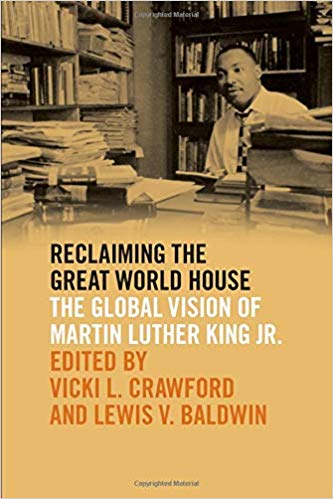
Reclaiming the Great World House - REVIEW


Reclaiming the Great World House - The Global Vision of Martin Luther King Jr.
Edited by Vicki L. Crawford and Lewis V. Baldwin
The Morehouse College King Collection Series on Civil and Human Rights

A global context for understanding the intellectual and sociopolitical legacy of MLK in the twenty-first century. The burgeoning terrain of Martin Luther King Jr. studies is leading to a new appreciation of his thought and its meaningfulness for the emergence and shaping of the twenty-first-century world This volume brings together an impressive array of scholars from various backgrounds and disciplines to explore the global significance of King - then. now, and in the future.

Employing King's metaphor of "the great world house," the major focus is on King's appraisal of the global-human struggle in the 1950s and 1960s, his relevance for today's world, and how future generations might constructively apply or appropriate his key ideas and values in addressing racism. poverty and economic injustice, militarism. sexism, homophobia, the environmental crisis, globalization, and other challenges confronting humanity today. The contributors treat King in context and beyond context, taking seriously the historical King while also exploring how his name, activities, contributions, and legacy are still associated with a globalized rights culture.

The University of Georgia Press and Morehouse College's Martin Luther King Jr Collection are pleased to announce the Morehouse College King Collection Series on Civil and Human Rights Series, a new collaborative book series. Using the 13,000 papers of the King Collection as a foundation, books in the series will offer new scholarship that provides insightful overviews and analyses of Dr. King's intellectual, theological, and activist engagement with a variety of broad themes.

These themes include (but are not limited to) poverty, nonviolence, the Vietnam War, capitalism, racial discrimination, education, and civil rights. Along with the thematically focused works, the series will include brief critical studies on King's involvement with specific campaigns, such as the Montgomery Bus Boycott of1956-57 and the Poor People's Campaign of 1968. Though scholarly in nature, the books are intended to be accessibly written, relatively brief (50,000-70,000 words), and engaging for general readers, offering overviews of King's life and legacy through a twentieth-first-century lens.

Vicki L. Crawford is the director of the Martin Luther King Jr. Collection at Morehouse College and general editor of the Morehouse College King Collection Series on Civil and Human Rights. She is a co-editor of Women in the Civil Rights Movement: Trailblazers and Torchbearers, 1941-1965 and the author of numerous scholarly articles.

Lewis V. Baldwin is a professor emeritus of religious studies at Vanderbilt University. He is the author of many books, including Make the Wounded Whole: The Cultural Legacy of Martin Luther King Jr.; Toward the Beloved Community: Martin Luther King Jr. and South Africa; and Behind the Public Veil: The Humanness of Martin Luther King Jr.
RECLAIMING THE GREAT WORLD HOUSE
The Global Vision of Martin Luther King Jr.

Edited by Vicki L. Crawford and Lewis V. Baldwin
Paperback 978-0-8203-5604-4
Hardback 978-0-8203-5602-0
University of Georgia Press
www.ugapress.org